When it comes to email, how you send matters as much as what you send.
But, should you send through an API or use SMTP?
If you’re seeing spam placement, hitting sending limits, or dealing with weird errors, this choice matters.
This guide explains how API and SMTP differ in inbox placement, speed, reliability, and day-to-day control.
You’ll see what each does well, where each struggles, and simple rules for when to pick one over the other.
We’ll also show an easy hybrid setup if you want the reach of SMTP with the control of an API.
Let’s dive in.
Key Takeaways
SMTP is simple, universal, and ideal for cold emails or small setups.
API is faster, offers better tracking, and suits high-volume or app-based sending.
Both need solid infrastructure for good deliverability and scale.
The best email infrastructure for API vs SMTP combines flexibility with reliability.
Infraforge helps you run both smoothly while keeping emails out of spam.
SMTP vs API: Quick Comparison
Factor
SMTP
API
Speed
Slower, emails move server by server.
Faster, direct connection to the provider.
Setup
Very simple, just add server details.
Needs developer integration, but more powerful.
Tracking
Limited, little insight after sending.
Strong, real-time data on opens, clicks, and errors.
Flexibility
Works everywhere with any client or tool.
Tied to the provider you integrate with.
Scalability
Struggles with bulk sending across domains.
Handles high-volume sending with ease.
Error Handling
Weak, hard to know why an email failed.
Strong, clear error codes for troubleshooting.
Best For
Cold email, small teams, fallback sending.
SaaS apps, transactional emails, bulk campaigns.
What is SMTP?
SMTP stands for Simple Mail Transfer Protocol. It’s the basic system that moves your emails from one place to another. Think of it as the “postal service” of the internet.
When you click send, SMTP takes your email, finds the right destination, and delivers it to the recipient’s server.
This image shows the SMTP working cycle- Email deliverability
It’s been around for decades and still powers most email tools today.
Whether you’re using Gmail, Outlook, or a sales outreach tool, SMTP is working quietly in the background to send your messages.
It’s reliable and universal, which is why it’s still heavily used today.
Pros of SMTP
Works with every email client and platform, so you can connect Gmail, Outlook, CRMs, or cold email tools without compatibility issues.
It is easy to set up SMTP, just enter your mail server, username, and password.
Sends from real mailboxes (like [email protected]), making your emails look personal and authentic instead of automated.
Great for cold email, since it mimics normal human sending behavior, improving deliverability and trust.
Reliable fallback option when API services face downtime or rate limits, switch quickly without changing your system.
Recognized and trusted by all major email providers, with proper SPF, DKIM, and DMARC setup, it helps avoid spam.
Perfect for small teams who want to send emails consistently and safely without managing complex infrastructure.
Cons of SMTP
Sends emails one by one, which makes it slower compared to API’s instant delivery.
Doesn’t offer real-time tracking for opens, clicks, or bounces.
Lacks automation features, so you can’t build workflows or event-based sending.
Returns only basic error messages, making troubleshooting harder than with APIs.
Difficult to scale across multiple domains or mailboxes manually.
Provides limited insights, without detailed analytics or performance reports.
Requires manual setup for each mailbox, while APIs manage everything through one connection.
When does SMTP make sense?
SMTP is not outdated; it still works well in specific cases:
Cold email campaigns: It sends directly from real inboxes (like [email protected]), making messages look natural and human, perfect for outreach where personalization and inbox trust matter more than speed.
Small teams or solo senders: If you don’t have developers or a big tech stack, SMTP lets you start sending quickly without learning APIs or writing code.
Fallback sending: When your API service hits limits, fails, or goes offline, SMTP keeps your emails flowing.
SMTP is still a big part of email infrastructure, but it falls behind when speed, scale, or deeper insights matter.
In those cases, APIs make sending and managing emails faster and more efficient.
What is an Email API?
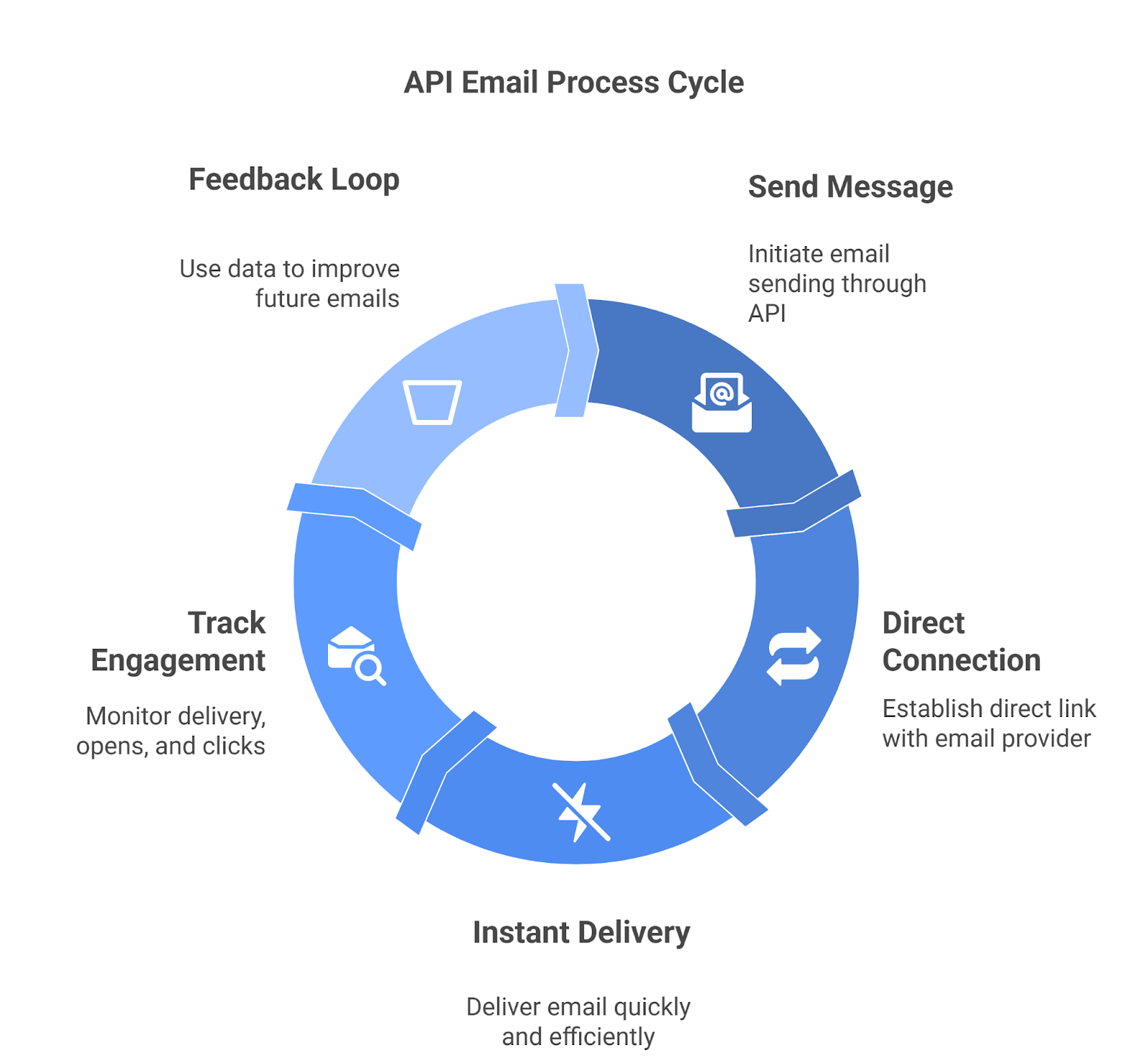
An Email API stands for Application Programming Interface. It’s a modern system that helps your app or platform send emails directly through an email provider, fast and without extra steps.
Think of it like a direct connection between your app and the email service. You send the message, and it goes out instantly, skipping the long route that SMTP usually takes.
This image shows the API Email process
For example, when you sign up for Netflix and instantly get a “Welcome to Netflix” email or a password reset link, that message is sent through an email API, not SMTP.
The API talks directly to the provider, sends the message within seconds, and tracks what happens next, whether it was delivered, opened, or clicked.
APIs are what most tools and SaaS platforms use for emails, like confirmations, updates, and alerts.
They’re designed for speed, tracking, and scale, which is why they’ve become the go-to choice for high-volume sending.
In simple terms, if SMTP is like mailing a letter, an API is like sending an instant message: fast, direct, and smart.
Pros of API
Sends emails instantly, so users get updates or confirmations the moment they take an action.
Lack of monitoring: Without alerts or tracking, you don’t know your deliverability is dropping until results suffer.
Infraforge: Best Email Infrastructure Provider with SMTP and Email API
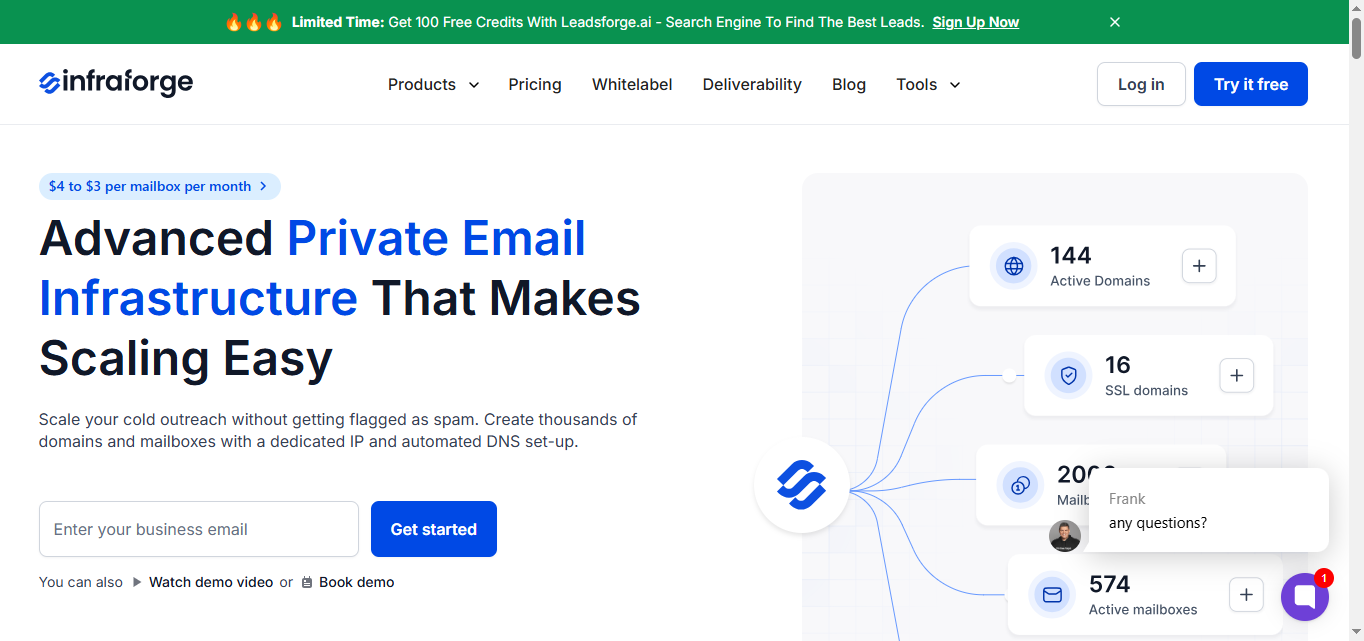
Infraforge is a dedicated email infrastructure platform built for cold outreach, offering both SMTP and API-based sending in one unified system.
This image shows the Infraforge homepage
It’s designed to help teams scale outreach safely while maintaining stable deliverability and strong domain reputation.
You can use:
SMTP for regular cold email campaigns that need natural, human-like sending.
API for automated or high-volume transactional sending — both managed under the same infrastructure.
Infraforge handles the backend setup that usually breaks deliverability between the two:
Maintains SMTP stability through managed IPs, domain authentication (SPF, DKIM, DMARC), and sender reputation control.
Secures API sending with domain-level protection and consistent delivery across requests.
Keeps domain health unified, so whether you send via SMTP or API, your reputation stays consistent.
Simplifies scaling by letting teams manage multiple domains, mailboxes, and delivery methods in one dashboard.
Infraforge is ideal for teams that want complete control over deliverability without juggling multiple setups or providers.
Conclusion
So, which is better for sending, SMTP or API?
Both matter, but for different reasons.
SMTP is universal and easy to set up. It works with any provider and handles basic transactional or cold emails well. But it slows down at scale, offers limited analytics, and can’t manage domain reputation effectively.
API sending is faster and gives detailed delivery feedback. It supports higher throughput (5–10x faster than SMTP) and better control over headers and rate limits. However, the setup takes longer, and it locks you to your provider’s system.
Infraforge supports both methods within a unified infrastructure. It provides automated DNS setup (SPF, DKIM, DMARC), domain and mailbox provisioning in minutes. Whether you send via SMTP or API, Infraforge gives you more control over infrastructure, reputation, and performance.