
If you're running cold email campaigns or planning to start one, you need to understand your ROI to know whether your efforts are paying off.
There are several factors affecting cold email campaign ROI, including infrastructure costs, lead quality, email deliverability, reply rates, and customer conversions.
Each factor plays a role in determining how much profit your campaigns generate compared with what you spend.
In this guide, I'll explain how to calculate cold email campaign ROI, which metrics to track, and how to improve your returns.
Cold email outreach ROI measures how much profit your campaigns generate compared with their total cost. It helps you understand whether your investment in cold email is paying off.
For example, suppose you spend $1,000 on a cold email campaign and generate $5,000 in gross profit from the customers you acquire. After deducting the campaign cost, you're left with $4,000 in profit. Your campaign has generated a 400% ROI, meaning you earned $4 in profit for every $1 invested after campaign costs.
To calculate ROI accurately, account for your campaign expenses, including email software, domains, mailboxes, lead data, email verification, and team time.
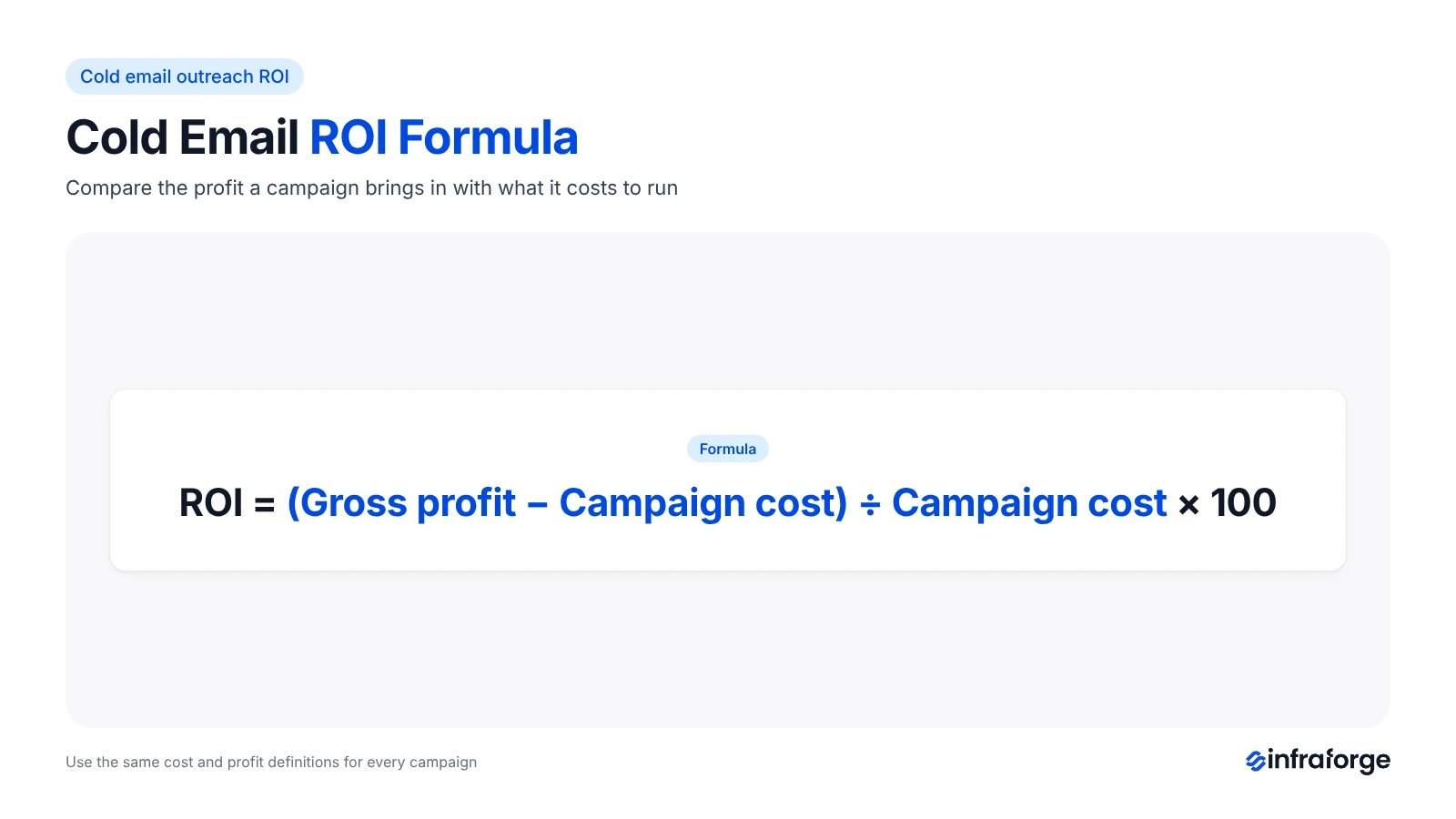
To calculate cold email outreach ROI, compare the gross profit generated by your campaign with the total cost of running it.
ROI = [(Gross Profit − Campaign Cost) ÷ Campaign Cost] × 100
Gross profit is the revenue generated by acquired customers minus the direct costs of delivering your product or service. Campaign cost includes the expenses of running your outreach, such as email infrastructure, software, lead data, verification, and team time.
Use consistent cost and profit definitions when comparing campaigns.
Suppose you run a cold email campaign to generate leads for your B2B business. The campaign reaches prospects, generates sales conversations, and brings in one new customer.
The following figures are illustrative and show how to calculate ROI. They are not industry benchmarks.
ROI = [($1,500 − $1,000) ÷ $1,000] × 100 = 50%
The campaign generated $1,500 in gross profit. After deducting the $1,000 campaign cost, $500 remained in profit. The campaign's ROI was 50%.
In other words, every $1 invested generated $1.50 in gross profit before campaign costs, leaving $0.50 after those costs.
Actual results depend on your audience, offer, conversion rates, customer value, and campaign expenses. Track your own funnel and financial data to understand whether your campaigns are profitable.
Here are the main costs to consider.
Email infrastructure includes the domains, mailboxes, and email hosting services you use to send cold emails.
Your expenses may include domain registration, mailbox subscriptions, DNS setup, and other infrastructure services.
If you use multiple domains and mailboxes to manage campaigns, include their costs in your calculation.
You can read this guide on understanding cold email infrastructure. This helps you account for the resources required to run your campaigns.
Cold email software helps you create campaigns, automate follow-ups, manage replies, and track performance.
Include your subscription fees for outreach platforms and any additional tools you use for inbox management, deliverability monitoring, or campaign reporting.
If a tool supports several campaigns, allocate its cost based on usage or another consistent method.
Building a relevant prospect list often requires paid databases, lead credits, data enrichment, and email verification services.
Include these expenses in your campaign budget. Email verification can help you identify invalid addresses before sending, reducing avoidable bounces and wasted outreach efforts.
Running cold email campaigns takes time. Your team may research prospects, build lists, write emails, set up sequences, manage replies, and book meetings.
Include the cost of the time spent on these activities if you want to measure the campaign's overall profitability.
For example, if a team member spends 20 hours managing a campaign at an estimated cost of $40 per hour, labor adds $800 to the total campaign cost.
Depending on your setup, you may also pay for CRM software, integrations, data enrichment, or other services that support your outreach process.
Include these expenses when they contribute to the campaign. If you share a tool across several campaigns, allocate its cost consistently rather than charging the full subscription to each one.
Account for these costs before calculating ROI. Leaving out infrastructure, labor, or other campaign expenses can make your results look more profitable than they are.
Several metrics influence cold email ROI. Tracking them helps you identify where prospects drop off, understand campaign costs, and find ways to improve conversions.
Track these metrics together rather than relying on reply rates alone.
For example, if positive replies are strong but few meetings are booked, review your call to action and follow-up process. If meetings are taking place but few prospects become customers, examine lead qualification, your offer, and the sales process.
Focus on the stage with the biggest drop-off before increasing sending volume.
Once you track these metrics, you can also measure how much it costs to generate meetings through your cold email campaigns. Two useful metrics are cost per booked meeting and cost per held meeting.
Follow this guide to cold email deliverability to understand the factors that affect inbox placement.
Cost per booked meeting measures how much you spend to book a meeting, while cost per held meeting measures how much you spend on meetings that actually take place.
Calculate them using these formulas:
Cost per booked meeting = Total Campaign Cost ÷ Meetings Booked
Cost per held meeting = Total Campaign Cost ÷ Meetings Held
For example, if you spend $2,000 on a campaign and book 20 meetings, your cost per booked meeting is $100.
If 16 of those meetings take place, your cost per held meeting is $125.
Tracking both metrics helps you understand how much you're spending to book meetings and how many of those bookings turn into actual sales conversations.
To calculate cold email ROI accurately, you need to connect campaign activity to the revenue it generates. Without clear attribution, you may overestimate your returns or credit multiple channels for the same sale.
Set your attribution rules before launching a campaign. For example, you could attribute an opportunity to cold email if the campaign generated the prospect's first qualified meeting. Track the contact, campaign, meeting, opportunity, and closed deal in your CRM.
If a prospect interacts with several channels before becoming a customer, use a consistent attribution model to assign credit.
First-touch attribution credits the channel that introduced the prospect, while multi-touch attribution distributes credit across multiple interactions.
Also, set an attribution window that reflects your sales cycle. Give opportunities enough time to convert before comparing campaign results, and avoid counting the same revenue in full across multiple campaigns.
Clear attribution helps you identify which campaigns contribute to qualified opportunities and paying customers, compare performance, and allocate your budget more effectively.
The cold email payback period measures how long it takes to recover your initial investment from the profit generated by your campaigns.
Payback period = Initial investment ÷ Monthly profit available to recover that investment
For example, suppose you spend $600 on initial setup and your campaign generates $300 in monthly profit after recurring costs. It would take two months to recover the initial investment.
Payback period = $600 ÷ $300 = 2 months
Use actual results where possible. If your sales cycle is long or your monthly profit changes, allow enough time for opportunities to convert before estimating your payback period.
A shorter payback period can help you recover your investment sooner, but it should not be your only measure of success. Consider customer retention, long-term profit, and the resources required to maintain the campaign as well.
Improving cold email ROI requires more than increasing reply rates or cutting costs. You need to identify where campaigns lose potential customers and make changes based on actual performance.
There is no single ROI benchmark that applies to every cold email campaign.
The results depend on your target audience, offer, product price, sales cycle, data quality, and campaign costs.
For example, a high-value B2B service can generate enough profit from a few customers to cover campaign costs and deliver a positive return.
However, a lower-priced product may need more customers to generate the same profit, depending on its margins and acquisition costs.
Rather than relying on one industry-wide figure, establish a baseline for your own campaigns.
Track these metrics over time:
First, use your previous campaigns results to set realistic targets. Next, compare campaigns that have similar audiences, offers, and sales processes.
At last, you can give each campaign enough time to progress through your sales cycle before making a final judgment.
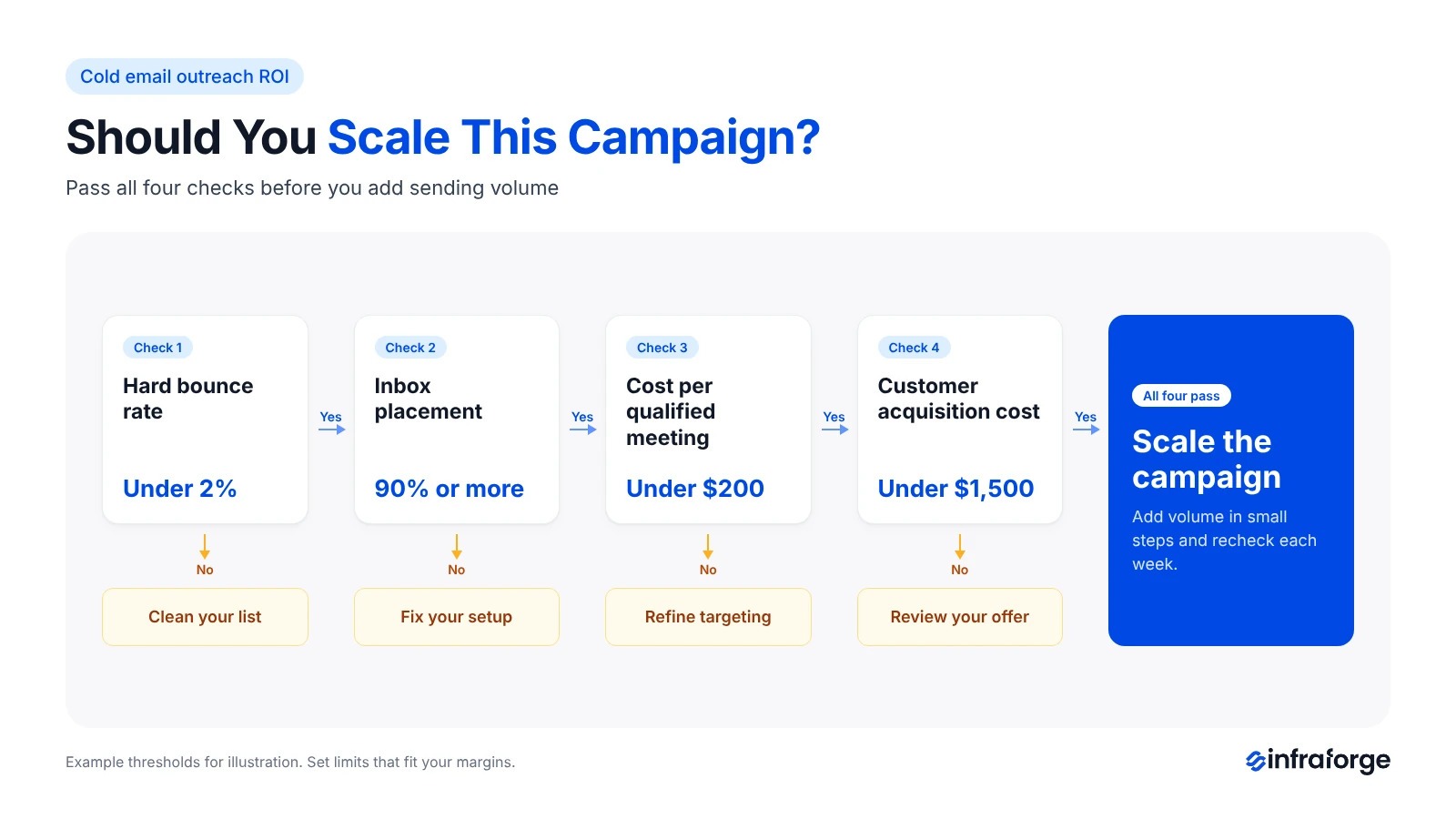
Before increasing your sending volume or campaign budget, review these points to make sure your cold email campaigns are delivering results.
Address any gaps before scaling. Increasing sending volume without checking these factors can raise campaign costs without improving ROI.
Cold email outreach ROI tells you whether your campaigns generate enough profit to justify their costs. To calculate it, compare the gross profit from acquired customers with your total campaign expenses, including email software, infrastructure, lead data, verification, and team time.
Track the full sales funnel, from email deliverability and positive replies to booked meetings, qualified opportunities, and paying customers. Use CRM data to connect your campaigns with revenue and identify where prospects drop off.
To improve ROI, target the right prospects, test your messaging, maintain good email deliverability, and monitor your cost per customer. Before scaling a campaign, make sure it brings in qualified customers and generates consistent returns.
A good ROI depends on your profit margins, sales cycle, customer value, and acquisition costs. A positive ROI means your campaign generates more gross profit than it costs to run. Set targets based on your business goals and use the same calculation method to compare campaigns.
Use gross profit rather than revenue to calculate ROI with the formula in this guide. Subtract the direct costs of delivering your product or service from revenue to get gross profit. Then subtract your campaign costs to calculate the profit remaining after those expenses.
Divide the total campaign cost by the number of qualified meetings generated.
For example, if a campaign costs $3,000 and generates 15 qualified meetings, your cost per qualified meeting is $200.
Cost per qualified meeting = $3,000 ÷ 15 = $200
Define what counts as a qualified meeting before comparing campaign results.
There is no fixed number. The result depends on your targeting, deliverability, positive reply rate, meeting conversion rate, sales process, and close rate.
Use your campaign data to estimate the number. For example, if 2,000 contacts generate 20 booked meetings, 16 held meetings, 12 qualified meetings, and four new customers, you acquire one customer for every 500 contacts reached.
Use the same contact and delivery metrics when comparing campaigns, and allow enough time for sales opportunities to convert into customers.
Not based on reply rate alone. Check whether replies come from your target audience and lead to qualified meetings, sales opportunities, and paying customers. Review deliverability, campaign costs, and gross profit before increasing sending volume.
Monitor campaign metrics during the campaign to catch problems with deliverability, replies, and meetings. Review ROI after allowing enough time for sales opportunities to progress through your sales cycle. Weekly performance checks and monthly or quarterly financial reviews help you track campaign activity and business results.
Cost per lead measures how much you spend to generate a lead, while customer acquisition cost (CAC) measures the cost of acquiring a paying customer. Track both to understand how much you spend on leads and conversions.
The cold email payback period measures how long it takes to recover your campaign investment through profit. Calculate it using your initial investment, monthly profit, and actual sales cycle.