AI-powered email outreach is transforming sales, but outdated systems are struggling to keep up. To succeed, teams need email infrastructure that ensures high deliverability, complies with strict regulations, and supports large-scale campaigns without risking sender reputation.
Key takeaways:
Why it matters: Without the right tools, AI-driven outreach can lead to blacklisting, poor deliverability, and wasted efforts. Smarter email systems reduce risks, protect sensitive data, and ensure campaigns reach their targets effectively.
AI-powered SDR outreach is navigating a tricky email environment where yesterday's strategies can quickly land in the spam folder. Email service providers (ESPs) are reshaping how they assess and filter bulk email traffic, making it harder for automated outreach to succeed without careful planning.
Email providers like Gmail, Outlook, and Yahoo have stepped up their game with stricter measures to combat automated outreach. These changes aren't minor tweaks - they're structural shifts that affect how every email is judged before it reaches someone's inbox.
One of the biggest changes? Engagement-based tracking. ESPs now monitor how recipients interact with emails. If too many messages are ignored, deleted, or marked as spam, the sender's reputation takes a hit. A poor reputation can lead to more emails being filtered out or blocked entirely.
Authentication has also become a non-negotiable. Scaling up email campaigns adds complexity, as sudden spikes in email volume can raise red flags. ESPs might see these spikes as spammy behavior, putting AI-driven SDRs in a tough spot. While the technology enables rapid outreach, maintaining a good sender reputation requires careful coordination.
Spam filters have also gotten smarter. Using machine learning, they analyze everything from writing style and email structure to link patterns and timing. If AI-generated emails are too formulaic or sent at predictable intervals, they’re more likely to be flagged.
These technical hurdles are just one side of the coin - regulatory and legal standards are tightening, too.
Alongside stricter technical rules, new regulatory frameworks are reshaping how outreach needs to be managed. Laws like the CAN-SPAM Act, GDPR, and California's CCPA have created a complex maze of compliance requirements, with hefty penalties for violations. Compliance isn't just a box to check; it's become a core part of operations.
For AI-driven SDR systems, this means keeping track of consent, honoring opt-outs across multiple channels, and maintaining detailed records of data processing. Traditional email platforms weren't built for this level of oversight, and manual tracking quickly becomes unmanageable when dealing with global campaigns.
The risks are high. Failing to meet compliance standards or running into deliverability problems can have serious consequences. ESPs might suspend accounts without warning, and legal penalties can target both companies and their leadership. Without the right infrastructure to handle compliance from the ground up, AI SDR teams are leaving themselves exposed.
Navigating these challenges calls for a new kind of email system - one that can balance deliverability with the demands of legal compliance.
The tools driving AI SDR (Sales Development Representative) email systems are moving far beyond traditional SMTP servers and static IP setups. What's emerging is a smarter, more dynamic infrastructure - one that views email delivery as a flexible, intelligent process rather than a rigid pipeline. This evolution is being shaped by two key factors: the need for AI-driven outreach to scale quickly and the increasingly strict measures enforced by email service providers (ESPs).
Traditional email systems were built on predictable sending patterns and manual reputation management. But these assumptions fall apart when AI takes over. AI SDRs handle fluctuating campaign volumes that demand real-time adjustments, making manual management of domains and IPs impractical.
The next generation of email systems is designed to thrive in this complex environment. They blend advanced automation with precise control, ensuring compliance and reliable deliverability. These systems adapt as quickly as the AI agents they support, paving the way for hybrid AI platforms that combine real-time analytics with adaptive email strategies.
Multi-agent AI platforms are reshaping how outreach is handled at scale. Tools like Agent Frank do more than send emails - they manage entire campaigns across multiple channels, tweak messaging based on engagement data, and coordinate follow-ups over time. However, inconsistent sending volumes present a major challenge, requiring automated solutions to maintain both deliverability and campaign momentum.
For example, an AI SDR might send 500 emails one day and 5,000 the next, depending on lead availability and campaign performance. These sudden spikes can trigger ESPs to flag the activity as suspicious. Without a system that can smooth out these fluctuations - by distributing sends across multiple IPs, rotating domains, and maintaining consistent warm-up routines - the entire operation risks being shut down.
In this context, real-time decision-making is essential. A hybrid AI system must decide which IP to use for each recipient, select the best domain based on reputation scores, and throttle sends to stay within ESP limits. At the same time, it must maintain campaign momentum. Different campaigns may also require tailored sending strategies - some focusing on speed, others on deliverability. Without this level of flexibility, the email infrastructure could become a bottleneck instead of a tool for growth. By adopting this adaptive approach, outreach efforts can scale effectively while staying compliant with ESP regulations.
Managing dozens of domains, multiple IPs, and thousands of mailboxes manually is simply not scalable. That’s where self-healing infrastructure comes in - a system capable of identifying problems, diagnosing their causes, and fixing them automatically.
One critical aspect of this is automated warm-up. Establishing the reputation of new IPs and domains requires a gradual process, but this is no longer a one-and-done task. Reputations can decline over time, and ESPs have different thresholds for acceptable sending behavior. Self-healing systems continuously monitor engagement signals and adjust warm-up patterns as needed, ensuring smooth operations.
Similarly, IP and domain rotation is shifting from a manual task to an automated requirement. When a reputation issue is detected, the system can seamlessly redirect traffic to higher-performing IPs without interrupting active campaigns. This kind of automation ensures that campaigns stay on track while protecting deliverability.
Reputation-aware routing takes this a step further by dynamically assigning clean IPs to high-value prospects while directing bulk sends to more robust resources. This ensures that every email is handled appropriately based on its importance and the recipient's value.
In today’s landscape, where ESPs are constantly updating their filters, automation isn’t just a convenience - it’s a necessity. A single misstep can harm deliverability for weeks. Platforms like Infraforge are already leading the charge with features like multi-IP provisioning and automated DNS setup, aiming to anticipate and adjust sending patterns before problems arise.
The move toward self-healing systems addresses a very real need: most teams don’t have dedicated email deliverability experts. These systems embed that expertise directly into the platform, automatically managing warm-up schedules, rotation strategies, and reputation monitoring. This allows teams to focus on their outreach goals while the platform handles the technical complexities, ensuring smooth and reliable email operations without requiring deep technical know-how.
AI SDR email systems are stepping beyond basic automation, bringing in smarter, privacy-focused platforms. These aren’t just tools for sending emails - they actively safeguard sender reputations. Building on earlier self-healing systems, this new infrastructure offers a higher level of safety and adaptability.
Why the shift? Email service providers (ESPs) are tightening filters, and compliance requirements are becoming trickier to navigate. AI SDR teams need systems that react to threats instantly while meeting the strict privacy demands of enterprise clients. The solution? Platforms that integrate deliverability intelligence directly into their framework, offering dedicated, isolated resources for each user.
Traditional email systems rely heavily on manual oversight to catch deliverability issues. Teams have to check bounce rates, monitor blacklists, and adjust sending strategies - often after the damage has already been done. AI-powered deliverability intelligence changes the game by automating these checks and responses in real time.
These systems continuously track key metrics like open rates, click-through rates, bounce rates, and spam complaints. If engagement dips below expected levels, the system steps in - adjusting sending volumes or pausing campaigns on problematic IPs. It’s a swift, hands-free process, often resolving issues within minutes. Blacklist monitoring, for instance, scans dozens of databases nonstop, alerting teams immediately and rerouting traffic from compromised IPs.
A standout feature is engagement-based routing. By analyzing historical engagement data for specific recipient domains, the system tailors its sending strategy. If emails to a domain frequently end up in spam, it might slow down sends, switch to a more reputable IP, or tweak message formatting. This level of precision ensures every email has the best shot at landing in the inbox. Like self-healing systems, these tools optimize performance without requiring human intervention.
The real magic lies in how these systems combine signals for quick, intelligent decisions. For example, a sudden spike in bounce rates might point to a temporary server issue rather than a reputation problem. An AI-powered system can tell the difference and act accordingly - pausing sends in one case or switching IPs in another.
For teams managing campaigns across hundreds of domains and thousands of mailboxes, this kind of automation isn’t just helpful - it’s essential. The alternative? Hiring deliverability specialists to monitor dashboards 24/7. Even then, humans can’t match the speed and accuracy of systems that react in milliseconds.
Beyond automation, robust security features are key to protecting sender reputation. Shared infrastructures come with risks - one sender’s poor practices can harm everyone. The answer lies in private infrastructure, where each user operates in complete isolation.
Dedicated IPs are the backbone of this approach. Unlike shared IPs, where reputation is collective, dedicated IPs give users full control. If there’s a deliverability issue, it’s contained to that user’s setup. Infraforge offers dedicated IPs at $99 per IP per month, ensuring exclusive control over sender reputation.
SSL certificates add another layer of trust and security. Emails sent over encrypted connections are protected during transit, reducing the risk of interception. Plus, SSL certificates signal to ESPs that the sender is legitimate, which can boost deliverability when paired with proper domain authentication. Infraforge provides SSL certificates for $2 per domain per month (billed quarterly), making this feature accessible even for teams managing multiple domains.
Domain masking solves another challenge - protecting primary domains from reputation damage. Instead of using main company domains for cold outreach, teams can use masked domains. These maintain brand identity while isolating any risks. If a masked domain’s reputation takes a hit, the primary domain remains unaffected. This approach is especially critical for businesses relying on their main domain for transactional emails and customer communication.
Isolated domain management takes things a step further. Campaigns are grouped by type, with strict separation between high-value outreach and bulk sends. This prevents one campaign’s issues from spilling over into others. For example, if a bulk campaign triggers spam filters, high-value outreach campaigns on separate domains remain unaffected.
These features create a secure, resilient infrastructure. Teams can test bold outreach strategies on isolated resources without jeopardizing their core email operations. Scaling becomes seamless, as new IPs and domains can be added without inheriting reputation problems. Plus, enterprise security requirements are met, ensuring sensitive data isn’t sent through shared infrastructure.
Platforms like Agent Frank are already leveraging these advanced, private infrastructures to provide secure scaling and consistent deliverability. As ESPs impose stricter rules, only teams using private, intelligent systems will be able to maintain reliable deliverability at scale.
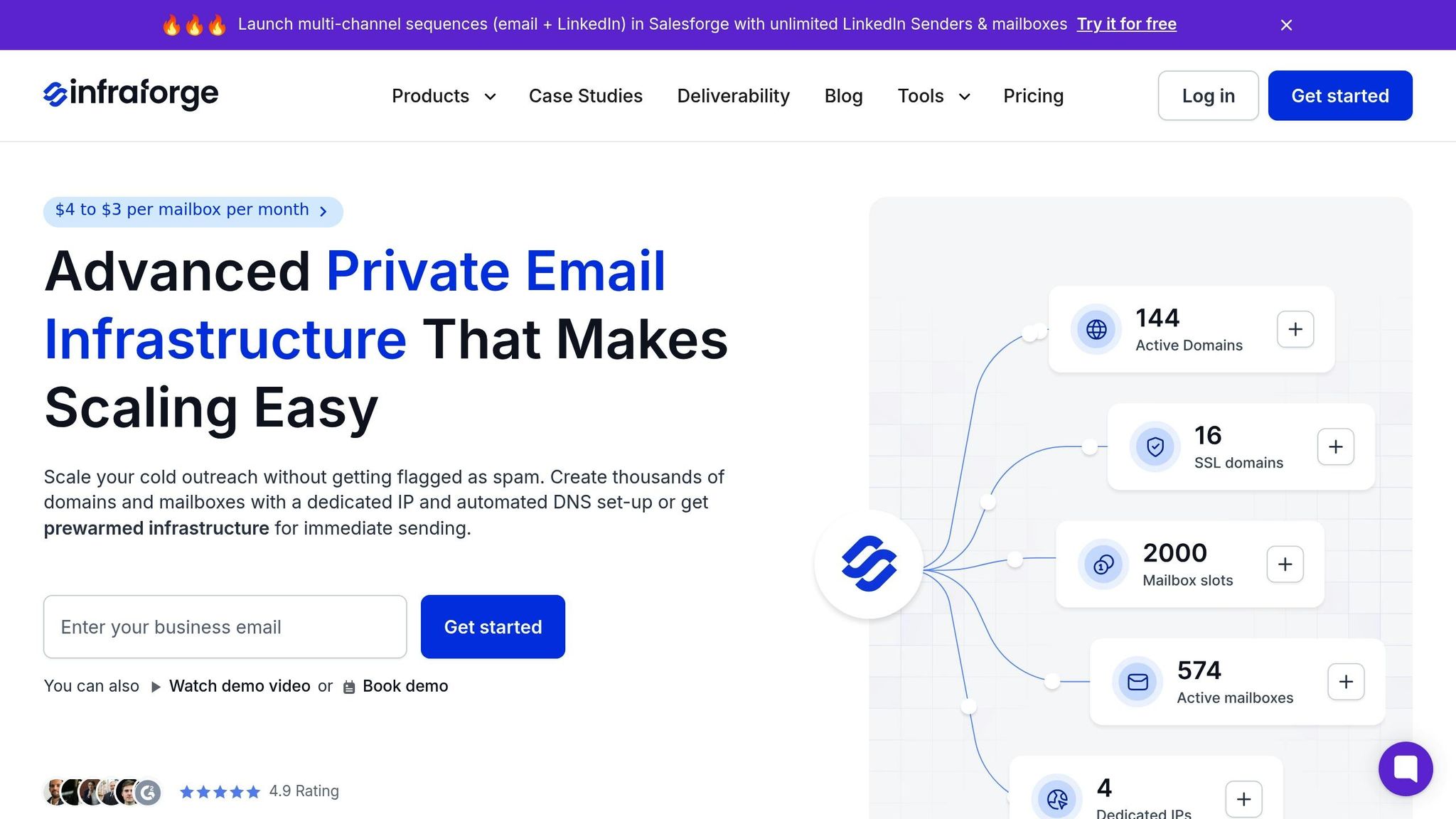
Infraforge is tackling today’s email deliverability challenges head-on while preparing for the future of AI-driven sales development representative (SDR) outreach. With ever-changing email service provider (ESP) rules and increasing deliverability risks, having a reliable infrastructure isn’t just helpful - it’s critical. Unlike platforms that treat email infrastructure as a simple commodity, Infraforge views it as the backbone for scaling AI agents effectively without running into deliverability roadblocks.
The platform’s design is built on a key principle: AI SDR systems require infrastructure that’s both powerful and controllable. Without control, automation can lead to reputation damage and performance bottlenecks. Infraforge bridges this gap with automation tools that users can actively monitor, tweak, and manage. This approach sets the stage for its robust feature set.
Infraforge’s features are designed to solve the real-world problems that teams face when scaling email outreach with AI SDR systems. Each capability is tailored to address specific technical challenges.
Infraforge integrates seamlessly with Salesforge, making it an ideal choice for teams using The Forge Stack. However, it’s also compatible with other email tools, offering flexibility for diverse tech stacks.
To understand Infraforge’s value, it’s important to compare it to other options for email infrastructure. The key differences lie in control, isolation, and scalability - areas where Infraforge excels.
Shared SMTP relays like SendGrid and Mailgun are designed for transactional emails, not cold outreach. Users share IP pools, meaning one sender’s behavior can impact others. These platforms also impose strict limits on sending and often suspend accounts for cold email activity. While pricing is volume-based, high-volume campaigns can become costly, and there’s little to no control over IP reputation.
Generic email hosting solutions like Google Workspace or Microsoft 365 work well for small-scale outreach but aren’t built for high-volume campaigns. Sending too many emails from a single mailbox triggers spam filters and rate limits. These platforms lack features like IP rotation, automated warm-up, and outreach-specific infrastructure.
Shared cold email platforms offer some outreach-focused features but still rely on shared IP pools, which carry collective reputation risks. They often lack customization options, dedicated IPs, and robust DNS controls.
Here’s how Infraforge stacks up against these alternatives:
| Feature | Infraforge | Shared SMTP Relays | Generic Email Hosting | Shared Cold Email Platforms |
|---|---|---|---|---|
| Dedicated IPs | Yes, $99/IP/month | No, shared pools | No | Limited or expensive |
| Full DNS Control | Yes, automated setup | Limited | Basic | Partial |
| Domain Masking | Yes, $2/domain/month | No | No | Sometimes |
| SSL Certificates | Yes, included | Varies | Basic | Rarely |
| Reputation Isolation | Complete | None | Per-account only | Partial |
| API Access | Full programmatic control | Limited | None | Limited |
| Pre-Warmed Infrastructure | Yes | No | No | Sometimes |
| Multi-Workspace Support | Yes | No | No | Limited |
| Scalability | Unlimited with added resources | Volume-based pricing | Manual scaling | Platform limits |
| Privacy | Private infrastructure | Shared visibility | Private | Shared visibility |
| Best For | AI SDR systems, high-volume outreach | Transactional emails | Low-volume sending | Small to mid-scale campaigns |
Infraforge’s private infrastructure model offers AI SDR teams the control and isolation they need. Dedicated IPs, domains, and mailboxes operate independently, so reputation issues don’t spill over into other campaigns. Scaling is as simple as adding resources, and the API ensures that the system can adapt dynamically to performance needs.
For teams running AI SDR systems like Agent Frank, shared platforms simply can’t keep up. These systems generate high email volumes that require infrastructure capable of both scaling and maintaining control. Infraforge delivers exactly that, positioning itself as the go-to solution for advanced AI SDR operations.
The pricing model reflects this focus on sustainable growth. Instead of charging per email, Infraforge charges for resources - starting at $40 per month for 10 mailbox slots (billed quarterly) or $33 per month (billed annually). Domains are priced separately based on their top-level domain (TLD). This structure encourages teams to invest in long-term infrastructure rather than chasing short-term email volume.
As ESPs tighten restrictions and AI SDR systems grow more advanced, the gap between shared and private infrastructure will only become more apparent. Teams using Infraforge will enjoy consistent deliverability, while those on shared platforms risk reputation issues and account suspensions. Infraforge is building the infrastructure that ensures AI SDR systems can thrive in this evolving landscape.
The rise of AI-powered outreach shows no signs of slowing down. To keep up, teams need to prepare their email infrastructure now to avoid costly deliverability issues later. Building a solid foundation takes careful planning, testing, and the right tools to handle large-scale operations. Infraforge provides powerful features to simplify this process, but having a clear strategy is key.
The focus shouldn’t just be on sending more emails - it’s about doing it responsibly. Think of your email infrastructure as a long-term investment, not a quick fix. Teams that rush into high-volume emailing without proper setup risk damaging their reputation, getting blacklisted, and wasting resources. A more effective approach is to scale gradually, monitor performance continuously, and adjust as needed.
To avoid deliverability problems, roll out your domains in stages rather than all at once. For example, you might start with 10 domains, monitor their performance for two to three weeks, and then add more based on the data.
Every domain needs time to establish a pattern of legitimate sending before increasing volume. Even with Infraforge’s pre-warmed domains, start small - sending around 20 to 30 emails per mailbox daily during the first week. This helps email service providers (ESPs) recognize your activity as trustworthy. After the initial phase, gradually increase email volume by 10–20% per week until you reach your target.
IP rotation schedules play a big role in maintaining your reputation. By spreading email volume across dedicated IPs, you can isolate potential problems. For example, assigning specific IPs to different campaigns or clients ensures that if one campaign encounters issues, it won’t affect others. Infraforge’s multiple workspaces feature makes managing this separation straightforward.
Warm-up timelines depend on whether you’re starting from scratch or using pre-warmed infrastructure. Infraforge’s pre-warmed domains and mailboxes can shorten this process, but a structured ramp-up is still essential. For new mailboxes added to pre-warmed domains, plan for a two-week warm-up period. During this time, focus on sending emails to engaged recipients - those likely to open and reply - to signal positive engagement to ESPs.
If you’re managing a large-scale AI SDR operation, staggered campaign launches are a must. For instance, instead of activating 50 AI SDR agents all at once, start with 10, monitor their performance for a week, and then activate another 10. This step-by-step approach helps you catch and fix problems before they grow.
Consistency in DNS configuration is another critical factor. Infraforge’s automated DNS setup ensures that SPF, DKIM, and DMARC records are correctly configured, but regular checks are still necessary. Misconfigured records can lead to authentication issues, harming your sender reputation.
For added security, use SSL and domain masking to protect your primary domain. Infraforge offers cost-effective features to make this easier. Additionally, reserve about 20–30% of your email capacity to handle unexpected spikes in volume. For example, if you have 100 mailbox slots, plan to use only 70–80 slots initially, keeping the rest available for growth or sudden demand.
Once your infrastructure is in place, the next step is proactive monitoring and management.
Without real-time monitoring, problems can slip through the cracks. Infraforge’s Masterbox feature provides a centralized view of all email accounts in a workspace, making it easy to catch issues early.
Masterbox consolidates replies from all mailboxes into one dashboard. It’s priced at $7 per workspace per month (billed annually) or $9 per month (billed quarterly). For teams managing dozens - or even hundreds - of mailboxes, this feature saves time by eliminating the need to log into each account individually. From this single interface, you can track engagement, monitor reply rates, and spot deliverability issues.
If a mailbox stops receiving replies, it could indicate a deliverability problem. Masterbox highlights these patterns, enabling teams to investigate and resolve issues quickly.
The Infraforge API adds another layer of control. With it, teams can automate tasks like mailbox provisioning, IP rotation, and configuration adjustments based on performance metrics. This automation is especially useful for AI SDR systems that need to adapt in real time.
For example, if an AI agent notices a drop in open rates for a specific domain, the API can automatically switch to a different IP or pause sending from that domain until the issue is resolved. These automated adjustments are supported by an alert system that notifies teams of problems like bounce rate spikes or authentication failures.
API integrations also enable performance-based routing. High-performing IPs and domains can be prioritized for critical campaigns, while lower-performing ones handle less important tasks. This ensures maximum deliverability where it matters most.
Teams can set up alerts for specific events, such as sudden drops in engagement or bounce rate spikes, allowing them to act immediately instead of waiting for scheduled reviews. For those using AI SDR systems like Agent Frank, integration with Salesforge ensures seamless coordination between outreach campaigns and email infrastructure. Salesforge’s multi-channel capabilities rely on dependable email delivery, which Infraforge supports without compromising on performance.
Regular audits should complement real-time monitoring. A weekly review of metrics like bounce rates, spam complaints, open rates, and reply rates can reveal trends that might not be obvious day-to-day. For instance, a gradual decline in open rates could signal a slow erosion of sender reputation that needs attention.
Infraforge’s bulk DNS updates feature simplifies maintenance for teams managing large numbers of domains. Instead of updating DNS records one by one, changes can be applied across hundreds of domains simultaneously. This helps keep everything consistent and compliant with evolving ESP requirements.
Workspace segmentation is another valuable tool. By creating separate workspaces for different clients, campaigns, or business units, you can isolate potential issues. If one workspace encounters deliverability problems, the others remain unaffected.
Finally, establish clear protocols for handling issues like blacklisting. This should include pausing affected campaigns, investigating the root cause, and taking corrective action.
The world of email is changing fast. With stricter rules from ESPs, higher deliverability standards, and AI-driven outreach pushing systems to their limits, sticking to outdated or shared setups is no longer an option. The future belongs to teams that prioritize smarter, safer, and more private email infrastructure to keep up with these demands.
Modern infrastructure uses AI to analyze performance in real time and predict engagement patterns while safeguarding sender reputation. This is achieved through dedicated IPs, pre-warmed domains, and automated monitoring. Private systems also add an extra layer of security with SSL encryption and domain masking, ensuring compliance with increasingly strict data protection regulations.
Infraforge brings this vision to life with its all-in-one platform. It equips AI SDR teams with tools like pre-warmed domains, automated DNS setup, multi-IP provisioning, and a centralized Masterbox dashboard. Its API allows real-time adjustments, while workspace segmentation helps contain potential issues before they escalate.
To make the most of these capabilities, preparation is key. Start by gradually rolling out domains, tracking performance metrics closely, and automating repetitive tasks with Infraforge. Scaling in stages, maintaining consistent DNS configurations, and staying proactive will help avoid blacklisting and maintain strong deliverability rates.
As regulations grow tighter and ESPs crack down on high-volume senders, the divide between well-managed and poorly managed email infrastructure will only grow. Teams that see email infrastructure as a strategic priority, rather than just a technical necessity, will be best positioned to succeed. Now is the time to take action.
Infraforge offers powerful tools like multi-IP provisioning, SSL encryption, and domain masking to elevate the success of AI-driven outreach campaigns. These features are designed to boost email deliverability while keeping campaigns aligned with shifting email regulations. Together, they help safeguard sender reputation, simplify IP rotation, and ensure the integrity of your campaigns.
With automated solutions for tasks like warm-up and reputation management, Infraforge enables your AI systems to grow effortlessly while keeping safety and compliance in check. This setup gives users the confidence to manage campaigns effectively in a regulatory environment that's constantly evolving.
Using dedicated IPs and a self-healing infrastructure in AI SDR email systems offers clear advantages for email performance and reliability.
With dedicated IPs, you gain full control over your email reputation. This means your deliverability rates improve since you’re not at the mercy of shared IPs, where the bad practices of others could harm your campaigns.
Meanwhile, self-healing infrastructure works behind the scenes to keep things running smoothly. It automatically identifies and fixes problems, such as IP blacklisting or drops in domain reputation. This reduces downtime, safeguards your sender reputation, and keeps your outreach campaigns on track.
Together, these tools create a more reliable, secure, and efficient email system - perfect for navigating today’s tighter regulations and increasing privacy concerns.
Infraforge takes email performance to the next level with its automated deliverability intelligence, designed to minimize the chances of emails landing in spam folders. With tools like IP rotation, reputation management, and domain masking, the platform ensures your email campaigns remain scalable while adhering to ever-changing email service provider (ESP) rules.
What sets Infraforge apart is its smart infrastructure, which actively monitors and fine-tunes email sending patterns. It handles warm-up processes automatically and safeguards sender reputation. This hands-off, adaptive system enables AI agents to send emails securely and efficiently, even in tightly regulated email ecosystems.