Cold emailing to EU contacts is legal under GDPR - but only if you follow strict rules. Here’s what you need to know:
Platforms like Infraforge help simplify GDPR compliance by offering tools like automated suppression list management, secure email systems, and pre-warmed domains to improve deliverability while meeting privacy standards.
GDPR compliance isn’t optional - it’s the law. But following these steps can also improve your email engagement and protect your sender reputation.
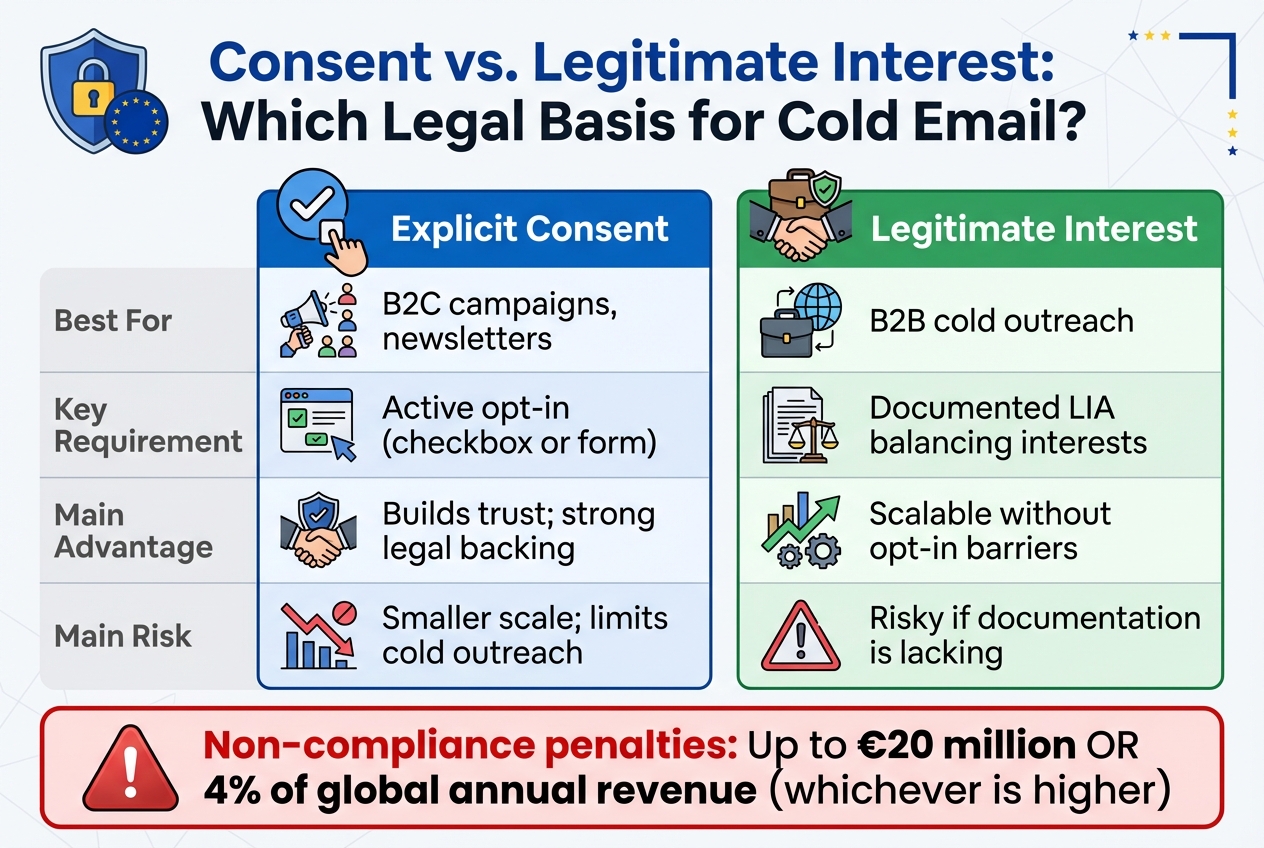
GDPR Cold Email Compliance: Consent vs Legitimate Interest Comparison
Yes, cold emailing is legal under GDPR, but only if you have a lawful basis for processing personal data. The regulation doesn’t outright ban cold outreach; instead, it sets strict rules to ensure businesses respect personal data and have clear, valid reasons for contacting individuals. This means your emails must prioritize transparency, relevance, and the recipient’s rights.
The consequences for non-compliance are severe: fines can reach up to €20 million (around $21.5 million) or 4% of global annual revenue, whichever is higher.
Cold emailing can be lawful under two conditions: explicit consent or legitimate interest. Most B2B cold email campaigns rely on legitimate interest because obtaining explicit consent before initial contact would undermine the concept of "cold" outreach. However, legitimate interest isn’t a loophole - it requires thorough documentation and a careful balance between your business needs and the recipient’s privacy rights.
Under GDPR Article 6, the two primary legal bases for cold emailing are explicit consent and legitimate interest. For B2B outreach, legitimate interest is the most practical approach. It allows you to contact professionals without prior opt-in, as long as your emails are relevant to their job roles and respect their privacy.
To comply with legitimate interest, you must complete a Legitimate Interest Assessment (LIA). This involves three steps:
Documenting this process is crucial in case regulators challenge your compliance.
For instance, a B2B software company successfully used legitimate interest to email IT managers. They clearly explained their purpose, disclosed that they obtained email addresses from public professional directories, provided an easy opt-out option, and tailored their content to align with the recipients’ job responsibilities. This approach not only increased engagement but also ensured GDPR compliance through a well-documented LIA.
Meeting the conditions for legitimate interest requires strict adherence to GDPR guidelines. You must use professional email addresses, personalize your content to match the recipient’s professional interests, disclose data sources and purposes, honor opt-out requests immediately, and maintain records of your LIAs and suppression lists. Failure to meet these standards - such as sending irrelevant offers or using scraped personal email addresses - can lead to GDPR violations.
Choosing between explicit consent and legitimate interest shapes how you approach cold email campaigns. Explicit consent requires recipients to actively opt in, such as through a checkbox or form. This consent must be freely given, specific, informed, and easy to withdraw. While this method offers stronger legal protection and fosters trust, it typically results in smaller outreach volumes and isn’t ideal for true cold outreach.
Legitimate interest, by contrast, allows you to send B2B cold emails without prior opt-in, enabling broader and more scalable outreach. However, it demands documented LIAs, strict relevance, and immediate opt-out fulfillment.
| Legal Basis | Best For | Key Requirement | Main Advantage | Main Risk |
|---|---|---|---|---|
| Explicit Consent | B2C campaigns, newsletters | Active opt-in (checkbox or form) | Builds trust; strong legal backing | Smaller scale; limits cold outreach |
| Legitimate Interest | B2B cold outreach | Documented LIA balancing interests | Scalable without opt-in barriers | Risky if documentation is lacking |
If a recipient opts out or withdraws consent, you must stop emailing them immediately. GDPR prioritizes recipient control, so unsubscribe requests must be honored within 24–48 hours, and suppression lists must be kept up to date.
When sending cold emails under GDPR, certain elements are non-negotiable. They ensure transparency, accountability, and compliance, while also protecting your sender reputation. Here's what you need to include:
Your email must clearly state who you are and how to contact you. This means using an accurate "From" name that reflects either your personal identity or your company. Pair it with a valid reply-to address and ensure your email domain matches your organization. Additionally, your email footer should provide your company name, physical business address, and at least one other contact method, like a phone number or general email.
For instance, a professional footer might look like this:
John Smith, Acme Solutions Inc., 123 Main Street, Suite 400, San Francisco, CA 94105 | Phone: (415) 555-0100.
Make sure these details are easy to find in both the email header and footer. Once you've covered sender identification, the next step is ensuring recipients can easily opt out.
Every cold email must include a simple and free way for recipients to unsubscribe. The process should be as frictionless as possible - no logging in, no extra forms, and no hidden steps. A common approach is to include a clear "Unsubscribe" link in your footer that leads to a confirmation page. Alternatively, you can add text like, "If you'd prefer not to hear from us again, click here to opt out."
For smaller email campaigns, you might ask recipients to reply with "unsubscribe." However, for large-scale outreach, it's better to use a clickable unsubscribe link supported by an automated suppression system. Tools like Infraforge's private email infrastructure, combined with platforms like Salesforge, can handle suppression lists and track opt-outs automatically. This minimizes manual errors and keeps your campaigns compliant as they grow.
With sender details and an opt-out method covered, the final piece is being upfront about your email's purpose.
Be transparent about why you're reaching out. Within the first two sentences, explain the purpose of your email and how you obtained the recipient's contact information. For example:
"I'm reaching out because your role aligns with our solution, based on publicly available business data."
This level of honesty not only meets GDPR standards but also shows respect for the recipient's privacy. Avoid misleading subject lines like "Important information about your account" if no prior relationship exists. Such tactics can harm transparency and potentially violate GDPR and other email regulations.
These core elements - clear identification, an easy opt-out, and transparent intent - lay the groundwork for GDPR-compliant cold email outreach. They also set the stage for more advanced practices like secure infrastructure and ethical list building.
When building an email list under GDPR, it’s essential to collect each email on a documented lawful basis - either through explicit consent or legitimate interest. This approach not only ensures compliance but also improves the effectiveness of your email campaigns.
Avoid using purchased or scraped email lists. These are risky because you can’t verify how the data was collected or prove you have a lawful basis to contact individuals. Instead, focus on legitimate methods for gathering email addresses. For consent-based emails, use website forms, event sign-ups, webinar registrations, or gated content with clear and unchecked opt-in boxes.
For B2B outreach under legitimate interest, you can use publicly available professional data, such as business emails listed on company websites or professional networking platforms. Alternatively, work with trusted data providers that can document their GDPR compliance. Before reaching out, conduct a three-step assessment:
For example, using business email addresses, ensuring relevance to the recipient’s role, limiting email frequency, and offering an easy opt-out option can help justify legitimate interest. However, avoid adding contacts if the relevance is unclear, such as sending generic pitches to personal email accounts.
Proper documentation is key to proving compliance, especially during audits. For consent-based emails, keep a record that includes the email address, timestamp, source, and the exact consent text. A double opt-in process is ideal for reinforcing evidence.
For contacts under legitimate interest, maintain concise records for each campaign. These should describe the target audience (e.g., "CIOs in German manufacturing companies"), explain the business purpose, justify the necessity of email outreach, and detail how you minimized intrusion (e.g., low email frequency and clear opt-out options). Additionally, log the data source, the date the contact was added, and a summary of your balancing assessment.
Keeping your email list clean and up-to-date is crucial for both compliance and deliverability. Automatically remove hard bounces and repeatedly failing role-based addresses. Regularly review and remove inactive contacts, such as those who haven’t opened or clicked an email in 6–12 months. Use a centralized suppression list that syncs via API, ensuring all opt-outs are honored across campaigns.
Your unsubscribe process should be simple - just one click leading to a confirmation page, with no extra steps. Log every opt-out, including the date, time, and source. For teams managing multiple systems or domains, tools like Infraforge, paired with platforms such as Salesforge, can help maintain consistent suppression list syncing and deliverability at scale.
Good list hygiene works hand-in-hand with clear data retention policies. GDPR requires you to limit how long personal data is stored. Create written policies to delete or anonymize inactive contacts after 12 to 24 months or when a prospect opts out. Automate these rules through workflows in your CRM or outreach platform, and log when records are removed.
It’s also a good idea to disclose your retention policies in your privacy notice and update them regularly to reflect changes in sales cycles or regulatory updates. By combining careful sourcing, thorough documentation, disciplined list maintenance, and clear retention practices, you can ensure your email list stays GDPR-compliant while achieving high deliverability rates.
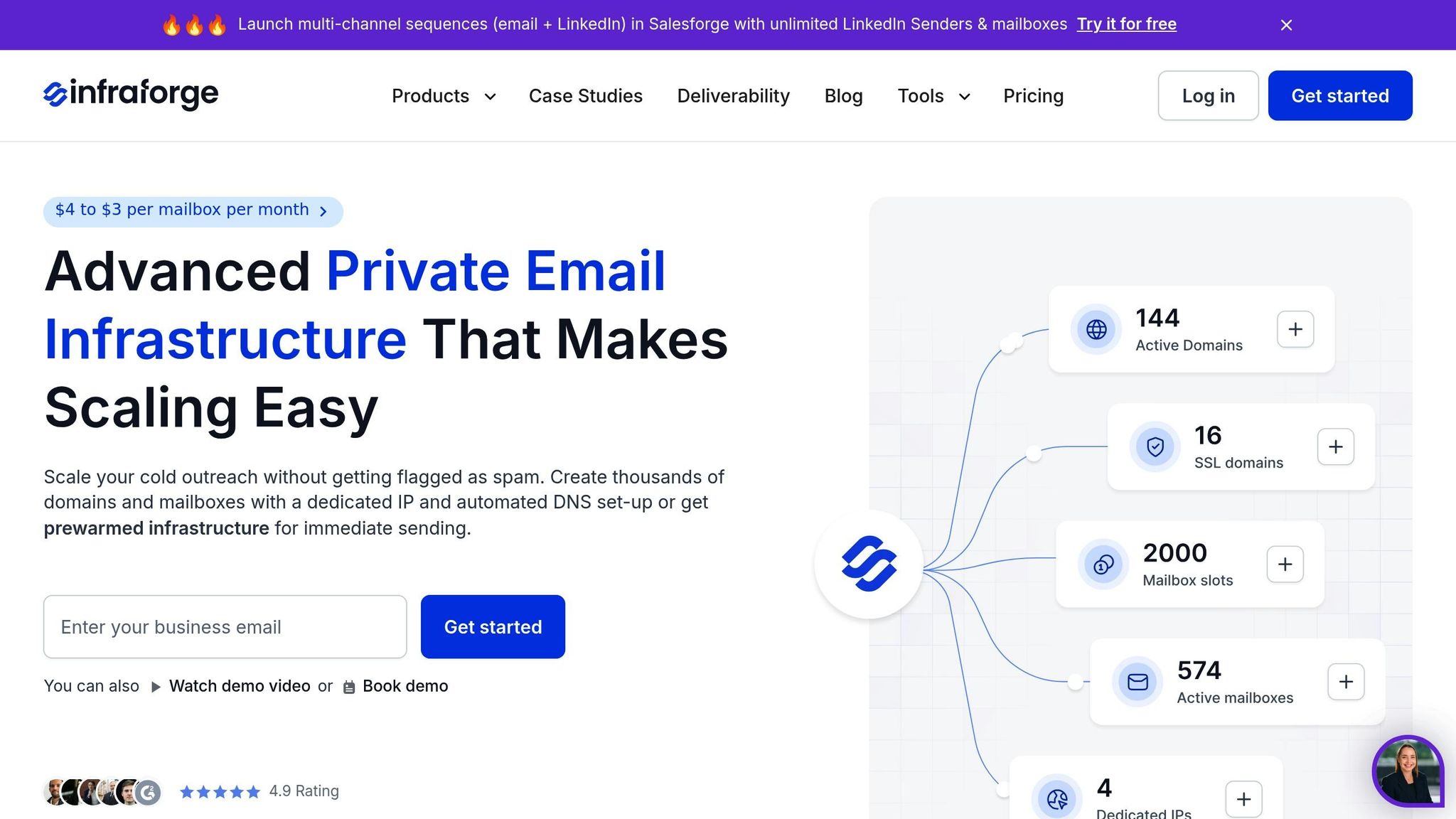
Infraforge provides the tools and infrastructure needed to meet GDPR's strict data protection standards while ensuring effective cold email campaigns. By combining robust security measures with features designed to enhance deliverability, Infraforge enables businesses to conduct secure and compliant outreach. Its private email infrastructure is tailored specifically for cold email efforts, balancing security with functionality to help you reach inboxes consistently.
Infraforge offers dedicated IPs, giving you full control over your sending reputation and security. Unlike shared email providers, dedicated IPs ensure your deliverability isn’t impacted by others on the same network. The platform also handles the setup of SPF, DKIM, and DMARC records automatically for every domain you add. These records verify sender identity and prevent spoofing, which aligns with GDPR's transparency requirements by ensuring recipients know exactly who is contacting them.
To protect personal data, Infraforge employs SSL encryption during transmission. Additionally, domain masking hides infrastructure details while maintaining compliance documentation. Setting up your first domain and mailbox is quick - ready in just five minutes. For added organization and security, Infraforge allows you to create separate workspaces for different outreach campaigns.
Launching cold email campaigns with new domains can often lead to spam filters flagging your messages. Infraforge solves this issue by providing pre-warmed domains and mailboxes, ready to send immediately. The warming process builds sender reputation gradually by mimicking natural sending patterns with controlled volume increases. This not only improves inbox placement but also ensures sender information is clearly displayed and opt-out options are easily accessible, meeting GDPR's transparency requirements.
Scaling cold email campaigns while staying GDPR-compliant requires careful management of email volume. Infraforge addresses this with multi-IP provisioning, which distributes sending across multiple dedicated IPs. This prevents reputation damage from high email volumes and supports compliant outreach to EU contacts.
The Infraforge API further simplifies scaling by enabling seamless integration with tools like Salesforge. This integration automates tasks such as suppression list management and ensures unsubscribe requests are processed instantly - an essential GDPR requirement. Infraforge’s pricing, at $651 per month for 200 mailboxes, offers a cost-effective alternative to services like Google Workspace and MS365.
"Infraforge is the ultimate solution to scale your outreach without compromising on deliverability and retaining full control over your set up and security." - Infraforge Website
When it comes to cold emailing, GDPR compliance isn’t just about following the rules - it’s about building trust and protecting your sender reputation while scaling your efforts effectively. By ensuring a lawful basis for outreach, staying transparent, offering easy opt-out options, and safeguarding personal data, you can turn compliance into an opportunity to stand out.
Legal compliance is only half the story; technical compliance plays an equally important role. With the right email infrastructure, much of the heavy lifting can be automated. Features like automated DNS setup for sender authentication, instant suppression list management to handle unsubscribe requests, and deliverability monitoring to avoid spam filters minimize manual errors and allow you to scale campaigns without sacrificing data protection standards. This kind of setup creates a solid foundation for success.
Platforms like Infraforge take it a step further by combining compliance tools with performance optimization, specifically tailored for cold outreach. With its cost-effective solutions and seamless integration with tools like Salesforge, Infraforge simplifies your compliance processes while enhancing your outreach efficiency. It’s a win-win for meeting regulatory requirements and streamlining your workflow.
The future of cold emailing lies in automated compliance infrastructure. Real-time opt-out processing, multi-IP provisioning, and API integration transform regulatory obligations into efficient, scalable systems. This not only shields you from hefty fines but also boosts campaign performance through better engagement and deliverability.
A Legitimate Interest Assessment (LIA) is a key process under GDPR, ensuring that processing personal data based on legitimate interests is lawful. Its purpose is to strike a balance between your business goals and individuals' privacy rights.
Here’s how you can carry out an LIA:
By conducting an LIA, you ensure that your cold email campaigns respect GDPR standards, minimizing risks while maintaining ethical data practices. Tools like Infraforge can support this effort by offering secure, privacy-focused email infrastructure tailored for outreach.
To keep your cold emails in line with GDPR requirements, there are a few essential steps to follow. Start by securing explicit consent from your recipients before contacting them. Every email should include a clear and accessible opt-out option, allowing recipients to unsubscribe whenever they choose. Also, ensure your company's contact details are easy to find and accurate. Most importantly, your data handling practices should reflect GDPR's principles of transparency, security, and lawful use.
Leveraging advanced email tools like Infraforge can help with compliance by managing domain authentication protocols - such as SPF, DKIM, and DMARC - to enhance deliverability and protect your campaigns. Still, the ultimate responsibility lies in how you handle email content and manage recipient data.
If you're considering using purchased email lists under GDPR, think twice. GDPR mandates that individuals must give clear and informed consent before their personal data is processed - this includes email outreach. Purchased lists typically don’t come with this consent, leaving you exposed to potential legal violations.
The consequences of non-compliance are steep. You could face hefty fines, legal troubles, and a serious hit to your brand’s reputation. The safer, smarter approach? Build your email lists organically and ensure every outreach effort complies with GDPR regulations. It’s not just about avoiding penalties - it’s about respecting privacy and fostering trust.