Email deliverability determines whether your emails land in inboxes or get flagged as spam. Sending too many emails too quickly - especially from new domains or IPs - can harm your sender reputation, trigger spam filters, and reduce engagement. This impacts future campaigns and can even lead to blocklisting.
Poor deliverability costs businesses revenue. For example, improving inbox placement from 85% to 97% could add $1.4M annually for a $10M email-driven program. Tools like Infraforge help manage email volume by offering dedicated IPs, pre-warmed domains, and real-time monitoring, ensuring emails reach the right place.
Email Deliverability Benchmarks and Safe Sending Limits
Sending a sudden flood of emails - jumping from hundreds to tens of thousands - can set off alarms for mailbox providers like Gmail, Outlook, and Yahoo. These providers monitor sending patterns for each IP address and domain, creating a baseline of what’s considered "normal." A sharp increase, especially from new or previously inactive infrastructure, raises red flags that mimic spam-like behavior.
When this happens, Internet Service Providers (ISPs) may take actions like throttling your delivery (slowing or delaying email sends), greylisting your traffic (temporarily rejecting emails to see if you’ll retry like a legitimate sender), or even sending your emails straight to spam folders while they assess your activity. If your email spike involves outdated or unverified lists, the resulting bounces and complaints only worsen the situation.
This is why knowing safe sending limits is so important.
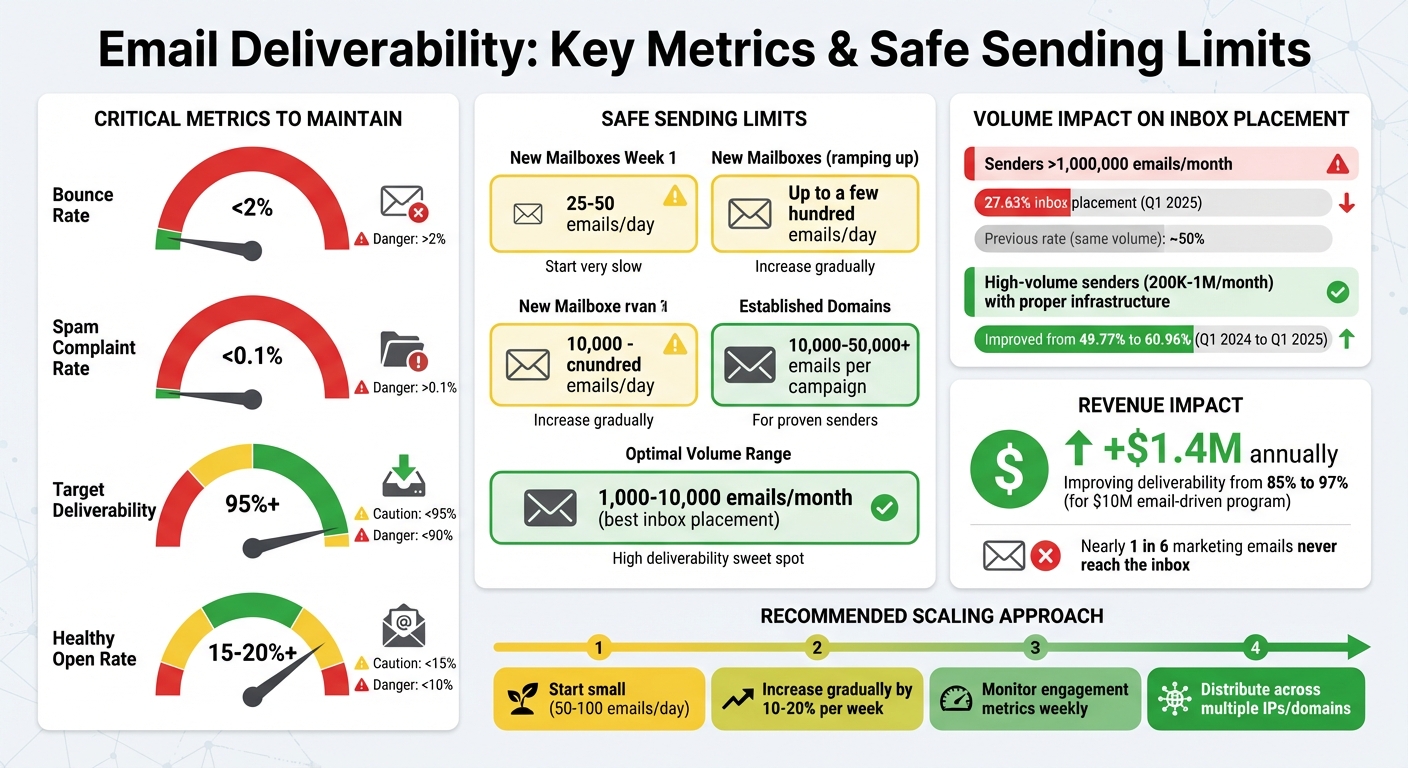
To minimize risks, stick to gradual volume increases. While there’s no universal "safe number", industry best practices offer helpful benchmarks. For new outreach mailboxes, start small - send 25–50 emails per day during the first week, then slowly ramp up to a few hundred. Established domains can handle higher volumes, often ranging from 10,000 to 50,000+ emails per campaign, as long as engagement stays strong.
Interestingly, sending more emails doesn’t always lead to better results. Data shows that senders in the 1,000–10,000 emails per month range often achieve inbox placement rates equal to or better than those sending much larger volumes. In fact, for senders delivering over 1,000,000 emails per month, average inbox placement rates dropped from about 50% to just 27.63% in Q1 2025. Without proper infrastructure - like dedicated IPs, pre-warmed domains, or multi-IP setups (such as those provided by Infraforge) - pushing volume too quickly can damage your reputation and even lead to blocklisting.
High email volume becomes even more problematic when recipients aren’t engaging with your messages. Modern spam filters from Gmail, Yahoo, and Microsoft heavily factor in engagement metrics like opens, clicks, replies, and spam complaints. Sending large batches to unresponsive audiences signals to mailbox providers that your emails lack value, increasing the likelihood they’ll land in spam or promotions folders.
The stats back this up: low engagement is now the top deliverability issue for 16.4% of businesses. At scale, even small engagement problems can snowball into major reputation issues. Industry guidelines recommend keeping spam complaint rates below 0.1% and bounce rates under 2%, but these thresholds get harder to maintain as volume grows and engagement drops. Once mailbox providers recognize a pattern of low engagement combined with high volume, they’ll downgrade future emails from your domain or IP - even if you later improve your targeting or reduce your sending volume.
Grasping these challenges around volume and engagement is essential for improving cold email performance in future campaigns.
When it comes to email deliverability, patience pays off. Instead of sending thousands of emails right away, start small - say, 50 to 100 emails a day - and gradually increase your sending volume. This process, known as IP warming, helps build trust with mailbox providers and establishes your sender reputation. While some setups allow for faster scaling, the timeline depends on your infrastructure and how well recipients engage with your emails.
Taking this slow and steady approach reduces the chances of being flagged as spam. Pairing gradual increases with positive engagement - like high open rates and low spam complaints - proves your legitimacy to email providers. Many tools now offer automated warmup features, making this process easier and less time-intensive.
Engagement is the backbone of successful email campaigns. Use your performance metrics - such as open rates, bounce rates, and spam complaints - to guide your sending volume. If your open rates drop below 15–20%, it’s time to pause and reassess your email list and content strategy. Healthy deliverability rates typically range between 90% and 98%, while anything below 80% signals a problem that needs immediate attention.
By closely monitoring these metrics, you can dynamically adjust your email volume to maintain strong deliverability and avoid overwhelming your recipients.
Relying on a single domain or IP for your email campaigns can be risky. If your sender reputation takes a hit - whether from a sudden spike in volume or a drop in engagement - your entire operation could be affected. To minimize this risk, distribute your emails across multiple domains and IP addresses. Each domain and IP should have its own warmup process to build independent reputations.
This diversification strategy not only protects your campaigns but also makes scaling more sustainable. If one domain encounters deliverability issues, others can continue functioning without interruption. Platforms like Infraforge simplify this process with features like multi-IP provisioning, dedicated IPs for each mailbox, and pre-warmed domains ready to go. At just $3–$4 per mailbox per month, these tools provide an affordable solution for scaling cold email outreach effectively.
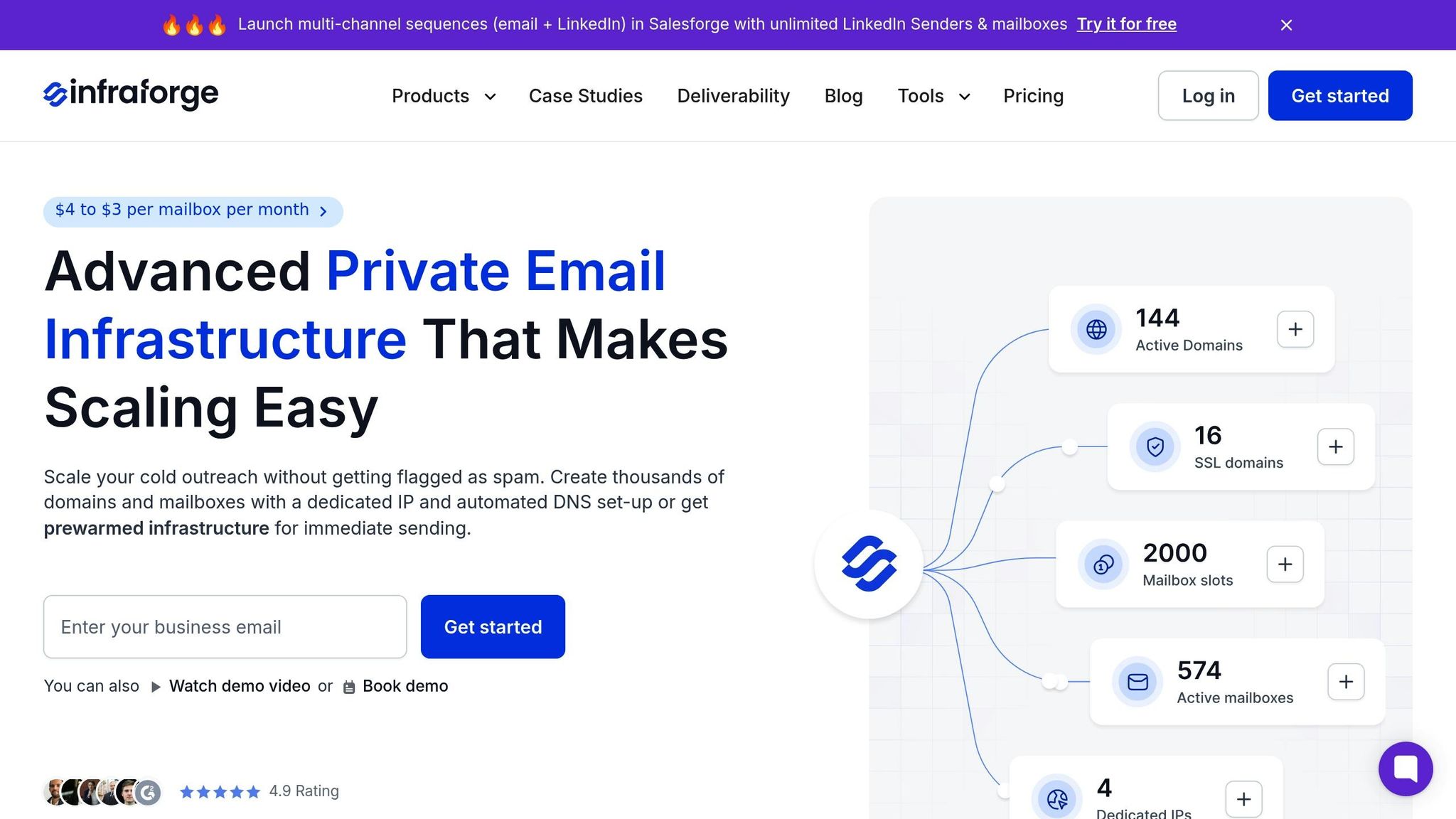
Infraforge addresses email volume challenges directly by providing tailored infrastructure solutions designed to safeguard sender reputation.
Infraforge assigns each mailbox a dedicated IP, ensuring that sender reputation remains independent. For high-volume campaigns, it employs multi-IP provisioning, distributing emails across multiple IPs and domains. This is particularly important for cold outreach, where bounce and complaint rates can be higher. Sharing IPs with other senders in such cases could hurt your deliverability fast.
For instance, instead of sending 50,000 emails from a single IP, you can split the load across 5–10 IPs, with each handling only a few thousand emails daily. This method helps keep your sending volumes within ISP limits.
This setup supports steady scaling. Infraforge offers additional IPs for $99 per month, while mailbox slots cost around $3–$4 each. This makes it a cost-effective way to build a reliable infrastructure that protects your campaigns as they grow.
And it doesn’t stop at IP management - Infraforge also simplifies domain authentication.
Infraforge provides pre-warmed domains and automates DNS configuration, including SPF, DKIM, and DMARC settings. This ensures new domains are fully authenticated from the start. As a result, your sales team can hit effective daily email volumes immediately, skipping the weeks-long ramp-up process.
In addition to handling IPs and domains, Infraforge keeps a close watch on your deliverability metrics.
Infraforge continuously monitors key metrics like inbox placement, spam rates, bounces, and complaints. It sends alerts the moment performance dips, allowing you to scale email volumes selectively. For example, you can increase email volume by 10–20% per week in areas where your reputation remains strong, avoiding blanket volume increases that could harm deliverability.
Infraforge also integrates seamlessly with tools like Salesforge for multi-channel sequences, Warmforge for optimizing ongoing deliverability, and Primeforge for managing Google Workspace and Microsoft 365 mailboxes. Together, these tools create a reliable system for high-volume cold outreach, ensuring your emails consistently land in inboxes.
Sending emails too quickly or in high volumes can set off spam filters, hurting your email deliverability. In fact, studies reveal that nearly 1 in 6 marketing emails never make it to the inbox. For businesses that depend on email for revenue, improving deliverability from 85% to 97% can mean an additional $1.4 million in annual revenue for a $10 million program.
To succeed, you need to align your email sending volume with your infrastructure’s capacity, engagement levels, and the expectations of Internet Service Providers (ISPs). Gradual increases in email volume help build trust with inbox providers, while sudden spikes can lead to spam flags. Aim to keep bounce rates under 2%, spam complaints below 0.1%, and overall deliverability above 95%. Regularly monitoring these metrics - ideally on a weekly basis - can help you identify and address potential problems before they escalate.
Scaling cold email campaigns without sacrificing deliverability requires a strong infrastructure. Dedicated IPs, multiple domains, proper DNS authentication (SPF, DKIM, DMARC), and pre-warmed mailboxes are critical components for sustainable email outreach. Platforms like Infraforge simplify this process, offering tools like automated DNS setup, multi-IP provisioning to spread the sending load, and real-time monitoring to catch issues early.
For instance, high-volume email senders (200,000–1,000,000+ emails per month) who used proper infrastructure saw their inbox delivery rates improve from 49.77% to 60.96% between Q1 2024 and Q1 2025. And with Infraforge’s solutions costing just $3–$4 per mailbox, it’s a cost-effective alternative to platforms like Google Workspace or MS365, while being specifically designed for cold outreach programs.
Ultimately, poor infrastructure and bad practices - not email volume - are what harm deliverability. With the right setup, you can confidently scale your outreach efforts, ensuring your emails land in inboxes rather than spam folders.
To safely ramp up your email volume, take a gradual approach. Start by sending emails to a smaller, targeted group and keep a close eye on key metrics like open rates and bounce rates. Consistent engagement is crucial here. Over time, warm up your domains and IPs to establish a strong sender reputation. Sudden spikes in email volume can raise red flags with spam filters, so scaling slowly is your best bet.
Tools like Infraforge can make this process much easier. They automate domain warm-up, handle dedicated IP management, and fine-tune your email setup. This ensures you can scale your email campaigns while keeping deliverability rates high and avoiding common pitfalls.
Recipient engagement is a key factor in determining whether your emails make it to the inbox or get lost in the spam folder. When people interact with your emails - by opening them, clicking on links, or replying - it signals to email providers that your content is relevant and worth delivering. These positive interactions strengthen your sender reputation, boosting the chances of your messages landing where they belong: in the inbox.
To help with this, Infraforge provides advanced email infrastructure designed to track engagement and optimize your domain and mailbox performance. By focusing on engagement, you can enhance deliverability and ensure your emails consistently reach the right audience.
Having the right email infrastructure is crucial for running large-scale campaigns successfully. It directly affects whether your emails reach inboxes, how easily your system can handle growth, and the reputation of your sender profile. Features such as dedicated IPs, automated DNS setup, and pre-warmed domains play a key role in ensuring your messages avoid the dreaded spam folder.
A solid infrastructure also helps manage high-volume outreach by reducing risks like spam filters or IP blacklisting. Tools that offer sender rotation and multi-IP provisioning can further enhance performance, ensuring your campaigns stay on track and maintain strong engagement rates.