
When sending emails from a new setup, your deliverability depends on two factors: IP reputation and domain reputation. These are separate scores ISPs like Gmail and Outlook use to decide if your emails land in inboxes or spam folders. Here's the key difference:
Modern ISPs, especially Gmail, prioritize domain reputation over IP reputation because it reflects your brand’s behavior more reliably. IP reputation can recover in 2–4 weeks, while domain reputation takes 6–12 weeks to rebuild. Both need careful management during warming to ensure successful email campaigns.
| Factor | IP Reputation | Domain Reputation |
|---|---|---|
| Portability | Tied to specific IP | Follows your domain |
| Recovery Time | 2–4 weeks | 6–12 weeks |
| ISP Priority | Medium | High |
| Warm-up Duration | 2–4 weeks | 4–8 weeks or longer |
To succeed, focus on engagement metrics (opens, clicks, replies) and maintain consistent sending patterns. Tools like Infraforge simplify warming by automating setups like SPF, DKIM, and DMARC, while providing pre-warmed domains and dedicated IPs.
Think of IP reputation as a trust score assigned to your IP address by Internet Service Providers (ISPs). It works a bit like a credit score, but instead of tracking your financial habits, it evaluates how your IP handles email. ISPs like Gmail and Hotmail keep a close eye on every email sent from your IP, looking at factors like how recipients interact with your messages.
Key elements ISPs monitor include spam complaints, bounce rates from invalid addresses, engagement metrics like opens and clicks, and your overall sending patterns. If you suddenly send a massive volume of emails or your schedule becomes erratic, it can set off alarms.
When you start with a new IP address, it has no history. Because spammers often hop between fresh IPs, ISPs treat new ones with extra caution. This means even if your domain is well-established and trusted, a brand-new dedicated IP will still need to earn its reputation independently.
Now, let’s dive into how the choice between dedicated and shared IPs influences the warming process.
Your IP warming strategy depends on whether you’re using a dedicated IP or sharing one with others.
Dedicated IPs are exclusively yours, which gives you full control. However, they require warming up from scratch. If you send thousands of emails right away from a new dedicated IP, ISPs might flag your activity, resulting in emails being blocked or sent to spam.
Shared IPs, on the other hand, are used by multiple senders through the same email service provider (ESP). These IPs generally don’t need warming since the ESP has already built their reputation. The downside? If other senders on the shared IP engage in poor practices, it can negatively affect your email deliverability.
Here’s a quick comparison of the two:
| Aspect | Dedicated IPs | Shared IPs |
|---|---|---|
| Warm-up Required | Yes, typically 4–8+ weeks | No, already operational |
| Starting Reputation | Blank slate (zero reputation) | Pre-established reputation |
| Control | Full control over sending behavior | Limited control (shared) |
| Deliverability Risk | Higher initially, improves with warming | Lower, but affected by others |
For cold outreach, dedicated IPs are often the better choice, even with the warming process. Services like Infraforge specialize in this area, offering dedicated IPs for each mailbox alongside automated warming and monitoring tools. They handle technical setups like DMARC, SPF, and DKIM automatically and use sender rotation to keep sending patterns consistent. At $651 per month for 200 mailboxes, this approach is more cost-effective than using platforms like Google Workspace or MS365 for cold email campaigns.
Even with a solid understanding of IP reputation, there are hurdles that can disrupt your efforts. Here are some of the most common challenges:
Building on the concept of IP reputation, domain reputation offers a more lasting measure of trustworthiness for email senders.
Domain reputation is essentially a trust score assigned to your sending domain - the part of your email address that comes after the "@" symbol. Unlike IP reputation, which evaluates the behavior of a specific server, domain reputation is tied directly to your business identity and remains consistent no matter where your emails are sent.
Internet Service Providers (ISPs) like Gmail and Yahoo assess your domain based on several factors: engagement metrics such as opens, clicks, and replies; spam complaint rates; bounce rates; and whether your domain is properly authenticated with records like DKIM, SPF, and DMARC. Modern email filters prioritize domain reputation over IP reputation, with Gmail leading this shift. Why? Because domains are harder to manipulate and represent established businesses, making them a more reliable measure of legitimacy. Your domain essentially acts as a digital signature for your business and stays consistent across email platforms.
This consistency not only helps protect the reputation you've built but also plays a key role in shaping your long-term email strategy.
One of the most valuable aspects of domain reputation is its portability - it follows you no matter where you go. Whether you switch email service providers, change IP addresses, or update your infrastructure, your domain reputation remains intact as long as your authentication records are properly configured. This is in stark contrast to IP reputation, which resets when you acquire new dedicated IPs or move to a new platform, requiring you to rebuild from scratch.
For email marketers, this means the months of effort spent building a strong domain reputation can continue to benefit you, even as you make changes to your infrastructure. However, this portability comes with a catch: any damage to your domain reputation - like spam complaints, low engagement, or authentication issues - will also follow you. While IP reputation can typically be restored in 2–4 weeks with good sending practices, recovering a damaged domain reputation can take significantly longer, often 6–12 weeks.
Even though domain reputation is stable, building and maintaining it comes with its own set of challenges.
Maintaining a strong domain reputation requires constant vigilance. Even a single misstep can have lasting consequences for your inbox placement.
To simplify the process, services like Infraforge offer pre-warmed domains and automated DNS setups, helping you navigate these challenges and streamline your email warming efforts.
Both IP and domain reputation play a role in email deliverability, but they operate differently. While IP reputation resets when you switch to a new IP, domain reputation is tied to your brand and follows it wherever it goes.
The main distinction lies in portability. IP reputation is linked to a specific server, meaning it resets if you change the IP address. On the other hand, domain reputation sticks with your brand, regardless of IP changes.
Recovery times also differ: IP reputation usually takes 2–4 weeks to recover, while domain reputation can take anywhere from 6–12 weeks. Additionally, IP reputation is specific to individual servers, while domain reputation reflects the overall behavior of your business. It's worth noting that multiple IPs can send emails from the same domain, but each IP maintains its own reputation.
Modern ISPs are increasingly prioritizing domain reputation. For example, Gmail assigns it a "High" priority, whereas IP reputation is considered "Medium." This shift makes sense - domains are directly tied to your brand and are easier to monitor over time.
Here's a quick overview of the differences between IP and domain reputation:
| Factor | IP Reputation | Domain Reputation |
|---|---|---|
| Portability | Tied to a specific IP address | Follows across different IPs and platforms |
| Recovery Time | 2–4 weeks | 6–12 weeks |
| Primary Factors | Sending behavior from that IP | Domain authority plus overall sending behavior |
| ISP Priority | Medium (e.g., Gmail) | High (increasingly prioritized) |
| Control Level | High with dedicated IP; low with shared IP | High (you own your domain) |
| Shared Risk | Yes (shared IPs affected by all senders) | No (unique to your domain) |
| Longevity | Changes when switching providers or IPs | Permanent and follows your brand everywhere |
| Warm-up Duration | 2–4 weeks | 4–8 weeks or more |
| Use Cases | Adding new IPs; moving to dedicated IPs | Migrating platforms; establishing new identity |
When warming up both IPs and domains, it’s best to work on them simultaneously. A strong domain reputation can speed up the IP warm-up process, but if you're using a new domain, be prepared for a longer warm-up period.
Since ISPs now weigh domain reputation more heavily, focus on building engagement with your domain. This means sending emails to active, opted-in recipients and sticking to a steady sending schedule - ideally weekly or more. These strategies help lay the groundwork for the practical warming techniques covered in the next section.
Gmail and Outlook have shifted their focus to domain reputation over IP reputation when filtering emails. Why? Because domains offer a more reliable way to gauge a sender's legitimacy. Unlike IPs, which can change frequently or be shared among multiple users, domains are tied to a business's identity, making them harder to manipulate.
Email systems today are more advanced, and domains have become a stronger indicator of credibility. Domains represent your brand, while IP addresses are just part of the technical setup that can change at any time.
SendGrid, a major provider of dedicated IPs, has noted a clear industry shift toward domain reputation in filtering decisions. Gmail, for example, now gives domain reputation a "High" priority while rating IP reputation as "Medium".
Why domains? Because they’re tougher for spammers to exploit. Spammers often rotate IPs to avoid detection, but domains are tied to a business and can’t be swapped out as easily. This allows ISPs to build a long-term record of a sender’s behavior.
Domains also stay consistent even when businesses change platforms, making it easier for ISPs to track sending patterns over time. Think of domain reputation like a credit score for your email domain. If users engage positively - opening, clicking, and marking emails as important - you’ll build a strong reputation and improve your chances of landing in the inbox.
Authentication protocols like SPF, DKIM, and DMARC are also key to domain reputation. ISPs use these to verify that senders have configured their emails securely, signaling that they’re trustworthy.
The rise of shared IP pools has further reduced the effectiveness of IP reputation as a filtering tool. When numerous senders share the same IP, ISPs can’t easily tie specific behaviors to individual businesses. Domain reputation solves this by serving as a unique identifier for each sender, no matter what infrastructure they use.
With domain reputation now taking center stage, warming strategies need a fresh approach. It’s no longer enough to slowly ramp up your sending volume from a new IP. You also need to focus on building engagement with your domain from day one.
Start by sending emails to engaged, opted-in users during the warm-up phase. Positive engagement metrics - like opens, clicks, and replies - help establish a strong domain reputation more quickly. The quality of interactions matters more than the sheer number of emails sent.
Consistency is also critical. ISPs monitor how regularly you send emails, and sticking to a predictable schedule (ideally weekly or more) builds trust faster than erratic sending patterns. This consistency shouldn’t stop after the initial warm-up; ISPs continue to evaluate your domain’s behavior over time.
Even if you’re using a dedicated IP, domain reputation now plays a bigger role in deliverability decisions. This levels the playing field for senders on shared IPs, as long as they maintain high engagement and follow best practices for their domains.
For businesses switching platforms, warming your domain is especially important. Your domain reputation follows you, but ISPs will still evaluate how it performs with the new infrastructure. Gmail, for instance, looks at both your domain and the new IP reputation, so proper warm-up is essential even if your domain is well-established.
Services like Infraforge simplify this process. With features like automated DNS setup, pre-warmed domains, and built-in monitoring, they handle the technical side of things while ensuring your domain’s reputation remains strong. Their tools, including automatic configuration of DMARC, SPF, and DKIM records, make it easier to scale without compromising deliverability.
The takeaway? Focus more on building domain reputation than managing IP reputation. While dedicated IPs still have their benefits, they’re no longer the main factor in email deliverability. Your domain’s engagement history, authentication setup, and consistent sending patterns carry more weight.
Keep a close eye on engagement metrics during and after warming. Positive signals like open rates, clicks, and replies boost your domain reputation, while negatives - such as spam complaints, hard bounces, and spam trap hits - can hurt it.
And remember, recovering from a damaged domain reputation takes time - 6 to 12 weeks compared to just 2 to 4 weeks for an IP. That makes it all the more important to get your domain warming strategy right from the start.
Building a solid reputation for your IPs and domains requires a thoughtful strategy. The focus should be on engaging recipients, avoiding common errors, and using reliable infrastructure.
When warming up IPs and domains, recipient engagement is far more important than the sheer volume of emails sent. Start by targeting your most engaged users - those who have opted in and consistently open, click, or reply to your emails. These subscribers are your best allies in building a positive reputation with Internet Service Providers (ISPs).
Here are the key metrics to keep an eye on during this process:
Consistency is crucial. A steady email volume, predictable frequency, and strong engagement metrics help establish a positive sending reputation faster. During the warming period, aim to send emails at least once a week. Irregular sending patterns can delay progress.
Start small by emailing your most engaged subscribers, and gradually increase your volume in predictable increments. Typically, warming up takes 4–8 weeks, with the longer timeframe providing a more stable foundation. While a shorter 4-week period might work for some, the extra time often results in better long-term results.
Don’t stress over a few unsubscribes during this phase. It’s normal to lose a handful of subscribers, and it won’t drastically affect deliverability as long as your overall engagement remains strong. Focus on maintaining high open, click, and reply rates instead of worrying about every single unsubscribe.
Certain errors during the warm-up phase can quickly damage your sender reputation. Here’s what to steer clear of:
To avoid these pitfalls, tools like Infraforge provide automated solutions that simplify the entire process.
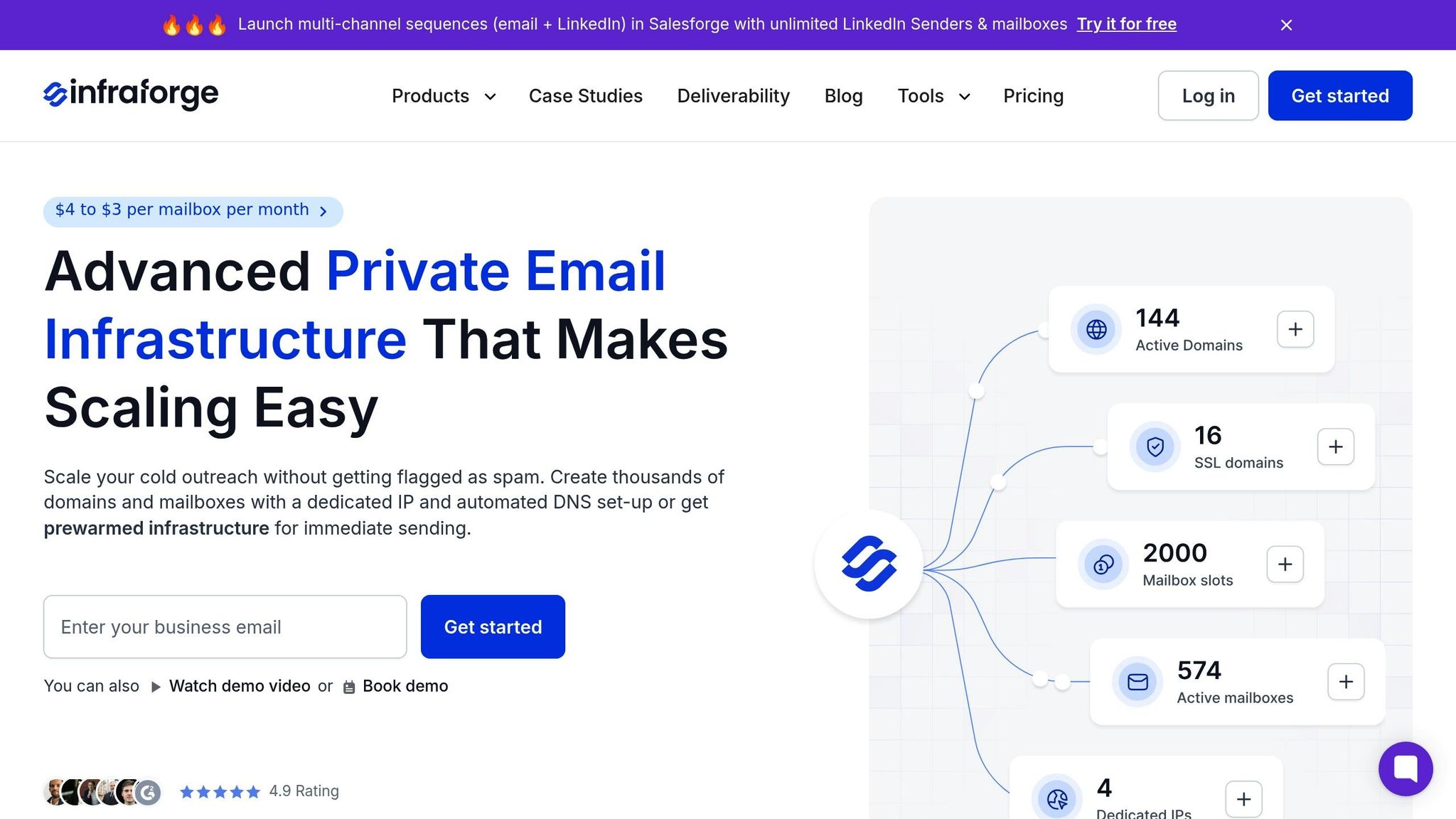
Managing the technical aspects of IP and domain warming can feel overwhelming, especially when scaling cold outreach campaigns. Infraforge’s advanced tools take the hassle out of the process by automating key steps and ensuring best practices are followed.
With Infraforge, you can navigate the complexities of IP and domain warming with ease, ensuring a smoother path to building a strong sender reputation.
IP reputation and domain reputation serve as two crucial filters that Internet Service Providers (ISPs) evaluate when deciding the fate of your emails. While IP reputation lays the groundwork by establishing trust during the SMTP connection, domain reputation determines whether your message reaches the inbox or gets flagged as spam.
In recent years, the balance between these two has shifted significantly. Providers like Gmail now place a greater emphasis on domain reputation because it directly ties to your brand identity and offers a more reliable measure of sender authenticity. Unlike IP addresses - which can be shared, rotated, or exploited by spammers - domains are more stable and harder to manipulate. This change works in favor of legitimate senders, as domain reputation is portable, following you through platform migrations and IP changes. Still, it’s essential to nurture both reputations, as they work hand in hand.
Building and maintaining these reputations is especially critical during the warming process, which typically takes 4–8 weeks. Even if your domain reputation is impeccable, a poor IP reputation can negatively impact deliverability. And while IP reputation can recover relatively quickly, repairing domain reputation takes much longer and requires more effort.
To simplify this process, Infraforge offers a streamlined solution. The platform provides dedicated IPs for each mailbox and automates DNS setup, including DMARC, SPF, and DKIM configurations. By combining pre-warmed domains and mailboxes, automated warm-up tracking, and smart sending limits, Infraforge ensures that both your IP and domain reputations are built and maintained together, saving you from technical headaches.
As outlined, a balanced strategy is the key to long-term email success. Treat IP and domain reputation as equal priorities, monitor engagement metrics closely, and focus on building a strong sender reputation. By doing so, you’ll safeguard your campaigns and maximize your chances of landing in the inbox. Start implementing these practices today to ensure your email deliverability stays on track.
Both domain reputation and IP reputation are key factors in email deliverability, but they affect it in distinct ways. Domain reputation relates to the sender's domain and reflects long-term sending habits, including metrics like email engagement (opens, clicks, replies) and spam complaints. In contrast, IP reputation is tied to the specific IP address used for sending emails and depends on the volume and quality of emails sent from that IP.
To run a successful email warming campaign, you need to maintain strong reputations for both your domain and IP. If your domain reputation is poor, it can negatively impact deliverability, even if your IP reputation is solid - and the reverse is also true. Tools like Infraforge can make this process easier by offering pre-warmed domains, dedicated IPs, and automated DNS configurations, helping you achieve optimal deliverability right from the start. Prioritizing both reputations builds trust with email providers and improves your outreach performance.
To keep your domain reputation solid during email warming, consistency and gradual progress are key. Begin by sending a small number of emails to recipients who are likely to engage, then slowly increase the volume over time. Make sure your content is relevant, steers clear of spam-like language, and follows established email best practices.
It's also crucial to configure your DNS records - specifically SPF, DKIM, and DMARC. These records authenticate your emails and help prevent them from being marked as spam. Use tools like Google Postmaster Tools or other reputation monitoring platforms to keep an eye on your domain's standing and address any issues quickly.
For a smoother process, platforms like Infraforge offer helpful features such as pre-warmed domains, automated DNS configuration, and advanced tools for improving deliverability. These resources can help you maintain a strong domain reputation while expanding your email outreach.
Engagement metrics like open rates, click-through rates, and reply rates are key to building a solid reputation for your IPs and domains during the warming process. Email providers rely on these metrics to determine if your emails resonate with recipients and provide value.
When you focus on boosting engagement, you’re also building trust with email providers. This trust improves your deliverability and lowers the risk of your emails ending up in spam folders. By emphasizing meaningful interactions, you set the stage for lasting success in your email outreach efforts.