If you’re using AI agents in your workflow, you already know they can’t function without a reliable email infrastructure.
AgentMail is designed to help AI agents use email without relying on traditional inbox tools or complex configurations.
But once you scale, deliverability starts to drop. Missed inboxes, weak authentication, or limited control can slow everything down. That’s why we tested tools built for the same purpose but optimized for scale.
In this guide, we’ve listed the 5 best AgentMail alternatives that support AI agents and offer stronger deliverability, smoother scaling, and better infrastructure flexibility.
TL;DR: AgentMail Alternatives Quick Look
Infraforge gives you a stable email foundation, making it easier for AI agents to send at scale without deliverability issues.
A1 Inbx fits workflows where AI agents need to read, understand, and reply to emails programmatically with full conversation context.
Mailforge helps teams get outbound email running quickly, so AI agents can start sending without dealing with technical setup.
Smartlead supports fully automated outreach, allowing AI agents to handle warm-ups, follow-ups, and reply management in one place.
Mailpool is useful when AI agents need to create and manage large numbers of inboxes and domains across campaigns or clients.
AgentMail changed how AI agents handle email; it gave them real inboxes, easy APIs, and fast setup. But when you start scaling your AI workflows, a few real issues show up that make developers look for better options.
Here’s what most teams run into:
1. No isolation between workflows or clients
AgentMail supports many inboxes, but they all share the same delivery environment. When one workflow sends aggressively or gets flagged, it can affect others, which becomes risky at scale.
2. Email access is simple, behavior control is not
AgentMail gives agents access to email, but it doesn’t control how emails are prioritized, routed, or handled differently across use cases. That logic has to be built separately.
3. Built for email I/O, not full automation flows
It integrates with AI frameworks and supports webhooks, but AgentMail mainly handles sending and receiving. Triggering actions, workflows, or decisions still requires additional systems.
4. Basic reading is built in, deeper understanding is external
AgentMail can read email text and pull out attachments, but understanding long conversations, documents, or complex context still needs extra logic outside the platform.
5. No visibility into inbox placement or spam signals
You don’t get insight into inboxing, spam filtering, or bounce patterns. As volume grows, it’s harder to know why performance changes.
6. Limited control over sending infrastructure
There’s no option for dedicated IPs or per-domain reputation control, which becomes important when email is a core part of larger AI-driven workflows.
How We Picked the Best AgentMail Alternatives
When we tested each platform, we focused on what really matters when your AI agents depend on email for communication and automation.
Reliable inbox performance for hundreds of AI agents running at once.
Stable deliverability and reputation control to keep agent emails out of spam.
Instant automation and triggers so agents can react in real time to incoming messages.
Scaling to thousands of agent inboxes and custom domains.
Replaces AgentMail when deliverability and long-term sending stability matter more than agent-level inbox APIs
A1 Inbx
Agent-level inboxes managed via API
Basic authentication with no advanced reputation control
Limited to moderate volume
Strong context-aware reading and replying
Closest functional replacement for AgentMail’s inbox and API model, but not built for outbound scale
Mailforge
Bulk inbox creation with flexible ownership
Shared IP pools optimized for cold email
Scales outbound quickly
No reply understanding or automation
Replaces AgentMail when the goal is fast outbound sending, not inbox intelligence
Smartlead
Inbox management tied directly to campaigns
Warm-ups, rotation, and sender health checks
Scales through automation, not infrastructure control
Full campaign logic with automated follow-ups
Goes beyond AgentMail by adding automation, but trades off infrastructure-level control
Mailpool
Large-scale inbox and domain provisioning
Automated setup with shared infrastructure
Designed for rapid, high-volume scaling
No message or reply intelligence
Replaces AgentMail when scale and speed matter more than agent-native inbox behavior
1. Infraforge
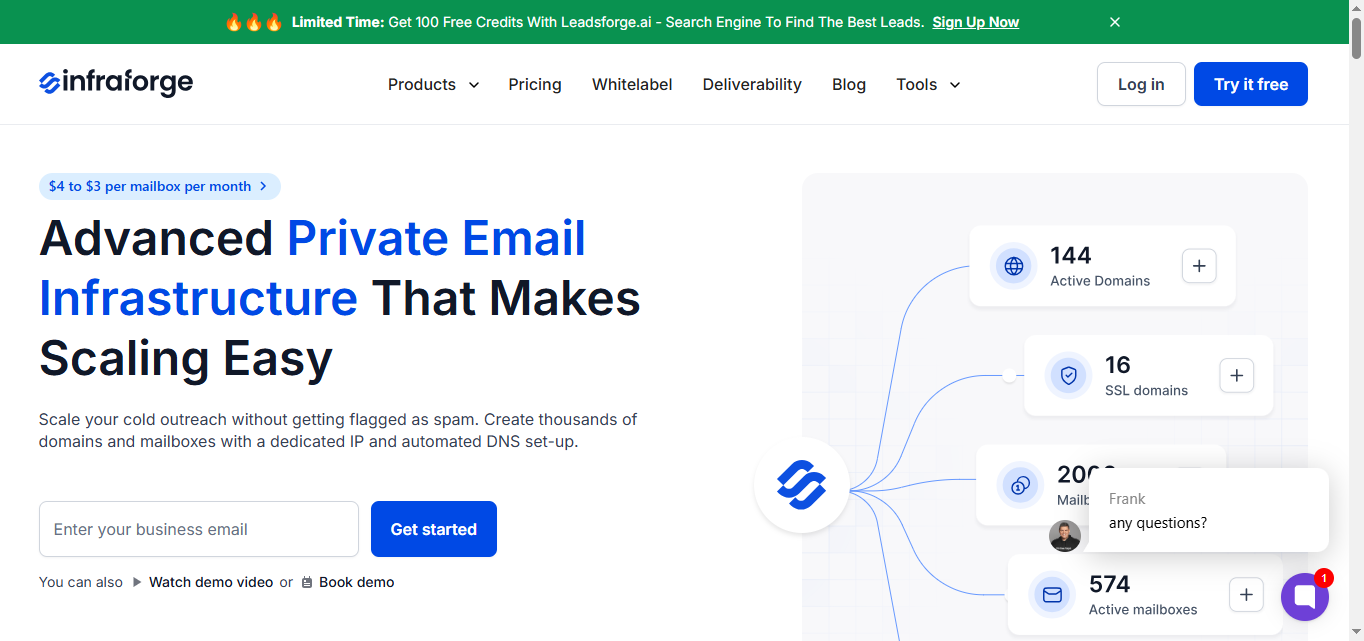
Infraforge is a private email infrastructure that helps you scale cold outreach with dedicated IPs, automated DNS setup, and pre-warmed mailboxes, all ready in just a few minutes.
This image shows the Infraforge- Best AgentMail alternative for safe and quick dedicated infrastructure
Infraforge gives the email agent its own safe, verified inbox with built-in authentication and reputation protection.
Setup and warm-up are handled for you in the background; your agents can simply connect through the API and focus on sending.
Key Features
Dedicated IPs and domains so each agent has its own sending reputation
Automatic setup for SPF, DKIM, and DMARC
Pre-warmed mailboxes that are safe to send from right away
Smart sending logic and rotation to help agents stay out of spam
API access for creating and managing agent inboxes easily
Multi-workspace support for organizing teams or clients
Works smoothly with Salesforge and other outreach tools
Deliverability Capabilities for AI Agents
Each AI agent gets its own domain and IP, so if one has a problem, it doesn’t affect the others.
Infraforge automatically sets up SPF, DKIM, and DMARC, so your emails go straight to the inbox instead of spam.
Mailboxes are warmed up slowly and safely, helping your agents build trust before sending at full volume.
Because emails are sent from verified, properly warmed inboxes, bounce rates stay low, and inbox placement stays consistent.
Pros
Let's AI agents start sending right away with ready-to-go pre-warmed mailboxes.
Let's AI agents send emails from different domains without interfering with each other. If one agent’s sending pattern causes an issue, it doesn’t affect the rest of the system.
Makes it easy to expand AI-driven email workflows as volume grows. When agents need more domains or inboxes, they can be added without stopping or reworking what’s already running.
Helps AI agents stay organized by allowing inboxes to be created, rotated, or separated as tasks or clients change.
Keeps AI-generated sending behavior steady and controlled, so automated activity doesn’t suddenly spike and trigger spam filters.
Cons
Focuses only on infrastructure; it doesn’t handle message logic or reply automation.
Needs to be used with an external sending tool to manage outreach campaigns.
It doesn’t help AI agents decide what to say or when to send emails. Message logic and follow-ups still need to come from another system.
2. AI Inbx
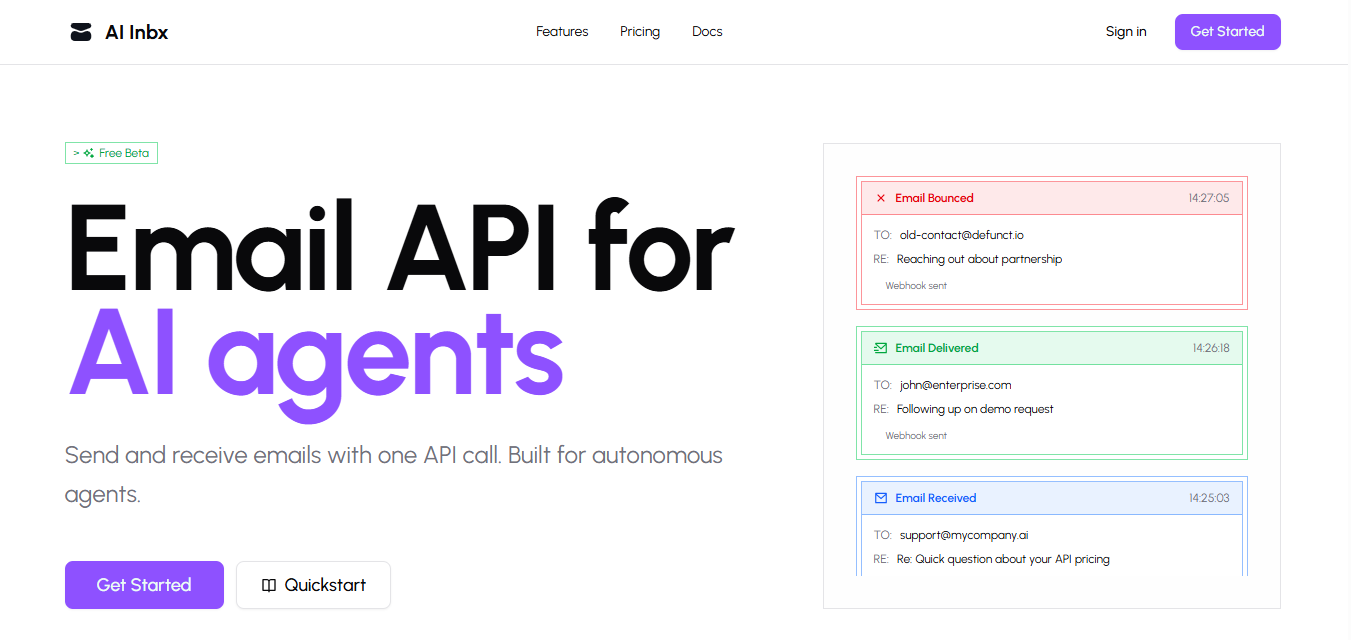
AI Inbx is an email API made just for AI agents. It lets your agents send, receive, and reply to emails with a single API call, no complex setup, no OAuth, and no manual processing.
This iamge shows the AI Inbx- Best AgentMail alternative with API for AI Agents
If you want customer replies, support, or lead follow-ups, AI Inbx gives them everything they need to read and respond naturally. It keeps full conversation history, cleans up messy email data, and makes sending as simple as one line of code.
Key Features
Smart threading keeps the full conversation together, so agents always understand context.
Clean, pre-parsed emails, your agent gets structured text, HTML, and attachments ready to use.
Easy attachment handling using download links, so no file size limits.
Real-time webhooks notify your agent the second an email arrives.
Unlimited inboxes with unique agent identities for easy scaling.
Instant domain setup, get a working domain the moment you sign up.
Deliverability Capabilities for AI Agents
Each AI agent sends from its own trusted inbox, keeping sender reputation clean and separate.
Emails are likely to go to inboxes, not spam, because authentication is already handled.
Pros
Helps AI agents read and reply with full conversation context, so emails don’t feel disconnected or out of place.
Delivers emails in a clean, structured format, letting agents focus on responding instead of parsing raw data.
Supports real-time workflows through instant webhooks, so agents can react as soon as messages arrive.
Uses simple API-key authentication, avoiding OAuth and human approval flows that break automation.
Handles attachments through links, which avoids file size limits and works well in automated systems.
Cons
Still in beta, so not all features are finalized yet.
Doesn’t include advanced infrastructure control like IP rotation or warm-up.
Not designed for high-volume cold outreach or aggressive outbound sending.
Better suited for reply-driven or support-style workflows than ongoing outbound campaigns.
Requires another system to manage outreach strategy, sequencing, and volume.
3. Mailforge
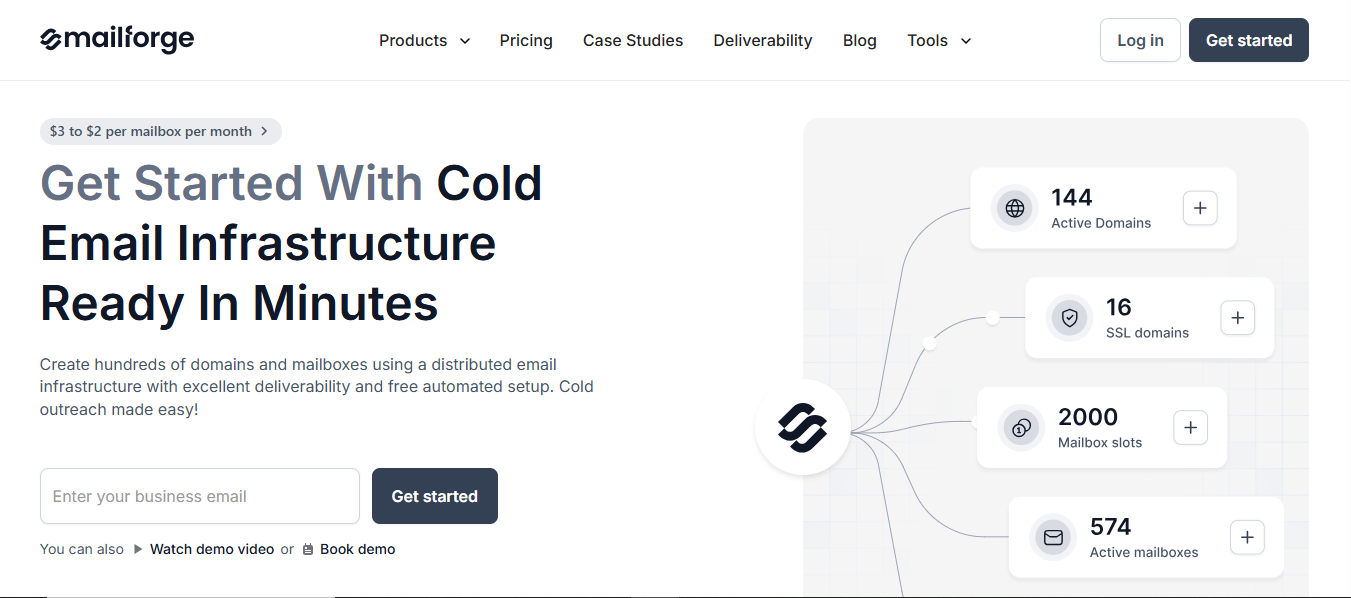
Mailforge is an email infrastructure tool made for cold outreach. It helps you set up domains and mailboxes in minutes, with everything, like SPF, DKIM, and DMARC, configured automatically.
This image shows the Mailforge- Best AgentMail alternative with Optimized IPs for coldoutreach
For AI agents, Mailforge works. Agent gets verified, ready-to-send mailboxes. It’s built for speed and scale, so your agents can focus on sending, not setup.
Key Features
Automatic setup for SPF, DKIM, and DMARC
Bulk DNS updates and domain transfers for scaling quickly
Multiple workspaces to organize teams
Works easily with Salesforge or any other outreach tool
All the authentication (SPF, DKIM, DMARC) done for you in the background, which means your emails pass every check and land right in the inbox.
As your agents keep sending, Mailforge protects their reputation, making sure performance doesn’t drop even at scale.
Pros
Helps AI-driven outreach systems scale fast by providing ready-to-use inboxes, so agents don’t get blocked waiting on setup.
Makes it easy for AI systems to rotate or replace inboxes when performance drops, without stopping active workflows.
Gives flexibility when agents need to send from many identities, without being tied strictly to Google or Microsoft accounts.
Cons
Doesn’t help AI agents understand replies or conversations. Any learning or response logic has to be managed elsewhere.
No built-in sequencing or follow-up logic, so agents still need another tool to manage outreach behavior.
4. Smartlead
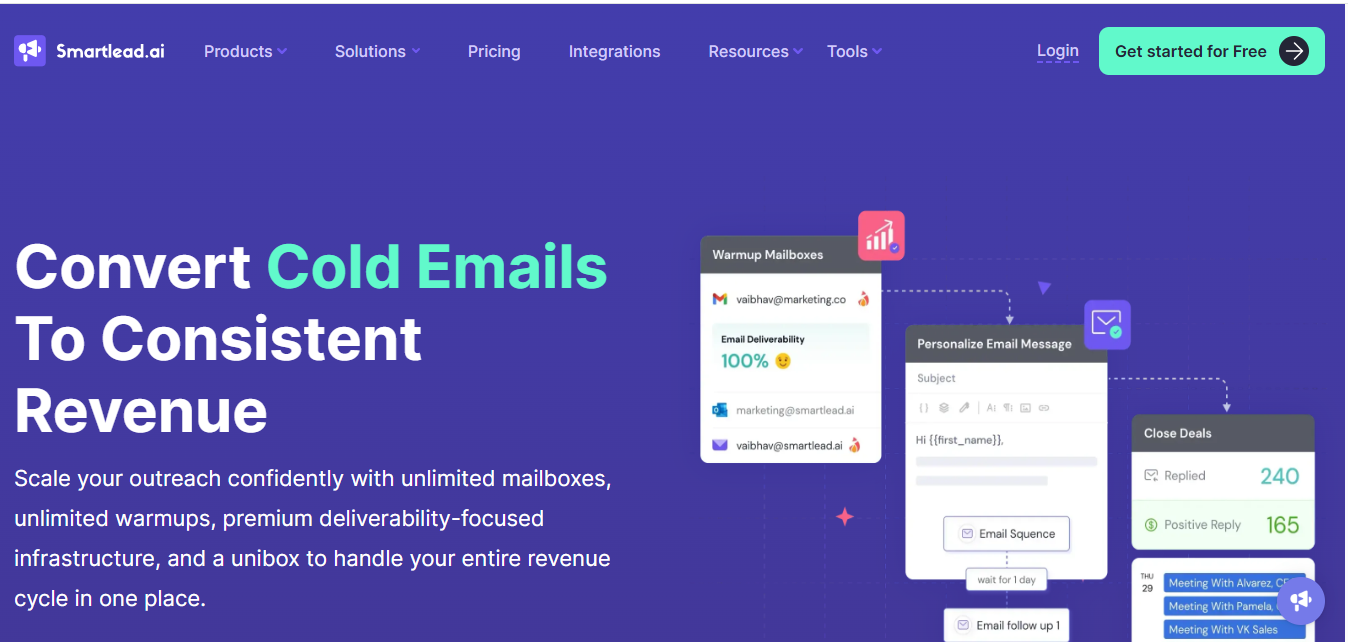
Smartlead is a cold email automation platform built for scaling outreach. It gives you unlimited mailboxes, unlimited warmups, and a Unibox to manage all your leads, replies, and deal flow from one dashboard.
This image shows the Smartlead- Best AgentMail alternative for Automation
Agents can create, send, and track emails automatically through APIs or webhooks. It handles rotation, reputation, and inbox management.
Key Features
Unlimited mailboxes and automatic rotation to spread out sending load
Built-in AI warmups that mimic real human conversations to build reputation
Real-time webhooks and API for agent-led campaigns and automation
Smart categorization that helps agents understand intent and respond faster
Unified inbox to keep all agent conversations in one place
SmartDelivery testing for inbox placement and spam score checks
Full white-label setup for branded agent operations
Deliverability Capabilities for AI Agents
Smartlead helps your AI agents build trust with inbox providers fast, it warms up emails using real, natural conversations that make sending look human.
The platform constantly watches how emails perform, so when open rates dip or messages start slipping into spam, it fixes delivery patterns automatically.
Even when hundreds of agents are sending at once, Smartlead balances volume across inboxes to keep the sender reputation healthy.
Before every campaign, Smartlead checks where your emails are landing, helping you make sure your agents hit inboxes.
Pros
Allows AI agents to run full outbound workflows on their own. From sending the first email to following up, most actions can happen automatically without manual checks.
Keeps all replies in one place, which makes it easier for AI systems to decide when to follow up, pause, or stop outreach.
Makes scaling easier for agents who send from many inboxes. Agents don’t need separate campaigns per inbox; Smartlead handles distribution in the background.
Works well when outreach needs to run continuously. Agents can launch, monitor, and adjust campaigns without stopping or resetting setups.
Cons
Focused mainly on outbound use cases, not on strong infrastructure.
Offers less control over the sending infrastructure itself. For cases where agents need full control over IPs or domains, this can be limiting.
5. Mailpool
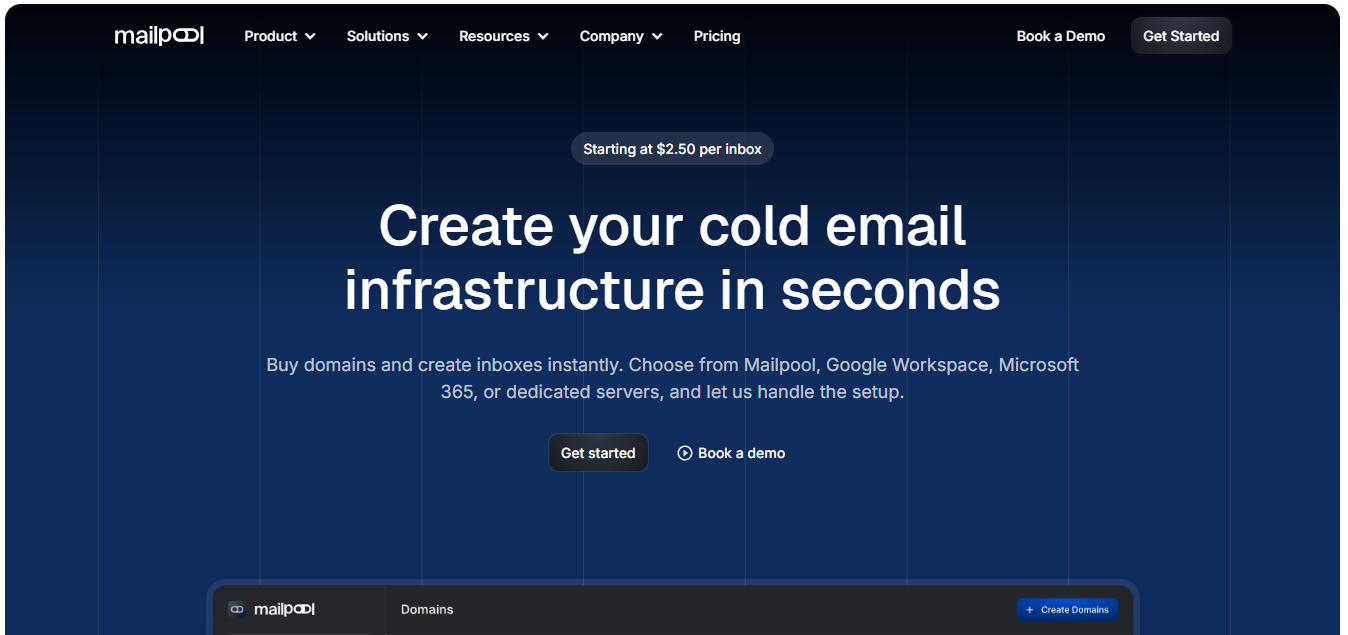
Mailpool is an inbox creation and email infrastructure platform that helps you build your cold outreach setup in seconds.
This image shows the Mailpool- Best AgentMail alternative for fast and fully automated inbox creation
Mailpool works like an instant infrastructure builder. Your agents can have verified inboxes created through an API, ready to send outreach right away.
It handles everything, from authentication (SPF, DKIM, DMARC) to deliverability optimization.
Key Features
Instantly create inboxes and domains with automated setup
AI Domain Generator for generating unique, professional sending domains
Automated SPF, DKIM, and DMARC setup for every new domain
Dedicated or shared IP options for different needs
Unlimited inbox creation and rotation
Real-time blacklist monitoring to protect sender reputation
Native integrations with Smartlead, Lemlist, Reply, and AI SDR tools like Luna
Deliverability Capabilities for AI Agents
It spreads out, sending across multiple inboxes to keep your reputation healthy.
If one domain gets flagged, Mailpool isolates it so the others keep performing normally.
Even when your agents send thousands of emails a day, they stay consistent, with fewer bounces, fewer spam flags, and stronger deliverability over time.
Pros
When agents need more sending capacity, new inboxes can be created without slowing campaigns down.
Works well when agents send on behalf of multiple clients or campaigns. Each inbox stays separate, which helps avoid reputation mix-ups as volume grows.
If one inbox underperforms, agents can switch without stopping outreach.
Fits nicely into existing outreach stacks, so AI agents can focus on sending logic instead of inbox management.
Cons
Shared network setup on lower tiers; dedicated servers cost extra
Doesn’t manage outreach sequences; needs to be paired with a sending tool
Doesn’t help AI agents understand replies or conversations. Any learning from responses needs to come from another tool.
Conclusion
If you liked the idea of AgentMail but want something more flexible or powerful, the tools we explored here cover every angle your AI agents need, from infrastructure to automation.
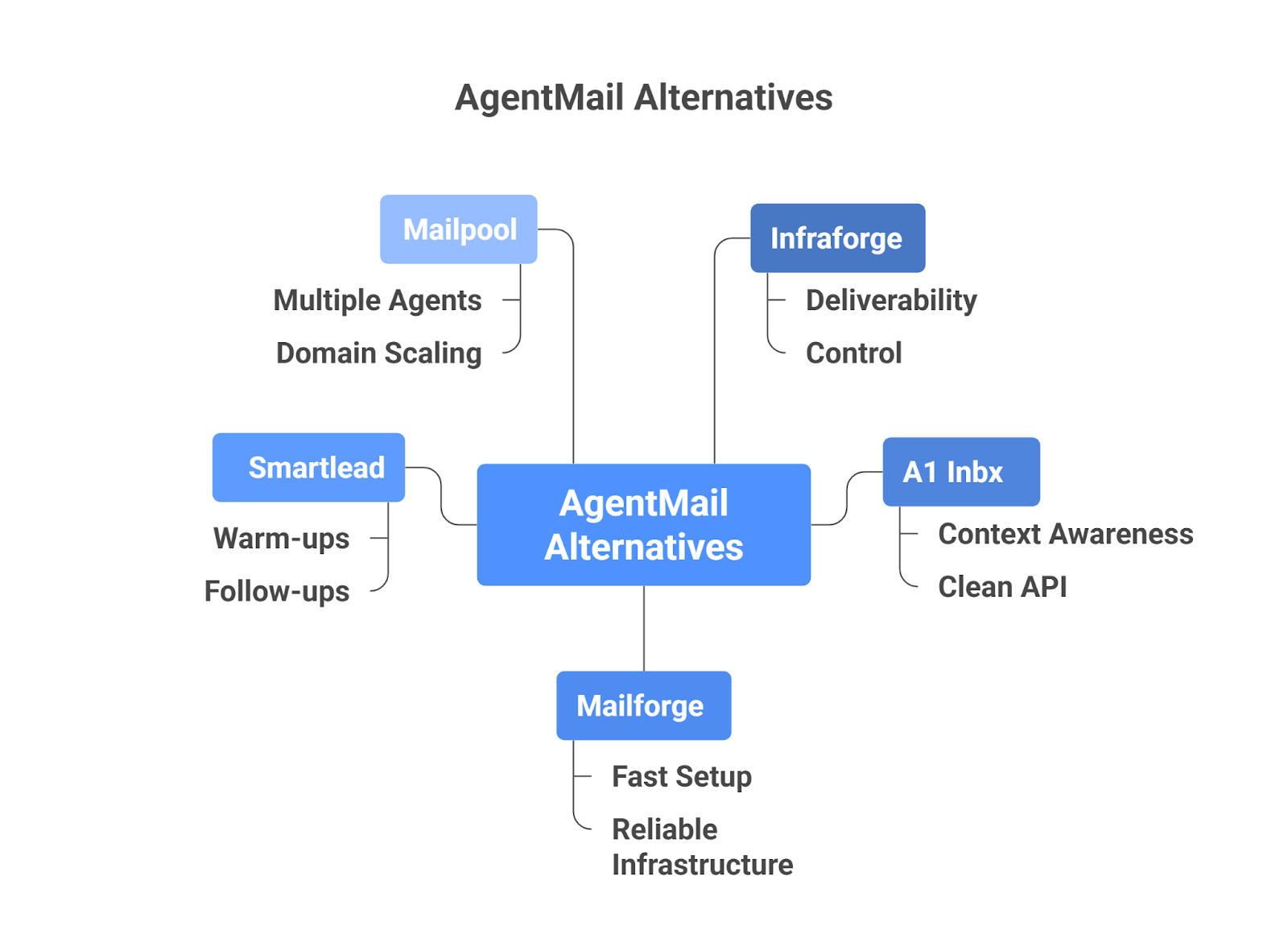
This image shows the AgentMail Alternatives
Infraforge gives you the strongest foundation if you care about deliverability and control.
A1 Inbx is great if your agents just need a clean, context-aware email API.
Mailforge works best when you want fast setup and reliable cold email infrastructure.
Smartlead helps if you want everything automated, from warm-ups to follow-ups.
Mailpool is ideal when you need to scale inboxes and domains for multiple agents or clients.
If your goal is to scale AI-driven outreach without inbox placement becoming the weak point, Infraforge gives you a strong foundation.
It handles the hard parts of email infrastructure, domain setup, warm-up, and reputation management, so your AI agents can focus on sending without running into spam issues as volume increases.
Get started with Infraforge and give your AI agents the stability they need to scale outreach safely.