AI SDRs can send thousands of personalized emails daily, but without private infrastructure, those emails may never reach inboxes. Shared systems, where multiple users share IPs and domains, often lead to poor deliverability due to reputation issues caused by other users' bad practices. This can result in flagged domains, wasted resources, and lost opportunities.
Key Takeaways:
Solution: Platforms like Infraforge provide private infrastructure tailored for AI SDRs, offering dedicated IPs, automated DNS setup, pre-warmed domains, and real-time monitoring. While it requires a higher upfront investment (e.g., $99/month per IP), it saves costs long-term by reducing inefficiencies and protecting sender reputation.
Without private infrastructure, AI SDRs risk operational breakdowns. For reliable scaling, dedicated setups are the way forward.
Shared infrastructure is like a group project where everyone shares the same grade - except here, it's about email deliverability. It involves multiple users sending emails through the same IP addresses and domain pools to cut costs. The catch? Your email-sending reputation is tied to everyone else on the system. For AI SDRs handling high-volume cold outreach, this shared setup can quickly become a liability.
In a shared setup, one user's bad practices can drag everyone else down. This is often called the "noisy neighbor" problem. If another user on the same IP address starts spamming - whether it's by using low-quality email lists or triggering spam complaints - it damages the IP's reputation for everyone involved. Major email providers like Gmail, Outlook, and Yahoo then scrutinize all emails from that IP, making it harder for legitimate messages to land in inboxes.
Even if your AI SDR sends highly personalized and well-thought-out emails, the poor behavior of others on the shared system can sabotage your efforts. Emails might end up in spam folders or face delays, undermining your campaigns. Worse, you have no insight into how others on the system are managing their email lists. If someone is sending to outdated or invalid addresses, it can trigger spam traps and bounces, further tarnishing the shared reputation.
Shared domains come with similar risks. If another user’s overly aggressive outreach results in spam flags or blacklisting, your emails suffer the same fate. The problem? You can’t fully control or fix your sender reputation when it’s tied to a pool of unknown users. These issues pile up, directly impacting the effectiveness and cost of your outreach campaigns.
The fallout from shared reputations isn’t just about emails landing in spam. It’s a bigger problem. According to industry data, 90% of founders and marketers rely on shared email setups - and many see their cold email campaigns fail because of it. That’s a staggering figure that underscores how much damage poor infrastructure can do.
Key warning signs include higher bounce rates and more spam complaints, which lead to lower sender scores and fewer emails reaching inboxes. For teams scaling AI-driven outreach, this inefficiency wastes resources and inflates costs. Valuable domains may get burned prematurely, forcing you to start over. The bottom line? Shared systems create risks that can cripple your campaigns, making it essential for AI SDRs to seek better alternatives to maintain their efficiency and results.
AI SDRs don’t just rely on email infrastructure - they push it to its breaking point. The very traits that make them effective for scaling outreach also amplify the weaknesses in the systems they depend on. When you pair the rapid pace of automation with the vulnerabilities of shared infrastructure, small issues can quickly escalate into major disasters. This operational intensity is what sets AI SDRs apart from traditional methods.
Unlike human SDRs, who work set hours and have limits on their workload, AI SDRs operate around the clock and handle massive volumes of outreach. A traditional sales rep might send 50 to 100 emails in an 8-hour workday. By comparison, AI SDRs - like Salesforge's Agent Frank - run 24/7, sending emails continuously. While a human SDR might send 500 emails in a week, an AI SDR can reach that number in just a few hours if not carefully managed.
This nonstop operation creates constant strain on email infrastructure. AI SDRs lack the ability to recognize problems as they arise. A human SDR might notice warning signs - like a spike in bounce rates or delivery issues - and pause their efforts. But an AI SDR will stick to its programming, continuing to send emails even as problems snowball, often making the situation worse before anyone notices.
On top of that, AI SDRs add layers of technical complexity. Unlike manual outreach, they require advanced routing and consistent email authentication to function properly. This level of orchestration is rarely a concern for human-driven campaigns, but it becomes critical when automation is involved.
Running AI-powered outreach on shaky infrastructure can lead to a cascade of problems. The very speed and volume that make AI SDRs effective can quickly turn into liabilities, especially when email systems can’t keep up.
Email providers like Gmail and Outlook monitor sending patterns closely. If an AI SDR starts sending high volumes from a shared IP with a mixed reputation, it raises red flags. These algorithms are quick to respond, often throttling email delivery or blacklisting the IP altogether. Throttling delays emails - sometimes for hours or days - throwing off carefully timed campaigns. Worse, once an IP is blacklisted by services like Spamhaus or Barracuda, emails from that address are likely to be rejected outright or sent straight to spam folders. This damage can linger for weeks or even months, making it difficult to recover.
Authentication issues also compound under automation. AI SDRs often rely on shared infrastructure, inheriting inconsistent SPF, DKIM, and DMARC settings from other users. When authentication fails at scale, email providers assume the sender is attempting to spoof or hide their identity, which can severely harm domain reputation. In some cases, this damage can be irreversible.
The most harmful effect is the feedback loop that bad infrastructure creates. Poor deliverability leads to lower engagement rates, which in turn worsens your sender reputation. This further reduces deliverability, creating a downward spiral. With an AI SDR operating at scale, this process accelerates - what might take weeks with manual outreach can happen in just days. Domains and IPs get burned faster than they can be replaced or warmed up, making it nearly impossible to maintain momentum.
The financial toll of these issues adds up quickly. Burned domains need to be replaced, new infrastructure has to be set up and warmed, and campaigns are often paused during troubleshooting. For companies running AI SDRs at scale, these interruptions can cost thousands of dollars in lost opportunities and wasted resources. On top of that, valuable time is spent fixing problems instead of optimizing campaigns. These cascading failures highlight the critical need for isolated, dedicated email infrastructure to safeguard your sender reputation and keep operations running smoothly.
The challenges discussed earlier aren't just minor hiccups - they highlight serious limitations in shared infrastructure that make it unsuitable for AI-driven outreach. If you're running AI SDRs at scale, shared systems can slow down campaigns and jeopardize your sender reputation. Private infrastructure isn't an optional upgrade; it's the essential foundation for running AI SDRs effectively and securely.
The key here is isolation. Shared infrastructure places multiple users on the same IPs and domains, meaning your sender reputation is at the mercy of others' actions. If someone else in the pool engages in poor sending practices, it can drag down your deliverability. Private infrastructure removes this risk entirely by giving you complete control over your sending environment.
Beyond isolation, private infrastructure ensures smooth operations for AI SDRs. Features like consistent authentication, stable routing, and dedicated resources help prevent spam filters from flagging your emails. By eliminating the unpredictable variables of shared setups, private infrastructure creates a reliable foundation for high-volume, automated outreach.
Dedicated IP addresses are a cornerstone of private infrastructure. Unlike shared IPs, where multiple users send emails from the same address, a dedicated IP is exclusively yours. This means your sender reputation is entirely under your control - no one else's mistakes can impact your deliverability.
Email providers like Gmail, Outlook, and Yahoo assign reputation scores to IPs based on sending behavior. When you share an IP, you inherit the track record of everyone else using it. If another user sends spam, hits spam traps, or generates high bounce rates, the entire IP gets flagged. Even if your campaigns follow best practices, your emails can still end up in spam folders.
Dedicated IPs solve this problem. With a dedicated IP, email providers recognize consistent and trustworthy behavior, which leads to better inbox placement. This stability is critical for AI SDRs, which depend on reliable deliverability to keep campaigns running smoothly.
Another major advantage of dedicated IPs is transparency. On a shared IP, it's almost impossible to diagnose deliverability issues because your performance data is mixed with that of other users. With a dedicated IP, every metric - bounce rates, spam complaints, engagement rates - reflects your campaigns alone. This clarity makes troubleshooting easier and allows you to fine-tune your approach using accurate, actionable insights.
Dedicated IPs also enable segmentation. By using multiple dedicated IPs, you can separate different types of campaigns or client accounts. For instance, one IP can handle high-volume prospecting while another focuses on follow-ups or re-engagement efforts. This segmentation minimizes risk - if one IP encounters issues, your other campaigns remain unaffected. It's an added layer of reliability that shared setups simply can't offer.
Private infrastructure goes beyond just dedicated IPs. It’s a comprehensive system designed to support high-volume, automated outreach while maintaining deliverability and protecting your reputation. Each component plays a critical role in ensuring that AI SDRs operate smoothly and efficiently.
Together, these components create an environment tailored for AI-powered outreach. They eliminate the risks of shared setups, provide the isolation and control needed for high-volume sending, and offer the tools to scale safely without harming your domains or reputation. This setup is exactly what Infraforge delivers - a robust, isolated, and scalable email delivery system built for AI SDR campaigns.
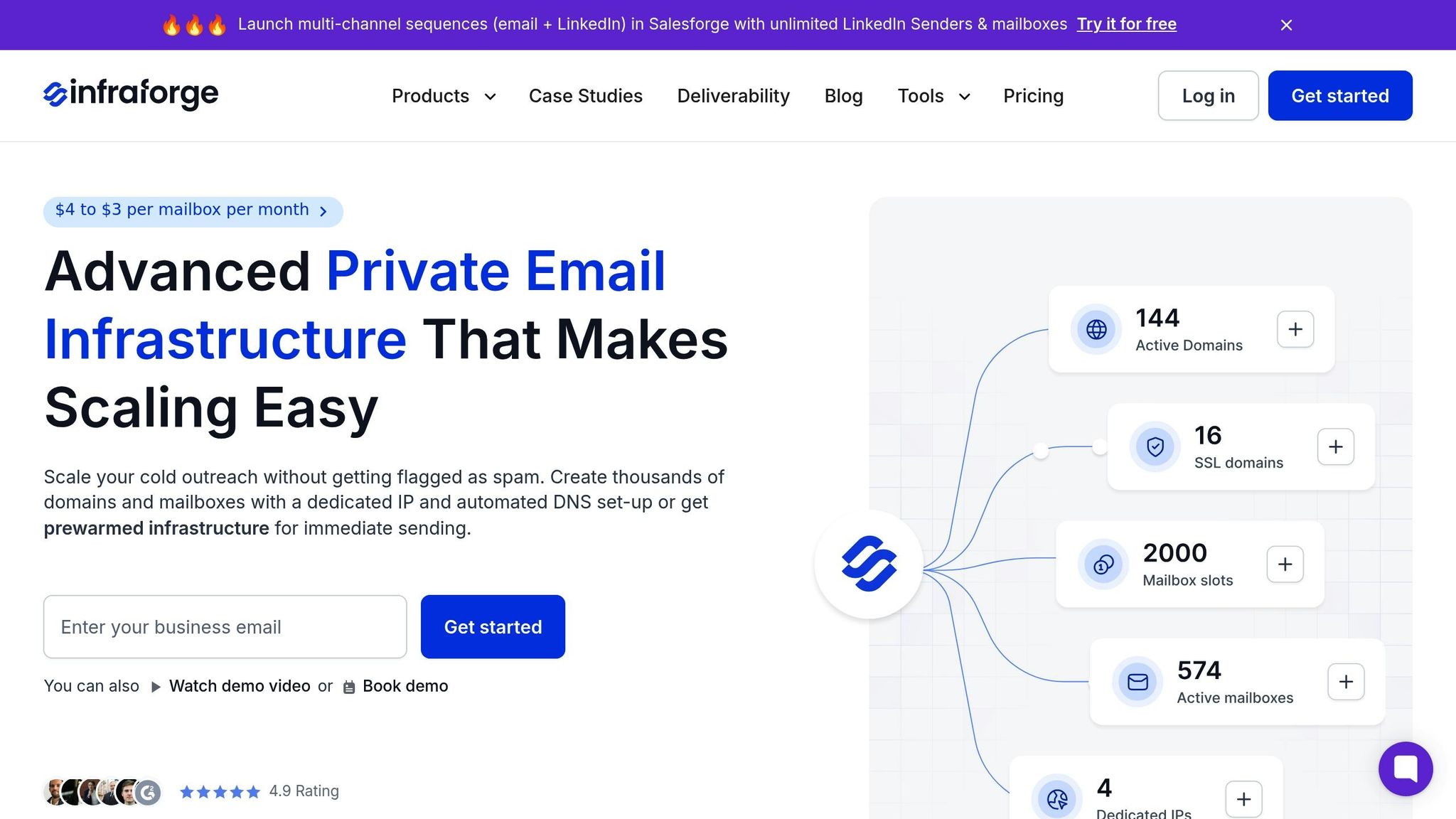
Infraforge was created to tackle the infrastructure challenges AI SDRs face when scaling cold email outreach. Unlike shared setups where you compete for resources and risk your reputation due to others' actions, Infraforge provides isolated, private infrastructure designed for high-volume campaigns.
The platform simplifies cold email management by handling DNS configurations and other technical tasks, ensuring your IP stays clean. Shared infrastructure carries risks that can undermine AI SDR reliability. Instead of patching together services and hoping your shared IP hasn’t been flagged, Infraforge offers a complete solution that handles the technical heavy lifting while giving you full control over your sending environment.
Every element - IP addresses, domains, mailboxes - is dedicated to your campaigns. This ensures your deliverability metrics reflect only your actions, allowing you to scale without inheriting problems caused by others.
Infraforge’s features are designed to directly address these challenges.
Infraforge’s tools are tailored to solve the common issues AI SDR users encounter with shared or underperforming infrastructure. Together, they create a dependable and scalable email-sending environment.
Here’s a side-by-side comparison of shared setups versus Infraforge’s private infrastructure:
| Feature | Shared Infrastructure | Infraforge Private Infrastructure |
|---|---|---|
| Sender Reputation | Shared across users | Isolated with dedicated IPs |
| Scalability Limits | Low | High |
| Deliverability Rates | Unreliable | Consistently high |
| Domain Burnout Risk | High | Minimal |
| Cost per Email | Low upfront, high long-term | Higher upfront, cost-efficient long-term |
| Setup Complexity | Basic | Advanced but managed |
Sender reputation is perhaps the most critical difference. On shared setups, your reputation is tied to everyone else using the same IPs and domains. If another user sends spam or has poor list hygiene, it impacts everyone. Infraforge isolates your reputation with dedicated IPs, so your performance depends only on your actions.
Scalability limits are another issue with shared setups. Most shared services cap sending volumes to prevent individual users from overloading resources. While this might work for small campaigns, it’s a major bottleneck for AI SDRs sending thousands of emails daily. Infraforge removes these limits, letting you scale as needed.
Deliverability rates on shared infrastructure are unpredictable. One week your emails might land in inboxes; the next, they’re flagged as spam because someone else abused the shared IP. Infraforge ensures consistently high deliverability by isolating your setup.
Domain burnout risk is another concern with shared setups. When multiple users send from similar domains or a shared IP gets flagged, domains can quickly become unusable. Infraforge minimizes this risk with domain masking, isolation, and the ability to rotate domains strategically.
Cost per email might seem cheaper with shared infrastructure, but the hidden expenses add up. Poor deliverability, time spent troubleshooting, and replacing burned domains all increase costs. Infraforge requires a higher upfront investment - starting at $40 per month for 10 mailbox slots (billed quarterly) or $33 per month (billed annually), plus $99 per month per dedicated IP - but it saves money in the long run by ensuring successful delivery and reducing wasted resources.
Setup complexity is where Infraforge stands out. While private infrastructure involves more components than shared setups, Infraforge simplifies the process with automated DNS configuration, pre-warmed infrastructure, and centralized tools. You gain enterprise-grade infrastructure without needing an IT team.
For AI SDRs, the advantages of private infrastructure become even more pronounced. AI agents operate at high speed and volume, which amplifies the weaknesses of shared setups and highlights the strengths of private ones. With hundreds of personalized emails going out daily, shared infrastructure’s unpredictability isn’t an option. Infraforge offers the stable, scalable foundation needed for AI-driven outreach to succeed.
Migrating to private infrastructure is a process that requires careful planning to protect your sender reputation and ensure smooth scaling of AI SDR outreach. It’s not something to rush through - taking the time to properly set up and manage the transition is key to avoiding the same deliverability issues you’re trying to solve.
Before you begin sending emails through your private infrastructure, you need to set up the technical groundwork. This phase is critical to ensuring your campaigns perform as expected.
Start with DNS configuration. Properly setting up your DNS records (SPF, DKIM, and DMARC) is non-negotiable. These records verify the legitimacy of your emails, helping them avoid spam filters. Tools like Infraforge automate this process, reducing the risk of errors and saving time. Without these configurations, even the best sending practices might not prevent your emails from being flagged as spam.
Warm up your domain. Gradually increasing your email volume is crucial for building trust with email providers like Gmail and Outlook. Start small - send 20–30 emails per day per mailbox, increasing by 10–20% daily. This mimics natural sending behavior. Infraforge offers pre-warmed domains to speed up this process, but it’s still important to respect the warm-up period to maintain a strong sender reputation.
Distribute email sending. Spread your email volume across multiple mailboxes and domains. For example, start with at least 10 mailboxes, each sending no more than 50–100 emails daily. This not only minimizes the risk of overloading any single domain but also ensures that issues with one mailbox don’t affect the entire operation. Infraforge requires a minimum of 10 mailbox slots, with pricing starting at $40 per month (billed quarterly) or $33 per month (billed annually).
Warm up dedicated IPs. If you’re using dedicated IPs, each one needs its own warm-up period. Begin with about 50 emails per day and gradually increase over two to three weeks. Infraforge offers dedicated IPs at $99 per month per IP. For users managing multiple campaigns or testing different strategies, assigning separate IPs to each campaign can help contain potential issues.
Secure your setup with SSL encryption and domain masking. SSL encryption ensures a secure connection between your infrastructure and recipient servers, while domain masking protects your primary brand domains. By using separate sending domains, you can shield your main domain from potential deliverability problems. With costs as low as $2 per domain per month (billed quarterly) or $6 per domain per year (billed annually), this is an affordable way to safeguard your brand.
Test thoroughly before launching. Send test emails to major providers like Gmail, Outlook, and Yahoo to confirm that everything is working correctly. Check your DNS records, tracking links, unsubscribe options, and email formatting. Catching errors now can save you from bigger issues later.
Once your setup is complete and tested, you’re ready to start running campaigns.
With your technical foundation in place, managing campaigns effectively becomes the next priority. Maintaining high deliverability and scaling outreach requires consistent monitoring and strategic adjustments.
Track deliverability metrics closely. Use tools like Infraforge’s Masterbox, which consolidates email data from all your accounts into one dashboard. Keep an eye on open rates, bounce rates, and spam complaints. Healthy campaigns typically maintain open rates above 20–30% for cold outreach and bounce rates below 5%. Sudden changes in these metrics can signal problems that need immediate attention.
Scale with additional IPs. As your campaigns grow, avoid overloading existing IPs by adding new ones. Each new IP should be warmed up independently to maintain deliverability.
Integrate with your AI SDR platform. If you’re using tools like Salesforge’s AI SDR (Agent Frank), connect it to your private infrastructure through Infraforge’s native integrations or API. This ensures your AI agent sends emails through your private setup rather than a shared system, keeping your campaigns under your control.
Rotate domains periodically. Even the best-maintained domains can face reputation issues over time. Plan to rotate your sending domains every three to six months by gradually shifting volume to new domains while phasing out older ones. Infraforge’s bulk DNS management simplifies this process, making it easy to update multiple domains at once.
Separate campaigns by IP and domain. For different strategies - such as cold outreach versus nurturing - use separate IPs and domains. This separation prevents one poorly performing campaign from affecting others and allows for more aggressive testing without risking your overall reputation.
Adjust based on engagement. Use metrics like open and reply rates to determine which campaigns are resonating with your audience. Scale up well-performing campaigns while reducing volume on those that aren’t delivering results. This flexibility lets you optimize without compromising your sender reputation.
Maintain consistent sending patterns. Email providers value predictable behavior. Avoid sudden spikes in volume, as these can trigger spam filters. Steady, consistent sending builds trust and ensures your emails continue reaching inboxes as your outreach grows.
AI SDRs are great for automating cold outreach at scale, but without the right setup, things can go south quickly. Shared infrastructure often amplifies risks, and when AI sends emails at high speeds, it can seriously damage your sender reputation. That’s where Infraforge steps in with a better solution: private infrastructure.
With private infrastructure, your sender reputation stays completely separate from others. Features like dedicated IPs, isolated domains, and SSL encryption ensure that someone else’s bad practices won’t hurt your deliverability. You get a controlled environment where key metrics - like open rates, bounce rates, and spam complaints - are purely based on your campaigns.
Infraforge simplifies these challenges by providing automated DNS setup, pre-warmed domains and mailboxes, multi-IP provisioning, and real-time monitoring tools like Masterbox. Additional layers of protection, such as SSL and domain masking, safeguard your main brand while you test and refine campaigns. Pricing starts at $33 per month (billed annually) for 10 mailbox slots, with dedicated IPs available at $99 per month and domain masking for $6 per domain per year.
Using shared infrastructure for AI SDRs comes with serious risks that can directly impact your email deliverability. One of the biggest concerns is reputation damage. If others sharing the same IP address engage in spam-like behavior, it can drag down the IP's reputation. This means your emails might end up flagged as spam - even if you’re following all the best practices.
Another issue is the lack of control over sending practices. AI SDRs are designed to send emails at a rapid pace and in high volumes. Without careful management, this can easily set off spam filters. On shared infrastructure, you have no way to isolate your efforts from others, leaving your sender reputation vulnerable.
The result? Poor deliverability. This can lead to fewer people opening your emails, reduced response rates, and a noticeable dip in the overall success of your outreach campaigns.
Private infrastructure plays a key role in scaling AI-powered email outreach by ensuring reliability, security, and consistent deliverability. Services like Infraforge offer tools such as dedicated IPs, SSL encryption, domain masking, and multi-IP provisioning. These features give AI Sales Development Representatives (SDRs) full control over their email-sending environment.
Unlike shared or budget-friendly setups, private infrastructure keeps each user's reputation separate. This means your domain won't suffer from the bad practices of others, like spamming that can lead to blacklisting. For AI agents, which operate at high speeds and volumes, this isolation is critical to minimizing risks. With private infrastructure, AI SDRs can confidently scale their efforts while safeguarding email performance and domain integrity.
Switching to private infrastructure for AI SDRs requires thoughtful planning and preparation. Begin by evaluating your current system to pinpoint what needs to transition. Establish clear objectives - whether it's boosting email deliverability, gaining greater control, or enhancing security. From there, outline a detailed migration plan, complete with timelines and assigned responsibilities. If you're not equipped with the necessary technical expertise, consider bringing in support to ensure a smooth setup, including features like dedicated IPs and domain masking.
Be prepared for some challenges along the way. These might include higher initial costs for hardware and setup, ongoing maintenance demands, and ensuring your infrastructure has enough computing power to handle AI SDR operations effectively. Despite these hurdles, the long-term advantages - such as better email performance and greater control over your reputation - often make the effort worthwhile.