When scaling cold email campaigns, your choice between dedicated IPs and shared IPs impacts deliverability, reputation, and overall performance. Here’s the key takeaway:
| Feature | Dedicated IPs | Shared IPs |
|---|---|---|
| Reputation Control | Solely yours | Shared with others |
| Volume Suitability | High-volume (>300,000 emails) | Low/irregular volumes |
| Setup Complexity | Requires warm-up, DNS setup | Minimal setup required |
| Cost | ~$651/month (200 mailboxes) | $2.49–$15/month |
| Scalability | Unlimited domains/mailboxes | Limited by provider restrictions |
Choose shared IPs if you’re starting small or sending sporadically. Opt for dedicated IPs as your campaigns grow and require greater control. Platforms like Infraforge simplify scaling with dedicated IPs by automating setup, warm-up, and domain management.
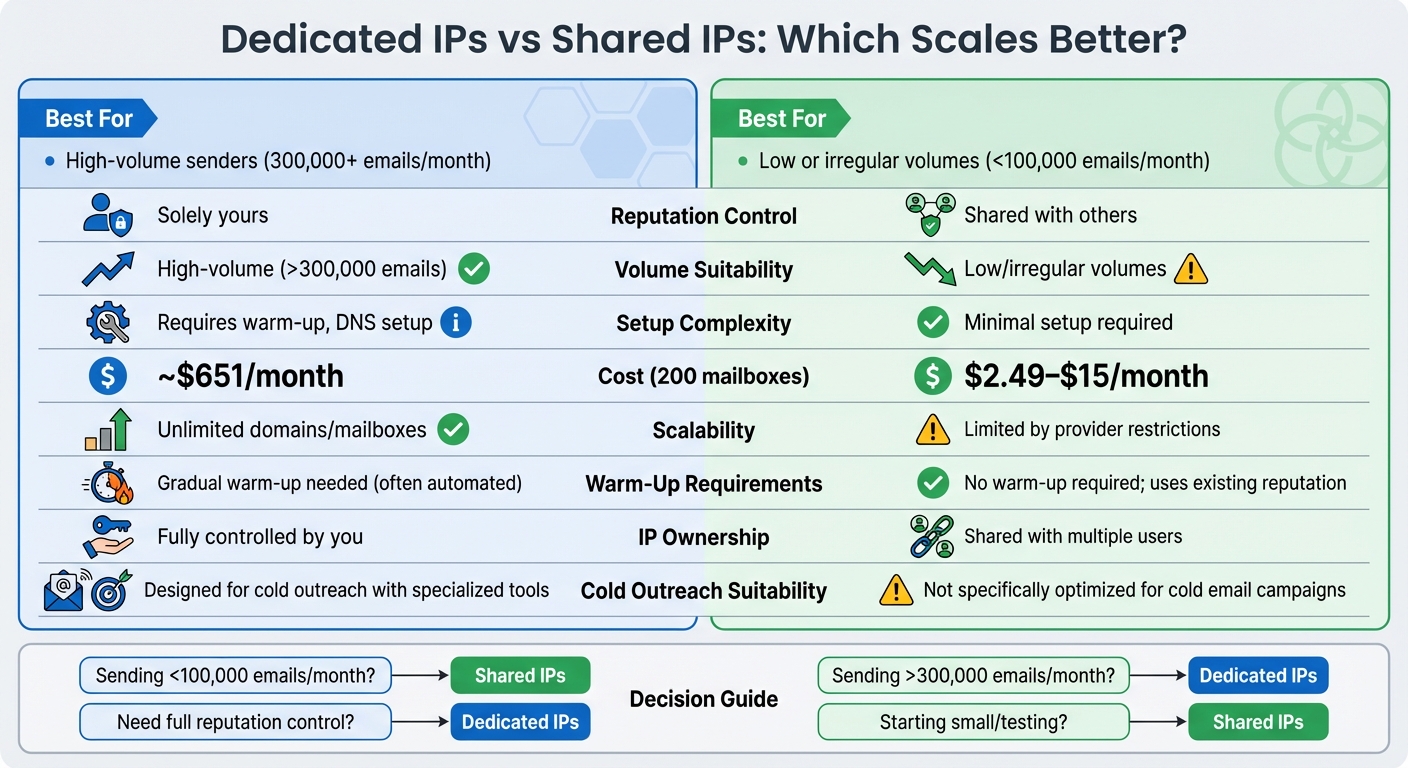
Dedicated IPs vs Shared IPs Comparison for Email Scaling
When it comes to scaling your cold email outreach, the type of IP you use plays a significant role. Your choice of IP directly impacts how well you can scale while maintaining deliverability. By understanding the differences between IP types, you can avoid common pitfalls as your email volume increases.
Email providers assign a trust score, or reputation, to the IP address you use for sending emails. This reputation becomes increasingly important as you send more emails. If you're using a dedicated IP, you have complete control over its reputation since you're the only one sending emails through it. Every email you send directly influences how email providers perceive your IP.
On the other hand, with shared IPs, your reputation is tied to other users who share the same IP. If someone else on that shared IP sends spam or triggers spam filters, it can negatively affect your deliverability, even if your practices are clean. While shared IPs benefit from the combined sending volume helping to stabilize reputation, you lose control over your individual sender score. For those scaling up, this lack of control can be a major drawback. Additionally, dedicated IPs come with their own challenges - if you're sending inconsistent or low email volumes, mailbox providers might flag your IP as inactive, which can hurt your reputation.
These reputation dynamics lead directly into the importance of DNS authentication and the warm-up process.
DNS protocols like SPF, DKIM, and DMARC are essential for protecting your sending reputation and ensuring your emails land in inboxes. For dedicated IPs, platforms like Infraforge simplify this process by automating the setup of these protocols for new domains in just a few minutes, reducing the technical workload. In contrast, shared IP providers like Google Workspace and MS365 typically offer basic DNS configurations, which aren't optimized for high-volume cold email campaigns.
Dedicated IPs also require a gradual warm-up process to build trust with email providers. This process can be automated using tools like Infraforge, which pre-warm domains and mailboxes for you. In comparison, shared IPs come with an already established reputation, so they don't require an individual warm-up phase.
Here’s a quick breakdown of how dedicated and shared IPs compare when it comes to scaling cold email outreach:
| Factor | Dedicated IPs | Shared IPs |
|---|---|---|
| IP Ownership | Fully controlled by you | Shared with multiple users |
| Setup Complexity | Automated SPF, DKIM, and DMARC setup in minutes | Basic DNS setup, not tailored for cold outreach |
| Volume Capability | Supports unlimited mailboxes and thousands of domains | May face limits as outreach scales |
| Warm-Up Requirements | Gradual warm-up needed (often automated) | No warm-up required; uses an existing reputation |
| Reputation Control | Solely determined by your sending behavior | Affected by the actions of other users |
| Cold Outreach Suitability | Designed for cold outreach with specialized tools | Not specifically optimized for cold email campaigns |
| Estimated Monthly Cost (per 200 mailboxes) | Around $651/month (e.g., Infraforge) | Approximately $1,200–$1,680/month (e.g., MS365/Google Workspace) |
Your decision between dedicated and shared IPs boils down to your specific needs - whether that’s greater control, cost efficiency, or ease of setup. Dedicated IPs offer more control and lower costs for larger campaigns when paired with a solid sending strategy. On the flip side, shared IPs are easier to start with but may pose challenges as your outreach efforts grow.
When it comes to email scaling, shared IPs offer a practical solution, especially for teams with lower or irregular sending volumes. One of the biggest draws is affordability - shared IPs typically cost between $2.49 and $15 per month, making them a budget-friendly alternative to dedicated IPs for smaller operations.
Another advantage is the pre-established reputation of shared IP pools. Unlike dedicated IPs, which require a gradual warm-up period to build trust with email providers, shared IPs let you start sending right away. This makes them a great choice for teams that need to launch quickly or run occasional campaigns without waiting for a reputation ramp-up.
Shared IPs also shine when it comes to low-volume or inconsistent sending. For instance, Postmark points out that senders who can’t maintain a steady volume of at least 300,000 emails per month often achieve better deliverability with shared IPs. If you’re sending sporadically - like a monthly newsletter or a seasonal campaign - the shared pool ensures the IP’s reputation remains stable, even during your quiet periods.
Of course, these benefits come with some trade-offs, which are important to consider.
The most significant downside of shared IPs is the shared reputation. Since multiple users share the same IP, your deliverability can be affected if another sender engages in poor practices, like sending spam or generating high complaint rates. Even if your email practices are impeccable, your emails could end up in spam folders because of someone else’s actions. Unfortunately, you have no control over who else is using the IP.
Another challenge is rate limits and volume caps, which can become a bottleneck as your email needs grow. Shared IP providers often impose restrictions to protect the overall reputation of the pool. If you’re trying to send tens of thousands of emails per day, these limits could unexpectedly disrupt your campaigns. Additionally, diagnosing deliverability problems becomes tricky since it’s hard to determine whether the issue stems from your activity or another sender’s.
Shared IP providers also enforce strict content and industry policies. If your campaigns involve certain industries or use aggressive outreach methods, you may find your account flagged or suspended. These restrictions can limit your ability to experiment with messaging or structure your campaigns as you’d like.
Despite these challenges, shared IPs can be highly effective in specific scenarios. They’re well-suited for small teams or startups sending low volumes - say, a few thousand emails per month to test product-market fit. Shared IPs also work well for seasonal or event-driven campaigns, such as holiday promotions or quarterly updates, where sending happens in bursts rather than consistently.
For teams looking to simplify operations, shared IPs are a great option. They eliminate the need to manage DNS settings, warm-up schedules, and reputation monitoring. Providers handle all the technical infrastructure, allowing you to focus on crafting engaging messages and building your email lists. For example, Mailforge, part of The Forge Stack, offers a shared email infrastructure that takes care of IP management, making it ideal for those who prioritize ease of use.
Shared IPs can also act as a stepping stone in your growth journey. You might start with a shared IP service like Mailforge to validate your outreach strategy and gain some initial traction. Once your sending volume increases and you need more control over your sender reputation, you can transition to a dedicated IP solution, such as Infraforge, to support your scaling needs.
Dedicated IPs give you complete control over your sender reputation, ensuring that your email deliverability is determined solely by your own sending practices. This level of control becomes especially important when you're scaling up to send thousands - or even tens of thousands - of emails daily. The last thing you want is for your campaigns to be affected by someone else's poor sending behavior.
Another key advantage of dedicated IPs is their ability to segment traffic effectively. With multiple IPs, you can assign specific IPs to different campaigns, regions, or client accounts. For instance, one IP might handle outreach to new prospects, while another is reserved for nurturing existing leads. This separation ensures that if one campaign runs into deliverability issues, it won't impact your other email streams.
Dedicated IPs also remove the volume restrictions often found in shared infrastructures. There’s no limit to how many emails you can send in a day, which is critical for enterprise-scale operations. You can set up as many domains and mailboxes as needed, and automated DNS configuration for DMARC, SPF, and DKIM records ensures accurate DNS authentication management across your infrastructure. This becomes essential when you're managing hundreds - or even thousands - of domains.
That said, while dedicated IPs offer significant advantages, they also come with challenges that require careful management.
One of the biggest hurdles with dedicated IPs is the warm-up process. To build trust with email providers, you need to start with low email volumes and gradually increase over time. Consistency is key here. Sending 10,000 emails one day and then going silent for a week can raise red flags with email providers, harming your deliverability.
Cost is another factor to consider. Dedicated IPs are more expensive, with additional IPs often costing around $99 per month. They also require consistent email volumes to maintain a strong reputation. Sporadic or seasonal sending can make it difficult to keep your IP "warm", as providers favor steady, predictable activity.
You’ll also need technical expertise to manage DNS settings and monitor deliverability. Dedicated IPs work best for operations that send several thousand emails daily - if your sending patterns are irregular, maintaining a trusted reputation becomes much harder.
For businesses handling enterprise-level outreach, multi-IP architectures offer a powerful solution. With this approach, you distribute your email volume across multiple IPs, which not only safeguards your overall deliverability but also allows for more precise segmentation. If one IP encounters a problem, the others remain unaffected, ensuring uninterrupted operations.
Here’s how it works: you assign specific domains and mailboxes to individual IPs based on your segmentation strategy. One IP might handle high-volume prospecting, another could be dedicated to follow-up sequences, and a third might focus on event-driven campaigns. Features like sender rotation and smart sending limits help you avoid spam triggers across all IPs simultaneously. At this scale, automating tasks like bulk DNS updates and technical setups becomes essential to avoid being overwhelmed by manual work.
This architecture highlights the importance of both scalability and reputation control in high-volume email outreach. Platforms like Infraforge are designed specifically for these needs, offering multi-IP provisioning, automated DNS configuration, and pre-warmed infrastructure. This eliminates the lengthy warm-up process, allowing you to launch large-scale campaigns immediately while maintaining the segmentation and control required for enterprise-level operations.
The choice between shared and dedicated IPs depends largely on your email volume and how your campaigns are structured.
If you're a small team sending fewer than 50,000 emails a month, shared IPs are a practical choice. They let you tap into an established reputation right away, avoiding the hassle of warming up a new IP. Dedicated IPs, on the other hand, require consistent, high-volume sending - at least 300,000 emails per month - to build and maintain their reputation. For teams with irregular or seasonal email activity, shared IPs are especially useful, offering flexibility without the risk of damaging reputation due to inconsistent usage.
As your email volume increases, you can reevaluate and shift strategies to match your growing needs.
For organizations transitioning from tens of thousands to hundreds of thousands of emails per month, a hybrid approach offers the best of both worlds. Use shared IPs for routine, lower-risk communications while reserving dedicated IPs for high-priority outreach. Over time, as your email volume stabilizes, you can gradually shift more of your campaigns to dedicated IPs, ensuring you build a strong reputation for critical messages.
When you're operating at enterprise scale - sending millions of emails across multiple domains or client accounts - dedicated IPs become a necessity. They give you complete control over segmentation, reputation management, and compliance. Unlike shared IPs, dedicated IPs allow you to assign specific infrastructure to each brand or campaign, ensuring that one campaign's performance doesn't impact another. While the cost of $99 per IP per month may seem steep, the benefits - better deliverability, stronger reputation management, and revenue protection - make it a worthwhile investment for large-scale operations.
Infraforge tackles the challenges of scaling dedicated IP infrastructure with a set of features designed to simplify management and boost efficiency. It addresses the limitations of traditional setups, making it easier to scale without the usual headaches.
Infraforge streamlines dedicated IP infrastructure so you can focus on what matters - your outreach. Tasks like DNS configuration, which usually take days, are reduced to minutes. The platform automates essential setups like DMARC, SPF, and DKIM, ensuring proper authentication and eliminating the manual errors that often plague large-scale deployments.
With pre-warmed domains and mailboxes, you can start sending emails immediately, avoiding the typical delays of warming up new infrastructure. For teams scaling at high speed, this means you can deploy new systems and begin outreach on the same day. The platform also supports multi-IP provisioning, allowing you to add dedicated IPs as your email volume grows. This is especially critical when handling enterprise campaigns that send 50,000–100,000 emails per IP daily.
SSL and domain masking offer protection against blocks while maintaining trust signals across multiple IPs. The Infraforge API takes scalability a step further by enabling programmatic expansion. You can automatically spin up new IPs, domains, and mailboxes as your campaigns grow. Bulk DNS updates are just a few clicks away, and the Masterbox feature provides a consolidated view of all emails across accounts within a workspace.
| Feature | Infraforge (Dedicated IP) | Shared IP Platforms |
|---|---|---|
| Ownership | Full control over IP reputation | Shared reputation with other users |
| Warm-up Automation | Automated DNS setup, pre-warmed domains/mailboxes ready immediately | Pre-warmed pools, but reputation influenced by others |
| Scalability | Multi-IP provisioning + API for programmatic scaling, unlimited domains/mailboxes | Limited by pool size and shared reputation risks |
| Control | Complete control over deliverability, DNS settings, and sending limits | Limited control, affected by other users' sending practices |
The key difference lies in ownership and control. With Infraforge, you have full autonomy over your sending reputation, and each dedicated mailbox costs $3–$4 per month (with a minimum of 10 mailbox slots). While shared platforms might seem simpler at first, they can’t match the level of scalability or the isolation of reputation that enterprise-level outreach demands.
Infraforge doesn’t just offer better control; it also integrates seamlessly with related tools to enhance scalability further. Its native API connections with Salesforge centralize multi-channel outreach, creating a unified system. When you provision new IPs through Infraforge, they automatically sync with Salesforge, streamlining campaign routing and deliverability monitoring.
Additionally, Warmforge - included for free with Salesforge subscriptions - handles ongoing warm-up and monitoring, while Leadsforge ensures a steady flow of fresh prospects into your sequences. This programmatic approach lets you scale your entire outreach stack, from generating leads with Leadsforge to provisioning infrastructure via Infraforge and executing campaigns in Salesforge, all without switching platforms.
For teams managing millions of emails monthly across multiple brands or client accounts, this integrated system eliminates the technical hurdles that typically slow down scaling efforts.
The decision between shared and dedicated IPs revolves around your email volume, consistency, and how you approach risk - points we've explored in detail throughout this article.
For those sending less than 50,000–100,000 emails per month on an irregular basis, shared IPs are a practical choice. They cost between $2.49 and $15 per month, offer immediate usability, and leverage a shared reputation pool, though you sacrifice individual control.
On the other hand, if you're consistently sending over 300,000 emails per month, dedicated IPs are the way to go. They give you complete control over your reputation and allow for advanced diagnostics and multi-IP scaling. However, they come with higher costs - ranging from $100 to $250 per month per IP - and require a careful warm-up process. Tools like Infraforge can simplify this process by automating warm-up, DNS setup, and mailbox management for $3–$4 per month (with a 10-mailbox minimum).
To make the best choice for your email strategy, consider this framework based on your current needs and future goals:
When deciding, weigh these four factors carefully:
Ultimately, align your choice with your current situation and growth plans, rather than focusing solely on where you'd like to be in the future.
Using dedicated IPs for large-scale email campaigns comes with several notable advantages. First, they help ensure better email deliverability because your emails won’t be impacted by the behavior of other senders, a common issue with shared IPs. This means your messages are more likely to land in inboxes rather than getting flagged as spam.
Another key benefit is the ability to build and maintain a strong sender reputation. A positive sender reputation is essential for keeping your emails out of spam filters and maintaining trust with email providers.
Dedicated IPs also give you greater control over email authentication settings like DMARC, SPF, and DKIM. This added control enhances security and reinforces the trustworthiness of your communications. For businesses handling high-volume email outreach, these benefits make dedicated IPs a dependable option for scaling campaigns successfully.
Sharing an IP address can directly affect your email deliverability since its reputation is shaped by the actions of everyone using it. If others on the same IP engage in spammy practices or attract numerous complaints, it could result in blacklisting or your emails being marked as spam - even if you follow all the rules.
This shared responsibility makes it challenging to ensure reliable inbox placement, particularly for high-volume email campaigns where deliverability is a top priority.
When deciding between a dedicated IP and a shared IP, it's important to weigh factors like email deliverability, control, sender reputation, and the size of your email campaigns. A dedicated IP gives you full control over your email sending and ensures a stable sender reputation, which is particularly useful for high-volume campaigns or when handling sensitive email communications.
On the flip side, shared IPs are budget-friendly and easier to maintain, making them a practical option for smaller-scale or occasional email outreach.
For those prioritizing scalability and reliable deliverability, dedicated IPs are often the smarter option. Services like Infraforge streamline this process by providing automated setups, pre-warmed domains, and tools designed to handle large-scale email campaigns with ease.