

Zapmail is a Google Workspace and Microsoft 365 reseller starting at $39/mo for 10 mailboxes. Maildoso sells SMTP and Google Workspace mailboxes, with monthly plans from $75/mo for 30 SMTP mailboxes. Neither gives you a dedicated IP you control, neither offers private infrastructure with isolated sequencer fingerprints, and neither plugs directly into a multi-channel outreach platform.
For private cold email infrastructure at scale, Infraforge is the stronger choice. Dedicated IPs, automated DNS, pre-warmed mailboxes, an API for programmatic scale, and native integration with the rest of the Forge Stack (Mailforge for shared-IP overflow, Primeforge for Google/MS365 mailboxes, Warmforge for warm-up, Salesforge for outreach). Pricing starts at $33/mo billed annually for 10 mailbox slots.
I've spent the last 18 months running cold email infrastructure at scale for B2B SaaS clients in the $5K-$100K ACV range. I've used Zapmail, Maildoso, and Infraforge. The decision comes down to one question most comparison posts skip: do you want to own your infrastructure, or rent it from a pool you can't see?
This post compares Infraforge against Zapmail and Maildoso on what actually matters at 1,000+ cold emails a day: IP control, deliverability, pricing scalability, and stack fit. Salesforge publishes other infrastructure comparisons in the same library if you want the same axes applied to different competitors.
The short version: Zapmail resells Google and Microsoft mailboxes, Maildoso runs SMTP on rotated shared IPs you don't control, and Infraforge sells dedicated IPs. Reviews flagging Zapmail's IPs are worth reading before you commit.
Cold Email Infrastructure Comparison at a Glance: Zapmail vs Maildoso
| Feature | Infraforge | Zapmail | Maildoso |
|---|---|---|---|
| Infrastructure type | Private dedicated IPs | Google Workspace / MS365 reseller | SMTP (rotated IPs) + Google Workspace |
| Entry price | $33/mo annual (10 mailbox slots) | $39/mo (10 Google mailboxes) | $75/mo (30 SMTP mailboxes) |
| Per-mailbox cost (entry) | $3.30/slot annual, $4 quarterly | $3.90/mailbox monthly | $2.50/mailbox (SMTP monthly) |
| Dedicated IPs | Yes (standard) | No (Google/Microsoft pools) | No (shared pool) |
| Pre-warmed mailboxes | Yes | Yes | Not advertised |
| Automated DNS (SPF/DKIM/DMARC) | Yes | Yes | Yes |
| Bulk DNS updates | Yes | Yes | Yes |
| API access | Yes (Infraforge API) | Yes (Zapmail API) | API in product roadmap |
| Free warm-up included | Via Warmforge (free, unlimited) | 3-30 placement test credits/mo | Inbox placement tests every 3 days |
| Multi-workspace | Yes | Yes (1 domain per workspace) | Master inbox concept |
| SOC 2 compliant | Yes | Not stated publicly | Not stated publicly |
| Native outreach platform | Yes (Salesforge) | No (exports to Instantly, Smartlead, etc.) | No (third-party only) |
| Best for | High-volume, agencies, scale | Teams wanting real G/MS mailboxes | Small teams wanting SMTP + GW mailboxes |
Zapmail Overview: Features, Pricing, and Reviews
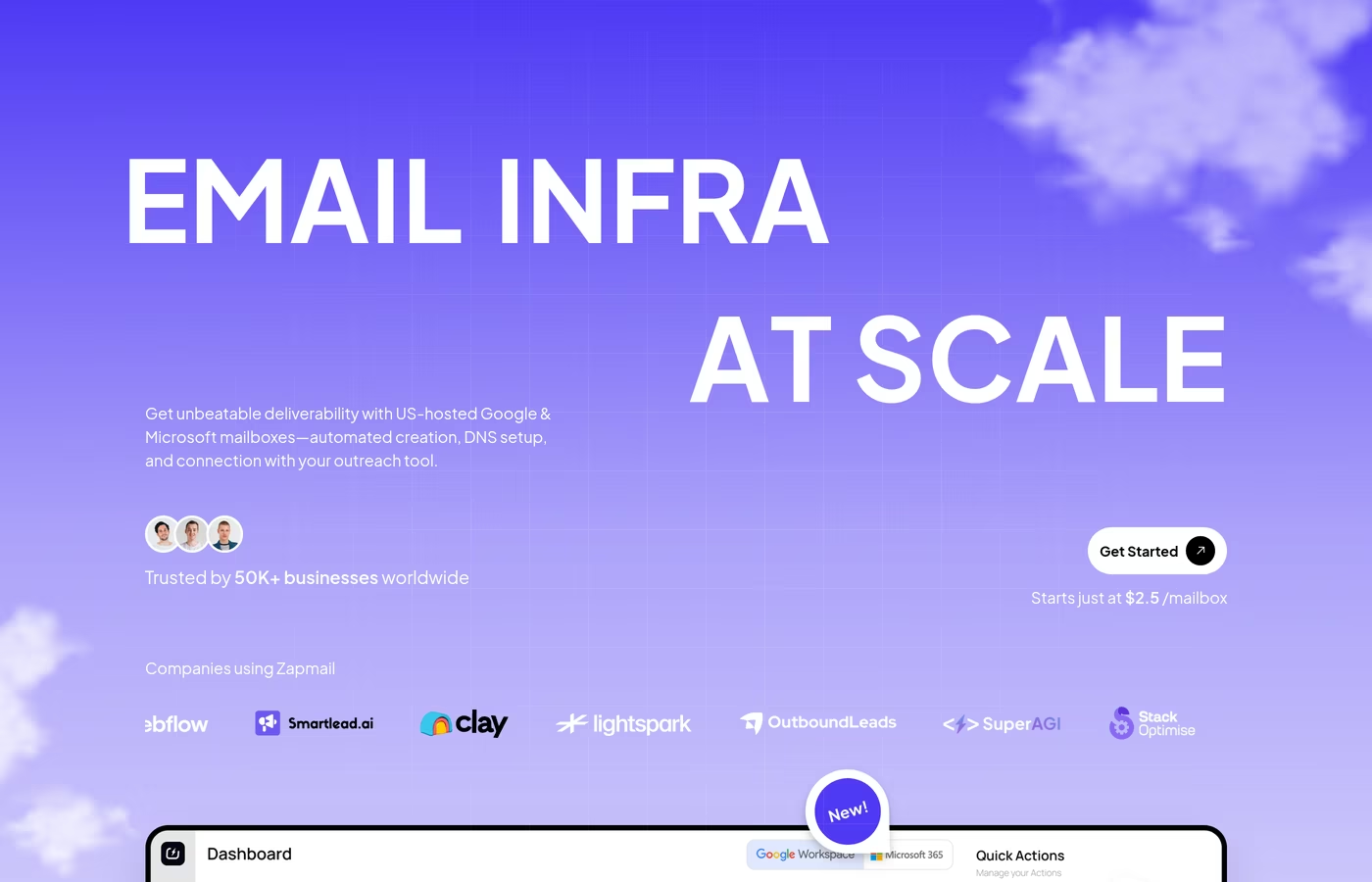
Zapmail is a Google Workspace and Microsoft 365 mailbox reseller. The product positions itself as automated provisioning of real Google and Microsoft accounts with US and EU IPs, automated DNS setup, and pre-warmed mailboxes that can start sending on day one. The homepage claims 1M+ mailboxes set up across 50K+ businesses.
Zapmail isn't a sending platform. It provisions the mailboxes, configures the DNS, and exports them to whichever cold outreach tool you use. The integration list includes Instantly, Smartlead, ReachInbox, Reply, and Lemlist.
Zapmail features
- Real Google Workspace and Microsoft 365 mailboxes - not SMTP relays, not educational accounts
- Pre-warmed mailboxes - skip the standard 2-week warm-up cycle
- Automated DNS setup - SPF, DKIM, DMARC, custom tracking domains configured at provisioning
- 1 domain per workspace - workspace isolation for deliverability
- Zapmail API - programmatic mailbox provisioning and deliverability insights
- Instant Domain Genie - AI-suggested available domain names
- Smart Mailbox Namer - auto-generated mailbox handles
- Persona Snapshots - AI-generated profile images for mailboxes
- Placement test credits - 3 to 30 per month depending on plan
- AI Insights credits - 3 to 30 per month depending on plan
Zapmail pricing
Zapmail bills three plans monthly, quarterly, or yearly (yearly includes 2 months free):
- Starter Plan: $39/month - 10 Google mailboxes included, additional at $3.50/mailbox, 3 placement test credits/month
- Growth Plan: $99/month - 30 Google mailboxes included, additional at $3.25/mailbox, 10 placement test credits/month
- Pro Plan: $299/month - 100 Google mailboxes included, additional at $3.00/mailbox, priority support, API access, 30 placement test credits/month
The marketing line "starts just at $2.50/mailbox" applies only at the yearly billing tier and at scale, not at the entry monthly Starter plan.
Who Zapmail is for
Teams that want real Google Workspace or Microsoft 365 mailboxes without setting them up themselves, and who plan to use a third-party outreach platform for the actual sending. The reseller model fits operators who care more about mailbox legitimacy (mainstream providers) than about IP control.
What Trustpilot reviewers say
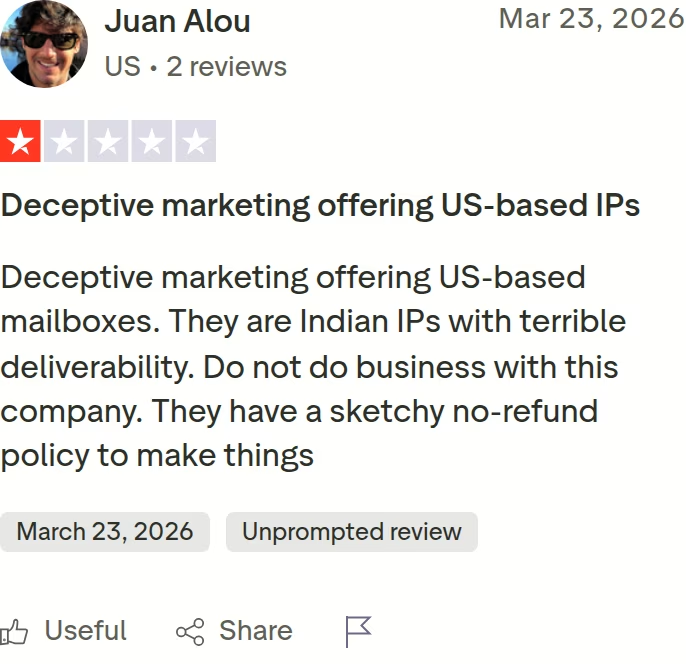
Zapmail holds a 4.5 star rating on Trustpilot with mostly positive reviews. The negative reviews follow a consistent pattern worth noting before purchase. As of May 2026, multiple 1-star reviews from verified users (Juan Alou, Hafiz, Cem, and others) document the same complaint: mailboxes marketed as US IPs are reportedly coming from Indian IP ranges, with one reviewer claiming a 0.6% reply rate as a result.
One reviewer (Cem, June 2025) wrote that Zapmail "buy inboxes from Google India for $1.7 dollars per inbox and resell." Another (Hafiz, Dec 2025) wrote: "Don't be fooled by the overly positive reviews. My experience was the complete opposite."
I'm not adjudicating the dispute. Zapmail's marketing is explicit about US/EU IP accounts, and the reviews are explicit in their disagreement. If you're considering Zapmail, the Trustpilot reviews under "lowest first" sort are worth 10 minutes of reading before you commit a quarter of revenue to the platform.
Honest limitations of Zapmail
- Reseller model means no dedicated IPs and no control over the underlying Google/Microsoft pool
- Recurring Trustpilot complaints documenting Indian IPs sold as US IPs - documented and unresolved as of May 2026
- Mailbox unit economics get worse at low volume; the marketed "$2.50/mailbox" only applies at yearly scale
- No native outreach platform; you're stitching together Zapmail with a separate sending tool
- No SOC 2 certification stated publicly on the site
Maildoso Overview: Features and Pricing
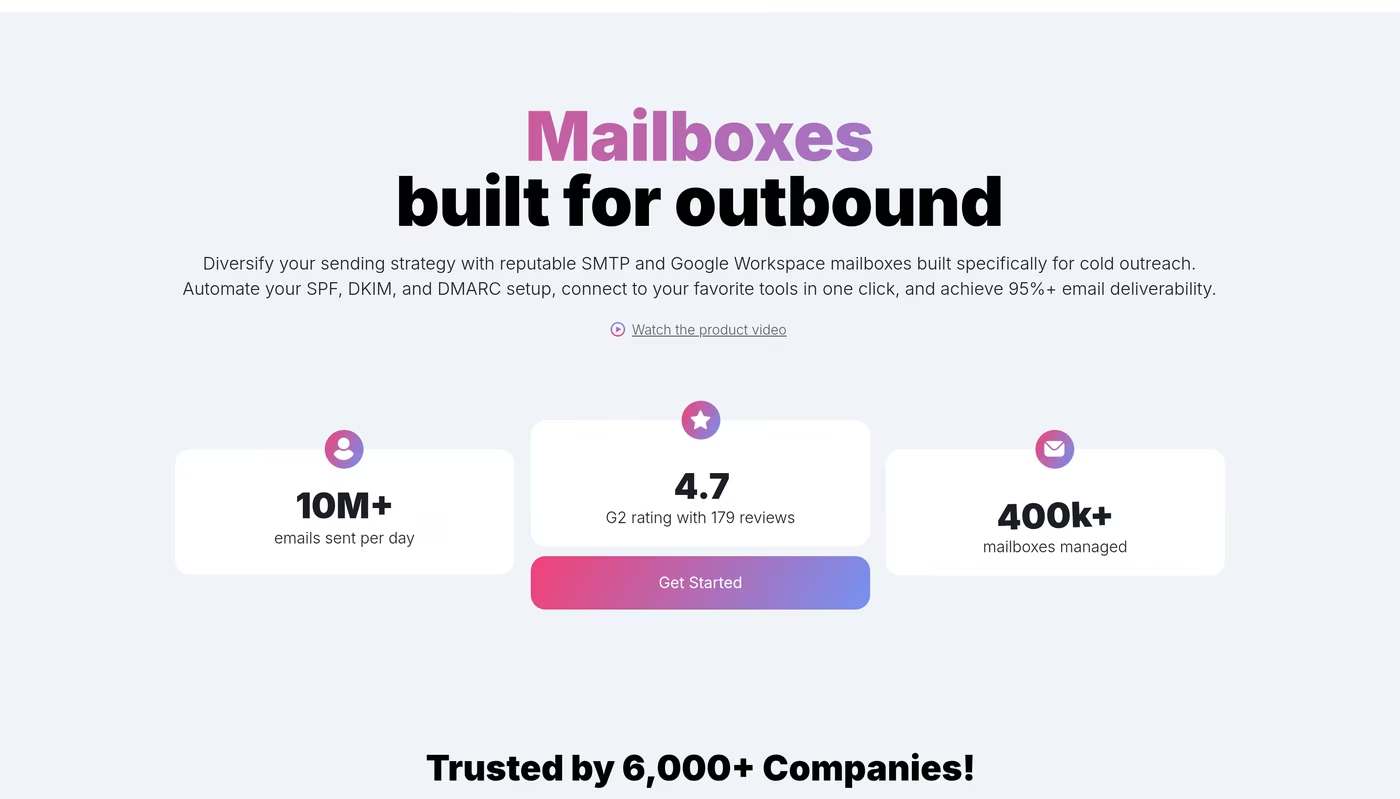
Maildoso is a cold email infrastructure provider that sells two mailbox types: reputable SMTP mailboxes (sent through rotated IPs) and real Google Workspace mailboxes. The product is built around speed (15-minute setup), an integrated master inbox that consolidates replies across mailboxes, and automated SPF/DKIM/DMARC configuration. Its homepage cites 10M+ emails sent per day, a 4.7 G2 rating across 179 reviews, and 400k+ mailboxes managed.
Maildoso provisions domains and mailboxes inside its dashboard. SMTP mailboxes run through IP rotation; Google Workspace mailboxes are each hosted in an isolated workspace (one workspace per domain). Maildoso isn't a sending platform, so you connect the mailboxes to a separate sequencer to actually send.
Maildoso features
- SMTP mailboxes - sent through rotated IPs, with self-healing accounts that pause burned mailboxes for 14 days and return them to rotation
- Google Workspace mailboxes - real GW accounts, one isolated workspace per domain, better suited for B2C targets
- Master inbox concept - reply routing and consolidation across mailboxes
- Domain forwarding - redirects prospects to your primary site by default
- Automated DNS - SPF, DKIM, DMARC, and custom tracking auto-configured
- Inbox placement tests every 3 days - automated deliverability checks with health scores
- GCDT link safety - lets you include links, images, or video in first-touch emails
- 15-minute setup - mailboxes registered and DNS-configured fast
- API and a 1,400+ member community - per the site's resources
Maildoso pricing
Maildoso sells three pricing structures, switchable by tab on its pricing page. All include domains and carry a 30-day money-back guarantee.
Monthly Combo (SMTP + Google Workspace):
- 15 GW + 15 SMTP: $90/mo ($3 per mailbox), 6 domains required
- 35 GW + 35 SMTP: $175/mo ($2.50 per mailbox), 14 domains required
- 150 GW + 150 SMTP: $675/mo ($2 per SMTP, $2.50 per GW), 60 domains required
Monthly SMTP:
- 30 mailboxes: $75/mo ($2.50 per mailbox), 6 domains required
- 70 mailboxes: $158/mo ($2.25 per mailbox), 14 domains required
- 300 mailboxes: $570/mo ($1.90 per mailbox), 60 domains required
Quarterly SMTP:
- 32 mailboxes: $299/quarter ($3.10 per mailbox), 8 domains free
- 68 mailboxes: $499/quarter ($2.40 per mailbox), 17 domains free
- 400 mailboxes: $2,199/quarter ($1.80 per mailbox), 100 domains free
Per-mailbox cost drops to $1.80 at the 400-mailbox quarterly tier, which is competitive at scale. Maildoso has a stated no-discount policy.
Who Maildoso is for
Small teams or solo operators who want fast provisioning, a unified master inbox, and a mix of SMTP and Google Workspace mailboxes. The product fits if your sending profile maps cleanly onto one of its plan sizes.
What reviewers say about Maildoso
Maildoso holds a 4.7 rating on G2 across 179 reviews, and most of that feedback is positive: fast setup, low per-mailbox cost, and the master inbox come up often. The critical reviews are the ones worth reading first. The recurring complaint in the lower-star Maildoso reviews is shared-infrastructure variance, where a bad batch of domains or a bad day on the rotated IP pool becomes your problem rather than someone else's.
One G2 reviewer in consulting described every one of their domains getting burned in a single day during what Maildoso called a large-scale issue, and said the replacement domains came back on .click, .top, and .xyz extensions instead of the .com domains originally purchased, a swap that drags down cold-email deliverability. Maildoso's reviews concentrate on G2 rather than Trustpilot, so this is a documented pattern in the negative feedback rather than a one-off rating.
Honest limitations of Maildoso
- SMTP mailboxes run on rotated shared IPs - no dedicated IP you control the way Infraforge offers
- Fixed plan sizes (15/35/150 combo, 30/70/300 SMTP) - awkward if you need a count in between
- No native outreach platform; you'll still need Instantly, Smartlead, or Salesforge to actually send
- Reviewers report intermittent deliverability variance on shared SMTP infrastructure when other senders in the pool send badly
- Master inbox is a clever feature but doesn't replace a real multi-channel outreach platform
- No SOC 2 certification stated publicly on the site
Infraforge Overview: Dedicated IP Email Infrastructure
Infraforge is the private email infrastructure layer of the Forge Stack. It provisions dedicated IPs, automated DNS, and pre-warmed mailboxes for high-volume cold outreach. Unlike Zapmail (a Google/MS reseller) and Maildoso (rotated-IP SMTP plus Google mailboxes), Infraforge sells you your own infrastructure with isolated sequencer fingerprints and full IP control.
The product is built for teams that have outgrown shared infrastructure or that need agency-grade isolation between client workloads. Woodpecker scaled to 2,500+ mailboxes on Infraforge, which is the case study cited on Infraforge's site and the most useful proof point I've found for scale viability.
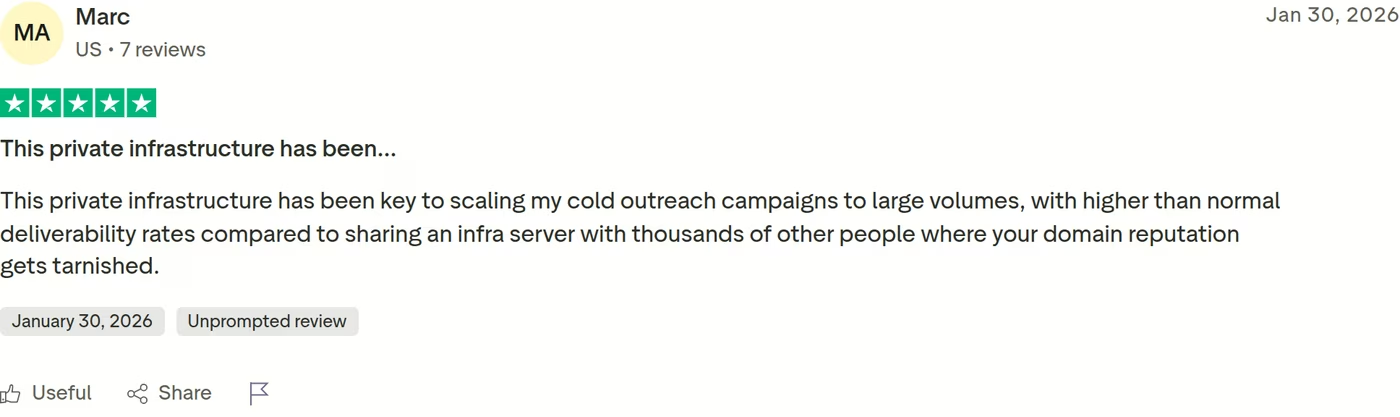
That dedicated-IP advantage is the thing Infraforge's own reviewers keep pointing to.
Infraforge features
- Dedicated IPs - your own IP address, your own sender reputation, no pool bleed from other senders
- Automated DNS setup - SPF, DKIM, DMARC configured at provisioning, following industry best practices
- Pre-warmed mailboxes - skip the 2-week warm-up for inboxes that are ready to send
- Bulk DNS updates from the dashboard - manage hundreds of domains without manual edits
- Multi-IP provisioning - purchase additional IPs at $99/IP/month for further reputation isolation
- SSL and domain masking - secure redirection with branded primary domain ($2/domain/month, $0.50 yearly)
- Masterbox - real-time overview of all emails across all accounts in a workspace ($7-$9/workspace/month)
- Multiple workspaces - one workspace per agency client, fully isolated
- Infraforge API - programmatic control for scale operations and CRM integrations
- Whitelabel and reseller program - 20% revenue share, resell under your own brand
- Free unlimited Warmforge warm-up - included when paired with a Salesforge subscription
- SOC 2 compliant - badged across all Forge Stack product pages
The Forge Stack context
Infraforge is one layer of the Forge Stack. The rest of the stack is built to connect natively without Zapier or Make in between.
Mailforge sits next to Infraforge as the shared-IP option for teams that want cost-effective scale alongside dedicated infrastructure. The recommended setup is a mixed stack. Primeforge handles Google Workspace and Microsoft 365 mailboxes specifically, for teams that want mainstream provider mailboxes alongside private infrastructure. Warmforge handles warm-up across the whole stack. Salesforge is the outreach platform that consumes all of it.
This matters because the alternative is what I've been doing for years with Zapmail, Maildoso, and the rest: stitching together five tools with five separate billing relationships, five logins, and zero shared support. The Forge Stack collapses that into one operational surface.
Infraforge pricing
Infraforge uses an on-page calculator rather than fixed plans. The calculator inputs are: emails per sequence, mailboxes per domain, and contacts per month. It outputs required domains and required mailbox slots, then computes both annual and quarterly costs.
- Minimum 10 mailbox slots - the floor for any Infraforge subscription
- Annual billing: $33/mo for 10 mailbox slots ($3.30/slot)
- Quarterly billing: $40/mo for 10 mailbox slots ($4/slot)
- At 25 mailboxes: $83/mo annual or $100/mo quarterly
- At 200 mailboxes: ~$651/mo ($3.26/slot) - this is the volume tier Woodpecker operates at
- Domains: $14/year per .com domain (charged once, not monthly)
- Add-on dedicated IPs: $99/IP/month quarterly
- SSL and domain masking: $0.50/domain/month yearly or $2/domain/month quarterly
- Masterbox: $7/workspace/month yearly or $9/workspace/month quarterly
Who Infraforge is for
Teams running B2B outbound at ACVs of $5K to $100K, targeting 3,000+ businesses, who have either outgrown shared infrastructure or who want isolation by default. Agencies managing multiple client workloads are a particularly clean fit because each Salesforge workspace gets its own isolated sequencer fingerprint and dedicated IPs.
Infraforge is explicitly not the right fit if you're sending fewer than 10 mailboxes worth of volume (you'll pay the 10-slot minimum either way), if you primarily target Fortune 500 procurement, or if you're a single operator who would do fine with a shared-IP product like Mailforge or Maildoso's SMTP plans.
Honest limitations of Infraforge
- 10 mailbox slot minimum - low-volume operators pay for capacity they won't use
- Dedicated IPs cost more per mailbox than shared pools at small scale (the economics flip past ~50 mailboxes)
- The Forge Stack value proposition assumes you'll use multiple Forge products; standalone Infraforge gives up some of the integration upside
- Free Warmforge warm-up is included only when paired with Salesforge; standalone Infraforge users pay separately for warm-up
in Action
Head-to-Head Feature Comparison: Zapmail vs Maildoso
IP control and infrastructure type
This is the axis that defines the whole comparison.
Zapmail ships you mailboxes inside Google and Microsoft's pools. You don't control the IPs because Google and Microsoft do. The Trustpilot reviews documenting Indian IPs at US prices are the practical risk of not controlling the layer beneath you.
Maildoso sends SMTP mailboxes through rotated shared IPs, and its Google Workspace mailboxes sit in Google's infrastructure. Either way you don't get a dedicated IP you control. On the rotated SMTP side, other senders share the IP ranges by definition, so if someone sends to bad lists you can absorb part of the blast radius.
Infraforge gives each Salesforge account dedicated IPs with isolated sequencer fingerprints. No shared pools, no reputation bleed. That's the entire reason the product exists.
Email deliverability and warm-up
All three products auto-configure SPF, DKIM, and DMARC. The difference is what happens after provisioning.
Zapmail includes 3 to 30 placement test credits per month depending on plan tier. Pre-warmed mailboxes are advertised, which skips the 2-week warm-up cycle.
Maildoso runs inbox placement tests every 3 days with per-mailbox health scores, and its SMTP accounts self-heal (a burned mailbox is paused for 14 days, then returned to rotation). Maildoso doesn't pre-warm; the recommendation is to warm up yourself before sending.
Infraforge integrates with Warmforge, the Forge Stack's dedicated warm-up product. Salesforge customers get unlimited Warmforge warm-up free with their subscription. The warm-up pool excludes external SMTP vendors and recycled inboxes, which is a deliverability advantage I've seen pay off on cold launches.
Automation and provisioning speed
Zapmail claims a 5-minute setup window with fully automated DNS via OAuth. The Instant Domain Genie and Smart Mailbox Namer are nice operational touches.
Maildoso claims a 15-minute setup with SPF, DKIM, and DMARC auto-configured, and one-click bulk connection to major sequencers. The dashboard handles domain registration directly.
Infraforge claims a 5-minute setup with automated DNS following industry best practices. Bulk DNS updates from the dashboard. Pre-warmed domains and mailboxes available. The trade-off is that Infraforge's dedicated IP allocation takes a beat longer than provisioning into Google's existing pool, which is the nature of dedicated infrastructure.
Inbox management and reply handling
Zapmail doesn't manage replies. You export mailboxes to Instantly, Smartlead, or another tool, and reply management happens there.
Maildoso's master inbox is one of the product's stronger features. It consolidates replies across mailboxes inside Maildoso itself, which removes a step.
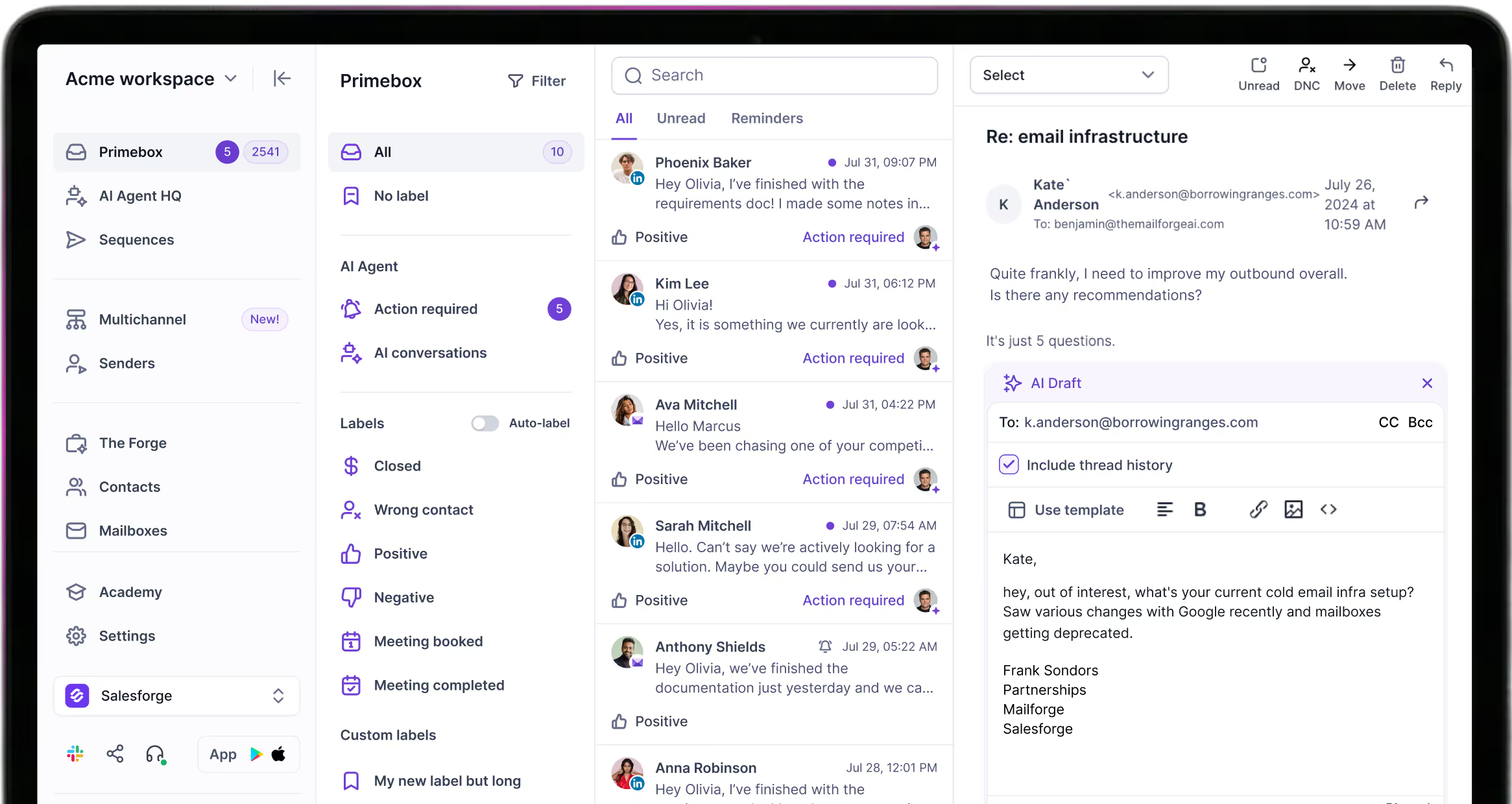
Infraforge pairs with Salesforge's Primebox, the unified inbox that handles email and LinkedIn replies in one view with AI sentiment analysis. Primebox is included free with every Salesforge subscription and is available on mobile.
Pricing scalability
The interesting comparison is not the headline price but how cost behaves as you grow.
Zapmail caps each plan at a fixed mailbox count (10, 30, or 100) and charges per additional mailbox above that. You jump tiers when you exceed the included count. At 50 mailboxes you're on Growth ($99) plus 20 add-on mailboxes at $3.25 = $164/mo. At 150 mailboxes you're on Pro ($299) plus 50 add-on mailboxes at $3.00 = $449/mo.
Maildoso sells fixed plan sizes per tab. On Monthly SMTP that's 30, 70, or 300 mailboxes ($75, $158, $570/mo). If you need 50 mailboxes you buy the 70 tier; if you need 150 you buy the 300 tier. The per-mailbox rate improves at the larger sizes but you pay for the whole tier.
Infraforge sells slots, not plans. You buy exactly the volume you need (minimum 10), and slots are decoupled from active mailboxes, which means you can delete and recreate mailboxes without additional cost. At 50 slots, that's ~$165/mo annual. At 150 slots, ~$495/mo annual. Scaling is linear, not stepped.
Integration with outreach platforms and the broader stack
Zapmail integrates with 50+ outreach tools via export. You manage two separate billing relationships (Zapmail plus your sending tool) and two separate logins.
Maildoso works with third-party sending tools but doesn't have a native outreach platform. Two separate billing relationships, two logins, two support channels.
Infraforge integrates natively with the rest of the Forge Stack: Mailforge for shared-IP overflow, Primeforge for Google/MS365 mailboxes, Leadsforge for lead data (500M+ contacts), Warmforge for warm-up, Salesforge for sending, and Agent Frank for AI SDR work. Single support team, single login, one workflow.
Pricing Comparison: Cost per Mailbox and Scalability
| Plan tier | Infraforge | Zapmail | Maildoso |
|---|---|---|---|
| Entry plan | 10 slots / $33/mo annual | Starter / $39/mo monthly | 30 SMTP / $75/mo monthly |
| Mid-tier | 25 slots / $83/mo annual | Growth / $99/mo monthly (30 mailboxes) | 70 SMTP / $158/mo monthly |
| High-volume tier | 200 slots / ~$651/mo | Pro / $299/mo monthly (100 mailboxes) | 300 SMTP / $570/mo monthly |
| Per-mailbox at scale | ~$3.26/slot | $2.50/mailbox (yearly Pro tier) | $1.80/mailbox (400 quarterly) |
| Billing flexibility | Monthly, quarterly, annual | Monthly, quarterly, annual | Monthly or quarterly |
| Domains included | $14/year each (separate) | Separate | Free domains included in plan |
| Dedicated IPs | Standard ($99/IP/mo add-on for more) | Not available | Not available |
| Free trial | No | No | No |
The scenario worth running: a team sending 1,000 cold emails per day, which the Forge Stack documentation puts at roughly 20-30 mailboxes across 5-10 domains.
On Infraforge at 25 slots: $83/mo annual + 5 domains at $14/year = $89/mo equivalent. Dedicated IPs included. Add free Warmforge warm-up with a Salesforge subscription.
On Zapmail at 30 mailboxes: $99/mo (Growth plan, monthly) or roughly $82/mo annual. Shared Google/Microsoft IPs (with the Trustpilot reviews about US versus Indian IPs as ongoing context).
On Maildoso at 30 SMTP mailboxes: $75/mo monthly ($2.50 per mailbox), 6 domains required. Rotated shared IPs. The 32-mailbox quarterly plan is the cheaper-per-mailbox route at $299/quarter.
Headline cost is similar across the three at this volume. What differs is what you're paying for: dedicated IPs you control (Infraforge) versus shared Google/Microsoft pools (Zapmail) versus rotated SMTP IPs plus Google mailboxes (Maildoso).
Start with InfraforgeWho Should Use Which Tool: Infraforge, Zapmail, or Maildoso
You might consider Zapmail if:
- You specifically want real Google Workspace or Microsoft 365 mailboxes and don't want to set them up yourself
- You're already committed to a sending tool like Instantly or Smartlead and just need the mailbox layer
- You're willing to read the negative Trustpilot reviews about US versus Indian IPs and form your own view before committing
You might consider Maildoso if:
- Your sending volume maps cleanly onto one of Maildoso's plan sizes (15/35/150 combo or 30/70/300 SMTP)
- You value the integrated master inbox and don't need a separate outreach platform's inbox features
- You want a mix of SMTP and Google Workspace mailboxes and are fine with rotated shared IPs on the SMTP side
Choose Infraforge if:
- You want dedicated IPs and isolated sequencer fingerprints rather than a shared pool
- You're scaling past 25-50 mailboxes where the dedicated-IP economics start to favor private infrastructure
- You're an agency managing multiple client workloads and need per-client isolation
- You want native integration with a broader outbound stack (Salesforge for outreach, Primebox for replies, Warmforge for warm-up, Leadsforge for data, Agent Frank for AI SDR work)
- You need SOC 2 compliance, API access for programmatic scale, or whitelabel reseller capability
Final Verdict: Which Cold Email Infrastructure to Choose
Zapmail and Maildoso solve narrower problems than Infraforge. Zapmail provisions Google and Microsoft mailboxes you don't fully control, and the Trustpilot reviews about US versus Indian IPs are a real risk to evaluate before purchase. Maildoso ships a clean SMTP-and-Google-Workspace product with a smart master inbox, but its SMTP mailboxes run on rotated shared IPs and it has no native outreach platform.
For private cold email infrastructure at scale, Infraforge is the stronger choice. Dedicated IPs by default. Automated DNS. Pre-warmed mailboxes. An API for programmatic operations. Native integration with the rest of the Forge Stack. SOC 2 compliance. Slot-based pricing that scales linearly rather than in fixed tier jumps.
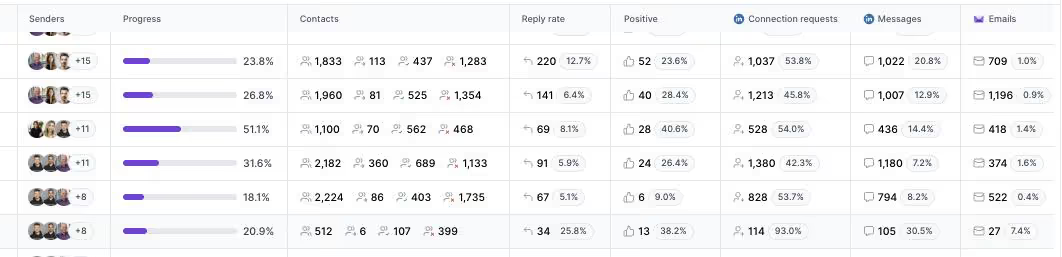
One falsifiable benchmark from the Salesforge case studies: Woodpecker scaled to 2,500+ mailboxes on Infraforge. ChannelCrawler hit an 85.71% positive reply rate running Salesforge + Infraforge + Warmforge together. UniteSync ran the Salesforge + Mailforge + Warmforge stack to an 85.26% positive reply rate at a $2.86 CAC. Those case studies are public.
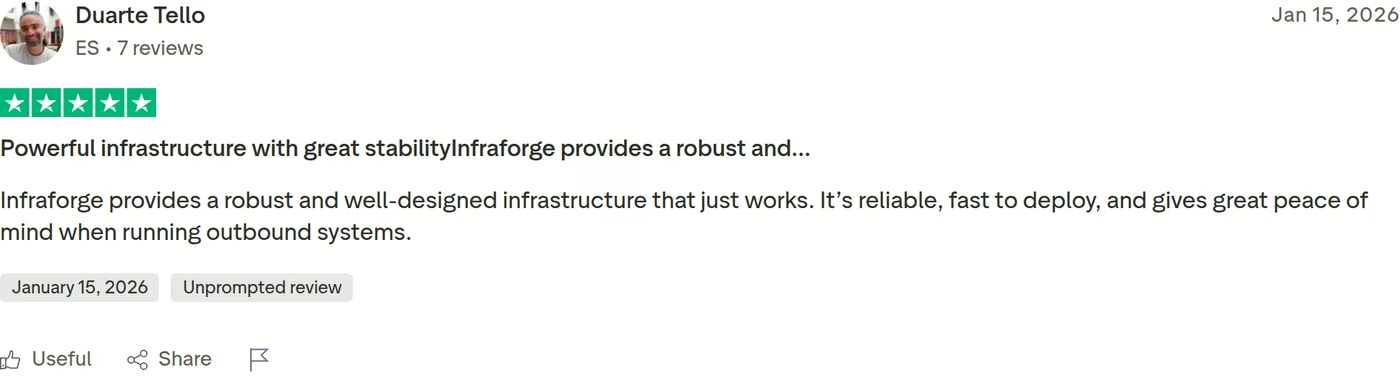
Reviewers running outbound on Infraforge describe the same stability the case studies do.
 Start a Forge Stack subscription
Frequently Asked Questions
It depends on what you mean by deliverability. Zapmail provisions Google Workspace and Microsoft 365 mailboxes inside Google and Microsoft's existing IP pools, which gives mainstream-provider trust signals but no IP control. Infraforge sells dedicated IPs with isolated sequencer fingerprints, which means your sender reputation is yours alone. For teams running high volume or who've burned shared infrastructure before, the dedicated-IP model is the deliverability play.
Maildoso sells SMTP mailboxes (on rotated shared IPs) and Google Workspace mailboxes. Infraforge sells you your own dedicated IPs. Maildoso's master inbox is a nice operational feature; Infraforge's Masterbox does the same thing as a $7-$9/workspace/month add-on. The pricing models differ too: Maildoso has monthly and quarterly plans in fixed sizes (from $75/mo for 30 SMTP mailboxes), while Infraforge sells slots at $3-$4 each on monthly, quarterly, or annual billing with a 10-slot minimum.
At the entry tier the prices are close. Infraforge is $33/mo annual for 10 slots, the lowest absolute entry and the smallest minimum commitment. Zapmail's Starter is $39/mo monthly for 10 Google mailboxes. Maildoso's smallest monthly plan is $75/mo for 30 SMTP mailboxes ($2.50/mailbox). At higher volume the economics diverge. Maildoso's 400-mailbox quarterly tier hits $1.80/mailbox, Zapmail's yearly Pro hits $2.50/mailbox, and Infraforge sits around $3.26/slot at 200 slots. Per-mailbox cost is only one factor; IP type matters more.
No. None of Infraforge, Zapmail, or Maildoso offer a free trial. All three require a paid subscription to provision real mailboxes (which carry real domain and hosting costs). Infraforge's minimum is the 10-slot subscription at $33/mo annual.
Yes. The standard approach is to spin up Infraforge mailboxes in parallel, warm them in the background via Warmforge, and migrate active campaigns over once heat scores hit 97+. Salesforge offers personal onboarding on the Growth plan to walk you through the migration sequence. Most teams keep some shared-IP capacity (Mailforge) alongside dedicated IPs (Infraforge) as a deliberate diversification.
Only Infraforge. Zapmail uses Google and Microsoft's shared infrastructure (you don't get a dedicated IP because Google and Microsoft don't sell them at the Workspace tier). Maildoso's SMTP mailboxes use rotated shared IPs and its Google Workspace mailboxes sit in Google's infrastructure, so neither gives you a dedicated IP you control. If dedicated IPs are a requirement, Infraforge is the only product in this comparison that ships them by default.
Warm-up runs through Warmforge, the Forge Stack's dedicated warm-up product. Unlimited premium Warmforge warm-up is included free with every Salesforge subscription. Standalone Infraforge users pay for Warmforge separately. The pool excludes external SMTP vendors and recycled inboxes, and traffic is multilingual to mirror real inbox patterns. Salesforge also publishes free deliverability tools (DKIM/SPF/DMARC checkers, blacklist lookup, placement test) that work alongside any infrastructure.
Maildoso is a fit for small teams or solo operators whose sending profile aligns with one of its plan sizes (15/35/150 combo or 30/70/300 SMTP) and who want the integrated master inbox plus a mix of SMTP and Google Workspace mailboxes. The rotated shared IPs on the SMTP side and the lack of a native outreach platform are the trade-offs.
The argument for the Forge Stack is operational, not feature-by-feature. One support team, one login, native integration without Zapier or Make in between. UniteSync ran Salesforge + Mailforge + Warmforge to an 85.26% positive reply rate at a $2.86 CAC, which is the kind of result that's harder to hit when you're managing five separate billing relationships and five separate support channels. The Forge Stack is the bet that consolidation pays off over time.