

Zapmail is a Google Workspace and Microsoft 365 reseller, priced from $39/mo for 10 mailboxes. Mailscale is self-hosted SMTP with a two-week deliverability guarantee, priced in tiers from $79/mo for 15 inboxes. Both share IP reputation across customers, and both carry documented post-signup complaints on Trustpilot.
For dedicated-IP cold email infrastructure built for outreach, Infraforge is the stronger choice. You get private dedicated IPs instead of a shared pool, automated DNS in 5 minutes, optional pre-warmed mailboxes, the Masterbox unified view, and native Warmforge warmup - priced linearly from $4 down to $3 per mailbox with no tier breakpoints.
I've spent the last two years buying, burning, and rebuilding cold email infrastructure for outbound campaigns. The pattern I keep seeing: reviewers compare per-mailbox prices and skip the things that actually break campaigns - shared IP pools, DNS that fails months in, support that vanishes, and tier jumps that punish growth.
This is a three-way look at the infrastructure I get asked about most: Infraforge, Zapmail, and Mailscale. Zapmail resells Google Workspace and Microsoft 365 mailboxes. Mailscale runs its own SMTP servers with a two-week deliverability guarantee. Infraforge gives each account private dedicated IPs and is part of the wider Forge Stack.
They sit in three different infrastructure categories, and the gap shows once you scale past 50 mailboxes.
Cold Email Infrastructure Comparison at a Glance: Zapmail vs Mailscale
| Feature | Infraforge | Zapmail | Mailscale |
|---|---|---|---|
| Infrastructure type | Private dedicated IPs | Google Workspace + MS365 reseller | Self-hosted SMTP, shared IPs |
| Entry price | $4/mailbox/mo quarterly, $3/mailbox/mo annual | $39/mo for 10 Google mailboxes (Starter) | $79/mo for 15 inboxes (Solopreneur) |
| Pricing model | Per slot, linear, no breakpoints | Per plan + per extra mailbox | Tiered with hard caps (15/50/200) |
| Free trial | No (sign up free, pay for mailboxes) | No free trial | 7-day trial, card required |
| Setup time | 5 minutes | ~10 minutes (claimed) | 60 seconds (claimed) |
| Automated DNS (SPF/DKIM/DMARC) | Yes, every domain | Yes, every domain | Yes, every domain |
| Pre-warmed mailboxes | Yes | Yes (separate purchase) | No |
| Bring-your-own domains | Yes, native | Yes | $2/domain/mo, no deliverability guarantee |
| API access | Yes, all plans | Pro plan only ($299/mo) | Not advertised |
| Unified inbox view | Masterbox (add-on) | No | No |
| Whitelabel/reseller | Yes, 20% revenue share | No | No |
| SOC2 compliant | Yes | Not advertised | Not advertised |
| Best for | High-volume senders, agencies, reputation isolation | Teams that specifically want Google Workspace | Solo operators on a budget who accept SMTP trade-offs |
Zapmail Overview: A Google Workspace Mailbox Reseller

Zapmail provisions real Google Workspace and Microsoft 365 mailboxes for cold outreach. It is owned by Outbox Labs Inc. and built around workspace-level isolation - each domain sits in its own workspace with its own admin access, so one flagged domain doesn't take down the rest. The homepage says it's trusted by 50K+ businesses.
Core features I'd highlight:
- Automated DNS setup (SPF, DKIM, DMARC) on every domain
- Real Google Workspace and Microsoft 365 mailboxes on US or EU IPs
- Pre-warmed mailbox option, sold separately, so you can skip the warmup wait
- OAuth connections to 50+ senders (Instantly, Smartlead, Reply, Lemlist, ReachInbox)
- AI mailbox naming and profile-photo generation for natural-looking accounts
- A headless email-infrastructure API for programmatic provisioning, on the Pro plan
- Free placement-test and AI Insights credits, scaled by plan (3 / 10 / 30 per month)
If you want the wider category view, I've covered how a Google Workspace reseller stacks up against owning your infrastructure.
Zapmail pricing
Zapmail bills three monthly plans. Starter is $39/mo for 10 Google mailboxes, plus $3.50 per extra mailbox. Growth is $99/mo for 30 mailboxes, plus $3.25 each, and it's the plan they push. Pro is $299/mo for 100 mailboxes, plus $3.00 each, and it's the only tier with API access. Annual billing adds two months free, so effective entry rates fall to roughly $32.50, $82.50, and $250 per month. Microsoft 365 and pre-warmed mailboxes cost extra. Domains start at $13/year.
One detail buried in Zapmail's help center: after the first year, mailboxes move to renewal pricing. Starter becomes $59/mo plus $6 per mailbox, and Growth becomes $169/mo plus $5.50 per mailbox. Zapmail attributes the jump to Google and Microsoft policy changes. Budget for year two, not just year one.
Who Zapmail fits
Zapmail fits teams that specifically want Google Workspace or Microsoft 365 mailboxes and don't want to touch Google Admin. The OAuth integration with Instantly and Smartlead is smooth, and the workspace isolation is a genuine strength against account bans.
What reviewers say
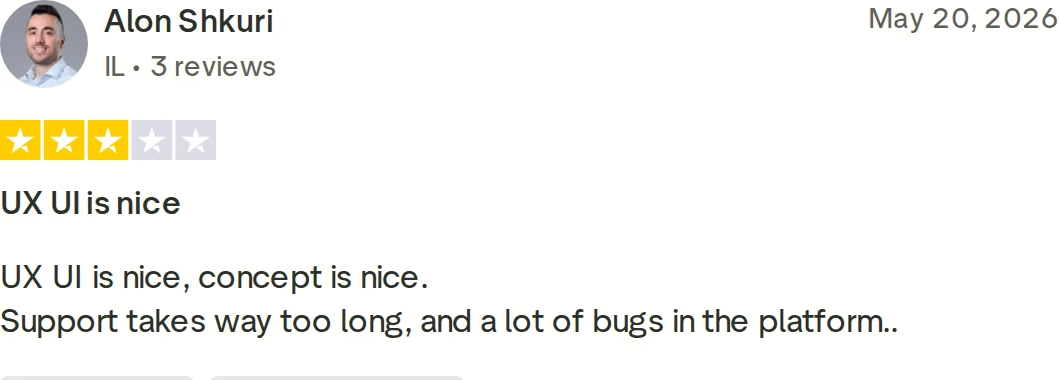
Zapmail holds a 4.4 rating on Trustpilot, and most reviews praise setup speed and support. The critical ones are worth reading first. A May 2026 reviewer rated it three stars: nice UX and concept, but support that takes too long and a lot of bugs in the platform. A separate thread on r/coldemail reported that some Google Workspace accounts were provisioned through an India-based reseller despite the US-hosted marketing, and Zapmail's founder posted email headers in rebuttal. I dug into the wider sentiment in my Zapmail review after reading 100+ user reviews. None of this is disqualifying; it's the friction that surfaces at scale.
Honest limitations
- API access is locked to the $299/mo Pro plan - 7.7x the entry price just to automate provisioning
- No free trial, and a strict no-refund cancellation policy
- Pre-warmed mailboxes and Microsoft 365 cost extra on top of the base plan
- No unified inbox across mailboxes
- Year-two renewal pricing is higher than year one
Mailscale Overview: Self-Hosted SMTP Infrastructure

Mailscale owns its full email stack - SMTP servers, IP pools, all of it - instead of reselling Google or Microsoft. It markets a 95-100% deliverability guarantee during the first two weeks of warmup, and replaces domains free of charge if inbox placement drops below 80%. The company reports 3,000+ customers and pitches inboxes as low as $1/month against $7.20 on Google Workspace.
Core features I'd highlight:
- Automated DNS setup (SPF, DKIM, DMARC) on every domain
- Self-hosted SMTP - Mailscale owns the servers and the IP pools
- In-platform domain purchasing at $10-$15/year, with up to 5 inboxes per domain
- CSV export of IMAP/SMTP credentials for any sender (Instantly, Smartlead, Apollo, Lemlist, Reply)
- The two-week deliverability guarantee, with free domain replacement under 80% placement
- A free cold email course plus an AI reply-bot tutorial on the Business plan and up
Mailscale pricing
Mailscale uses fixed tiers tied to inbox caps. Solopreneur is $79/mo for 15 inboxes (around 2,000 prospects). Business is $119/mo for 50 inboxes (around 10,000 prospects), with extra inboxes at $1 each. Enterprise is $249/mo for 200 inboxes (around 30,000 prospects), again $1 per inbox beyond the cap. Annual billing takes 20% off, so the tiers fall to $63, $95, and $199 per month. Domains are bought inside Mailscale; bring-your-own domains cost $2/domain/month with no deliverability guarantee. The 7-day free trial requires a credit card.
Who Mailscale fits
Mailscale fits solo operators and small agencies who want one bundled price - infrastructure, a deliverability guarantee, and training together. If you land exactly on a tier cap, the per-inbox math at scale is low, since Enterprise annual works out to $1 per inbox at 200. If Mailscale is on your shortlist, it's also worth seeing Mailscale next to Maildoso.
What reviewers say
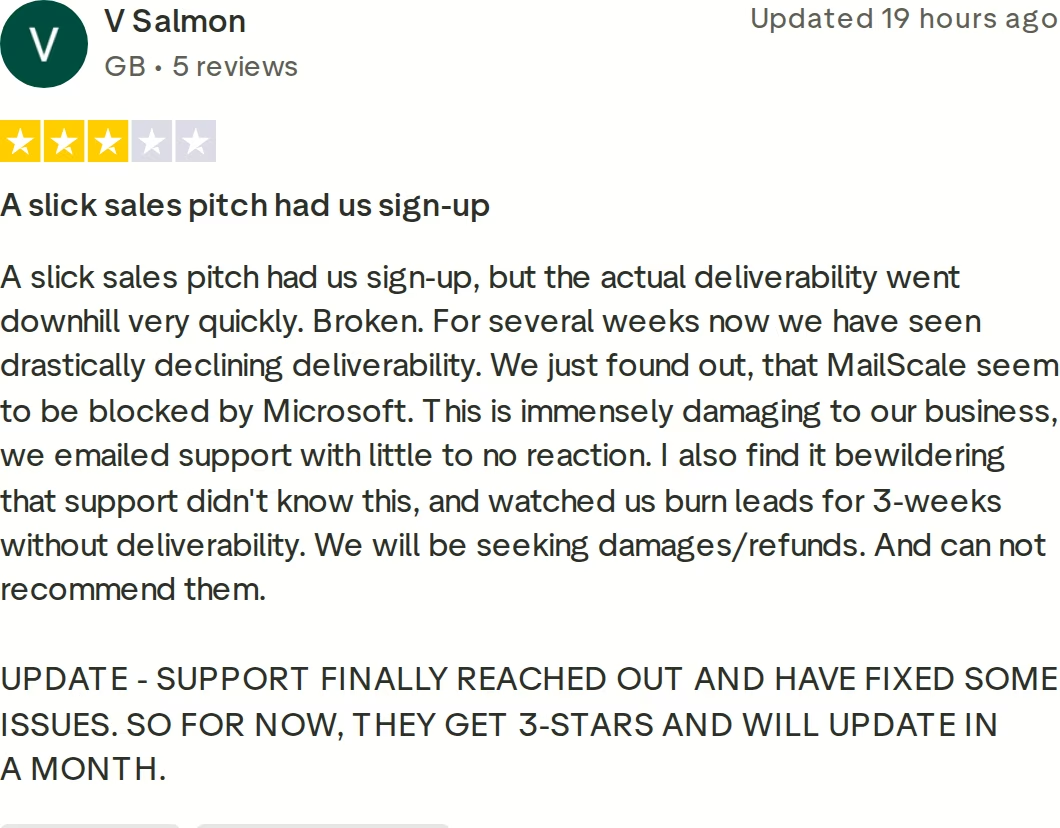
Mailscale's Trustpilot score is 4.1, but the gap between the setup reviews and the post-week-two reviews tells the story. A reviewer updated on June 1, 2026 described deliverability that went downhill very quickly, domains blocked by Microsoft, and three weeks of burned leads with little support response. A separate one-star review from April 2026 documented a $1,140/year auto-renew and a Stripe cancel button that had been disabled - the reviewer called it a textbook dark pattern. The deliverability guarantee covers weeks one and two; these complaints land in week three and beyond.
Honest limitations
- Shared IP pool across all SMTP customers - one bad neighbor affects everyone on the IP
- Hard tier breakpoints - inbox 16 jumps you from $79 to $119, inbox 51 jumps you from $119 to $249
- Bring-your-own domains cost $2/domain/month and void the deliverability guarantee
- Multiple Trustpilot reviews describe cancellation friction and auto-renew surprises
- IMAP/SMTP credentials only - no native OAuth
Infraforge Overview: Private Dedicated-IP Infrastructure
Infraforge is private dedicated email infrastructure built for cold outreach. It's one of the seven products in the Forge Stack, alongside Mailforge (shared-IP infrastructure), Primeforge (Google and Microsoft mailboxes), Warmforge (warmup and deliverability), Leadsforge (a 500M+ lead database), and Salesforge (multi-channel outreach). The one thing it does that neither competitor here does: it puts every account on its own dedicated IPs, so your sender reputation depends on your sending alone. It holds a 4.9 G2 rating and lists Woodpecker, Deel, and Dreamdata among its users.
Core features:
- Dedicated IPs on every account - no shared pool, no reputation bleed from other senders
- An isolated sequencer fingerprint per account
- Automated DNS setup (SPF, DKIM, DMARC) on every domain, following best practices
- Pre-warmed domains and mailboxes so you can send from day one
- Masterbox - one view of every email across every account in a workspace ($7-9/workspace/month add-on)
- Bulk DNS updates across hundreds of domains from one dashboard
- SSL and Domain Masking ($2/domain/month) to show branded sites without exposing your sending domain
- Multi-IP provisioning at $99/IP/month for extra isolation
- The Infraforge API on every plan - not gated behind a top tier
- Multiple workspaces for clean client or project separation
- Domain transferring in or out - you own the domains
- Works with any sender (Salesforge, Instantly, Smartlead, Lemlist, Reply, Apollo)
- SOC2 compliance and a 20% revenue-share whitelabel program
The Forge Stack context
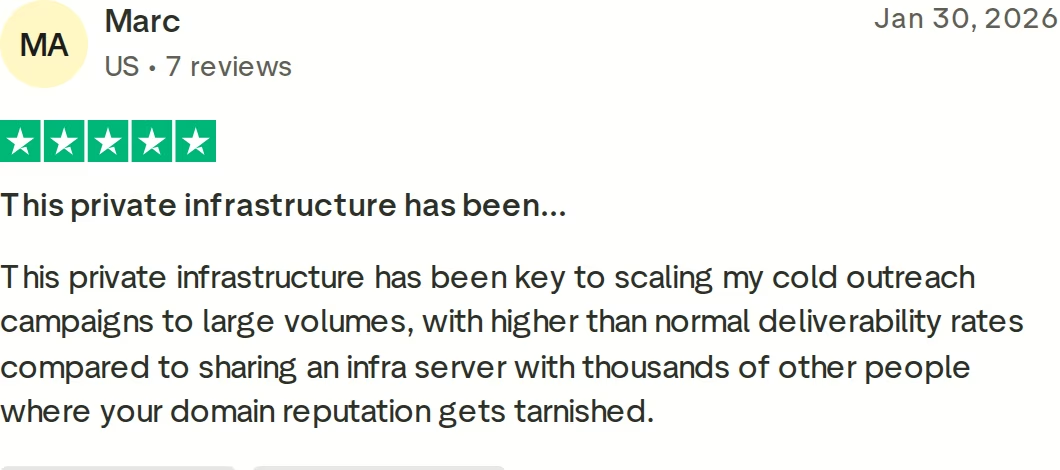
Infraforge is the infrastructure layer. The pairing most case studies run on: domains and mailboxes in Infraforge, warmup and monitoring in Warmforge, prospect data from Leadsforge, and sending through Salesforge. For unified reply handling across email and LinkedIn, the stack adds Primebox™ inside Salesforge. Each product works on its own.
Infraforge pricing
Infraforge prices per mailbox slot: $4/mailbox/month billed quarterly, dropping to $3/mailbox/month on annual billing or at higher volume. Annual reflects two months free, starting at $33/month for 10 mailboxes. The minimum is 10 slots. The price is linear - no tier breakpoints. Domains run about $14/year per .com. Add-ons are priced openly: SSL and Domain Masking at $2/domain/month, extra IPs at $99/IP/month, Masterbox at $7-9/workspace/month. You can confirm the current rate on the Infraforge pricing page.
At 200 mailboxes, Infraforge runs about $651/month on dedicated IPs, against roughly $1,680/month on Google Workspace and $1,200/month on Microsoft 365 native - before the time saved on DNS setup.
Grab Your Infraforge MailboxesWho Infraforge is best for
Infraforge fits B2B teams and agencies running high-volume cold outreach who can't risk reputation contamination from other senders. The Forge Stack's published fit is clear: B2B products with ACVs between $5K and $100K, sold to startups, SMBs, and mid-market, targeting 3,000+ businesses. Woodpecker scaled to 2,500+ mailboxes on Infraforge - the upper end of what dedicated IPs handle.
Honest limitations
- No free trial - you buy domains and mailbox slots to test it (you can sign up and explore the app for free)
- Higher per-mailbox cost than shared-IP Mailforge ($2-3/mailbox) - the trade-off is reputation isolation
- Each Forge product is its own subscription - there's no single Forge Stack bill
- Dedicated IPs punish bad habits. High spam-complaint volume hurts you more on a dedicated IP, not less, and Infraforge's own Trustpilot includes one-star reviews about removing mailbox slots and refunds. Go in knowing it's built for senders who follow deliverability best practices.
in Action
Head-to-Head Feature Comparison: Zapmail vs Mailscale
IP infrastructure and reputation
This is the axis most reviews skip, and it's the whole game. Infraforge runs every account on dedicated IPs, so your reputation rises and falls on your sending alone. Mailscale shares IP pools across all its SMTP customers - the June 2026 Trustpilot review describing domains blocked by Microsoft after weeks is downstream of that model. Zapmail shares Google Workspace admin infrastructure across customers in its reseller agreement, using workspace-level isolation as the mitigation. Workspace isolation does help with account bans, and it's a real Zapmail strength. But it isn't IP isolation. On shared infrastructure, another customer's spam complaints can drag your inbox placement down even when your own sending is spotless. It's worth understanding how dedicated and shared IPs scale before you commit.
Setup speed and DNS automation
All three automate SPF, DKIM, and DMARC on every domain, and all three claim near-instant setup - Mailscale says 60 seconds, Zapmail about 10 minutes, Infraforge 5 minutes. Execution is where they split. Infraforge follows DNS best practices on every domain and supports bulk DNS updates across hundreds of domains. The cited January 2026 Mailscale complaint, where every provisioned domain still failed DMARC two months later, shows the automation existing but failing at the account level. Zapmail's Google Workspace DNS setup is generally well reviewed.
Deliverability and warm-up
Infraforge integrates with Warmforge, the Forge Stack's deliverability center. Warmforge warms mailboxes in a premium-by-default pool of real Google Workspace and Microsoft 365 inboxes, scores each mailbox with a per-mailbox Heat Score (0-100), and runs placement tests and blacklist checks. The pool excludes external SMTP vendors by policy. Mailscale handles warmup in-platform and guarantees 95-100% placement for the first two weeks. Zapmail sells pre-warmed mailboxes as a separate purchase but doesn't run continuous warmup or placement monitoring on the same dashboard. I've tested the main email warmup tools side by side if you want to compare approaches.
API access and programmatic scale
Infraforge includes API access on every plan. Zapmail gates its API to the $299/mo Pro plan. Mailscale doesn't advertise a public API. If you're provisioning mailboxes for clients, automating rotation, or building a monitoring dashboard, that API is the difference between a workflow and an afternoon of manual clicking. Paying 7.7x the entry price to reach it, as Zapmail's structure requires, is a real cost for agencies.
Bring-your-own domains
Infraforge supports your own domains natively, with the same DNS automation. Zapmail supports them too. Mailscale charges $2/domain/month for bring-your-own and says plainly it can't guarantee deliverability on domains it didn't sell - which effectively voids its headline guarantee for anyone migrating existing domains.
Compatibility with sending tools
All three plug into standard senders. Infraforge connects to Salesforge natively and to any IMAP/SMTP tool - Instantly, Smartlead, Lemlist, Reply, Apollo. Zapmail uses OAuth to reach 50+ tools, which is a clean connection. Mailscale hands you a CSV of credentials to import wherever you send.
Unified inbox and reply management
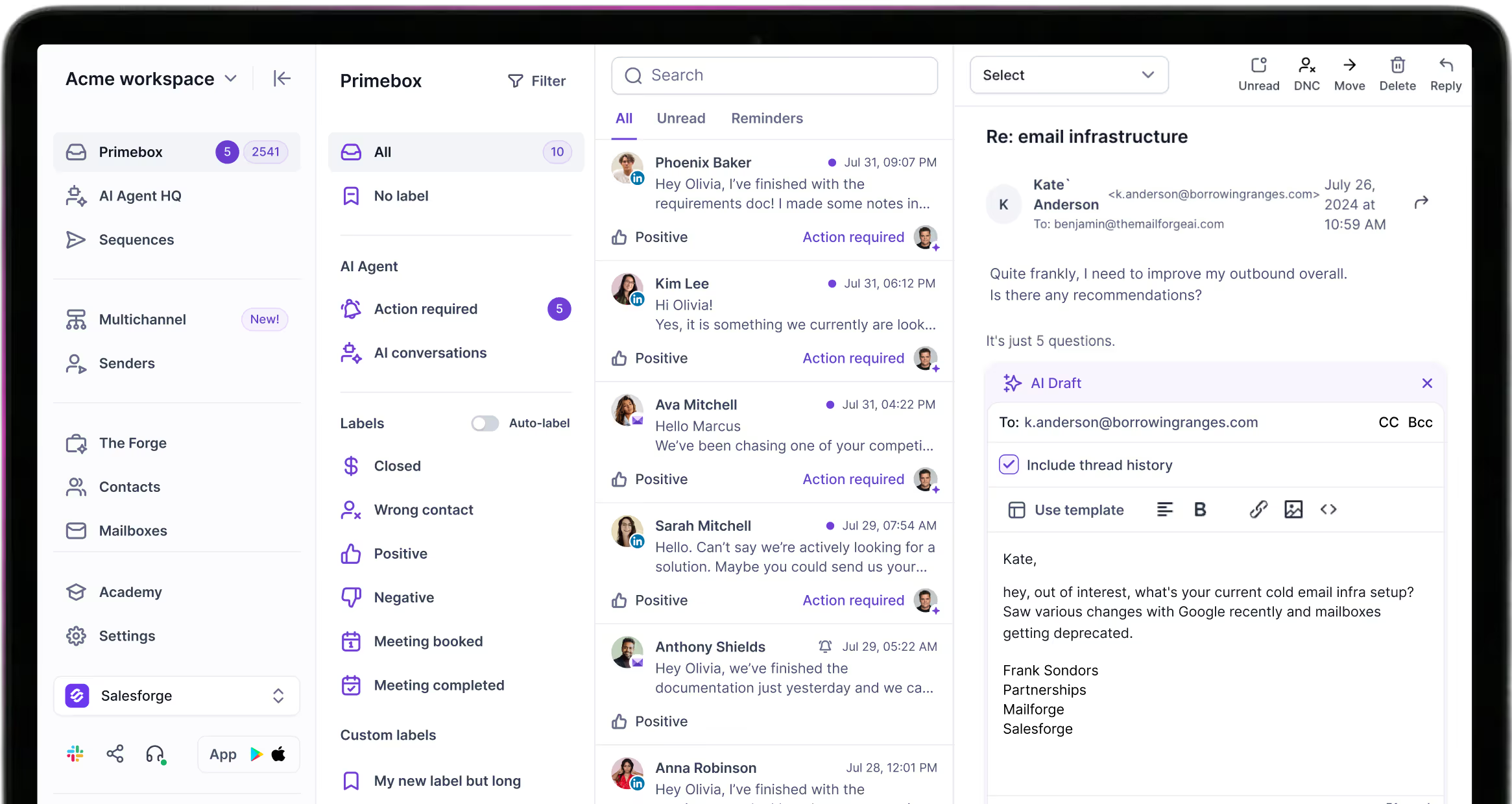
Infraforge offers Masterbox, a workspace-level view of every email across every account ($7-9/workspace/month). For full unified reply handling across email and LinkedIn, the Forge Stack adds Primebox™ inside Salesforge, with sentiment tagging and AI-drafted replies. Neither Zapmail nor Mailscale offers a unified inbox - you check replies in your sender or mailbox by mailbox.
Compliance, whitelabel, and the wider stack
Infraforge is SOC2 compliant, and the Forge Stack publishes a Trust Center. Neither Zapmail nor Mailscale advertises SOC2 or an equivalent audit on its site. For agencies, Infraforge runs a whitelabel program with 20% revenue share and up to three-year terms, which I've covered in more depth in this guide to cold email infrastructure for agencies. Neither competitor publishes one. One more breadth point: these are all infrastructure tools, so none of the three sends outreach on its own. Infraforge plugs into Salesforge for email and LinkedIn sequences and Agent Frank, the AI SDR. The competitors leave the outreach layer entirely to you.
Pricing Comparison: Infraforge, Zapmail, and Mailscale
| Plan | Mailboxes | Monthly | Annual | Notes |
|---|---|---|---|---|
| Infraforge (per slot) | 10 minimum | $4/mailbox | $3/mailbox (2 months free) | Linear, no breakpoints |
| Zapmail Starter | 10 included | $39/mo | ~$32.50/mo | +$3.50/extra mailbox |
| Zapmail Growth | 30 included | $99/mo | ~$82.50/mo | +$3.25/extra mailbox |
| Zapmail Pro | 100 included | $299/mo | ~$250/mo | +$3.00/extra, API included |
| Mailscale Solopreneur | 15 cap | $79/mo | $63/mo (20% off) | Hard cap at 15 |
| Mailscale Business | 50 cap | $119/mo | $95/mo | +$1/inbox beyond 50 |
| Mailscale Enterprise | 200 cap | $249/mo | $199/mo | +$1/inbox beyond 200 |
What 50 mailboxes actually costs
Fifty mailboxes is roughly what you need to send 1,000-1,500 cold emails a day at safe per-mailbox volumes. Here's the all-in math on annual billing, with domains:
- Infraforge: 50 x $3 = $150/mo, plus ~17 domains at $14/year = about $170/mo, dedicated IPs included
- Zapmail Growth: $82.50/mo for 30, plus 20 extra at $3.25 = $147.50/mo, plus domains at $13/year = about $170/mo
- Mailscale Business: $95/mo covers all 50, plus 10 domains at $12/year = about $105/mo, shared IPs
Mailscale is cheapest on the sticker. The question is whether the shared SMTP pool and the week-three deliverability pattern in its reviews are worth the savings. If you want to size this for your own volume, here's how to work out how many mailboxes you need.
What 200 mailboxes actually costs
- Infraforge: 200 x $3 = $600/mo, plus ~70 domains = about $680/mo, dedicated IPs included
- Zapmail Pro: $250/mo for 100, plus 100 extra at $3.00 = $550/mo, plus domains = about $640/mo, API included at this tier
- Mailscale Enterprise: $199/mo covers all 200, plus ~40 domains = about $235/mo, shared IPs
Mailscale Enterprise is about a third of the others. You're paying for shared SMTP with a two-week guarantee. Infraforge and Zapmail Pro land within about $40 of each other - Infraforge with dedicated IPs and SOC2, Zapmail with native Google Workspace.
Who Should Use Which Tool
You might consider Zapmail if:
- You specifically need real Google Workspace or Microsoft 365 mailboxes, OAuth-connected, and don't want to manage Google Admin
- You're a freelancer or small team at 10-30 mailboxes and the Starter or Growth math works for you
- You're comfortable with reseller infrastructure and don't need API access at the entry tier
You might consider Mailscale if:
- You're a solo operator on a tight budget, fine with shared SMTP, and your sender doesn't need OAuth
- You land exactly on a tier cap (15, 50, or 200) so you skip the breakpoint penalty
- A two-week placement guarantee is enough runway, and you'll test the cancellation flow before you enter a card
Choose Infraforge if:
- You're sending high-volume cold outreach past 50 mailboxes and can't risk reputation contamination from a shared pool
- You're an agency running infrastructure for multiple clients and want isolated workspaces, dedicated IPs, and a 20% revenue-share whitelabel
- You want API access without paying $299/month to reach it
- You want SOC2 compliance and an audit trail in your sending stack
- You're using or planning the rest of the Forge Stack - Warmforge, Salesforge, Leadsforge - and want native integration
Final Verdict: Which Cold Email Infrastructure to Choose
Zapmail and Mailscale are real products that fit specific shapes of operation. Zapmail is the pick if you specifically need Google Workspace mailboxes through a reseller and accept the IP-origin questions and the year-two renewal bump. Mailscale is the pick if you want a bundled tiered package and accept that the guarantee covers weeks one and two, not week ten.
For high-volume cold email infrastructure with reputation isolation, Infraforge is the stronger choice. Dedicated IPs on every account, automated DNS in 5 minutes, API on every plan, SOC2 compliance, and pricing that stays linear instead of jumping at tier caps. At $3/mailbox on annual billing, you're within about $40 of Zapmail Pro for materially different infrastructure.
One benchmark you can check: Woodpecker scaled to 2,500+ dedicated mailboxes on Infraforge, and ChannelCrawler hit an 85.71% positive reply rate on Salesforge, Infraforge, and Warmforge. Both case studies are public.
 See What Infraforge Can Do
Frequently Asked Questions
Is Infraforge better than Zapmail and Mailscale?
For high-volume cold outreach that needs reputation isolation, yes. Infraforge runs every account on dedicated IPs, while Zapmail resells Google Workspace with workspace-level isolation and Mailscale runs shared-IP SMTP. Past about 50 mailboxes, dedicated IPs are the upgrade that protects inbox placement, because your reputation no longer depends on other customers' campaigns. Zapmail and Mailscale fit smaller or budget-first setups.
What's the main difference between Infraforge, Zapmail, and Mailscale?
Three different infrastructure models. Infraforge is private dedicated-IP infrastructure built for cold outreach. Zapmail is a Google Workspace and Microsoft 365 reseller with workspace-level isolation. Mailscale is self-hosted SMTP with shared IPs and a two-week deliverability guarantee. The choice comes down to whether you want dedicated IPs (Infraforge), real Google Workspace mailboxes (Zapmail), or the cheapest tiered package (Mailscale).
Which is cheapest: Infraforge, Zapmail, or Mailscale?
On sticker price, Mailscale is cheapest - Business is $95/mo annual for 50 inboxes. Infraforge runs about $150/mo for 50 mailboxes on annual billing, and Zapmail Growth about $147.50/mo for the same count. Mailscale's lower price reflects shared SMTP; the trade-off is the post-guarantee deliverability pattern its Trustpilot reviews describe. At 200 mailboxes the per-inbox gap narrows.
Does Mailscale have a deliverability guarantee?
Yes, but read the fine print. Mailscale guarantees 95-100% inbox placement during the first two weeks of warmup and will replace domains free if placement drops below 80%. The guarantee covers the warmup window, not month three, and several Trustpilot reviewers describe deliverability declining after that window. Bring-your-own domains are excluded from the guarantee entirely.
Can I switch from Zapmail or Mailscale to Infraforge?
Yes. Infraforge supports domain transferring in or out, so you can bring existing domains. New mailboxes need a two-week warmup before campaigns, which Warmforge handles. The Infraforge API lets you provision mailboxes programmatically if you're moving more than a few dozen, and support helps with migrations. You keep ownership of your domains either way.
Which has better email deliverability?
Dedicated IPs give you the most control, because your sender reputation rests on your sending alone. Infraforge's dedicated-IP model plus native Warmforge monitoring is the setup most likely to hold inbox placement over months. Shared infrastructure - Mailscale's SMTP pool, Zapmail's reseller model - leaves you exposed to other senders' reputation, which is the root cause behind several of the deliverability complaints in their reviews.
Does Infraforge offer a free trial?
No. Infraforge is infrastructure, so you buy domains and mailbox slots to use it - there's no free sandbox. You can sign up for free, explore the app, and only pay when you provision your first mailboxes. The minimum is 10 slots at $4/month each on quarterly billing, or $3/month each on annual billing. Domains are about $14/year.
Who is Zapmail best for?
Zapmail fits teams that specifically want real Google Workspace or Microsoft 365 mailboxes and don't want to manage Google Admin themselves. Its OAuth connection to 50+ senders is clean, and workspace-level isolation reduces account-ban risk. It's a reasonable fit at 10-30 mailboxes; just budget for the year-two renewal pricing and the API being locked to the $299/mo Pro plan.